
Your pet store can look busy and still feel unclear on paper. Sales come in, but product costs, shipping, refunds, expired stock, fees, and tax can quickly change the profit picture. Canada’s pet food retail market reached C$6.7 billion in 2024. Pet products need extra care because food can expire, supplements may need batch tracking, and subscription boxes can hide several costs inside one sale.
At SAL Accounting, we help eCommerce sellers make sense of those moving parts. By the end, you’ll know how to track product costs, expiry, sales tax, payouts, and the numbers that affect profit. Canada pet food market data.
Quick Takeaways
- Pet stores need tighter inventory tracking than many other ecommerce businesses because food, treats, supplements, and raw products can expire or spoil.
- Your real product cost is usually higher than the supplier price once freight, duties, packaging, prep, and damaged stock are included.
- Payouts from Shopify, Amazon, PayPal, Stripe, and marketplaces should not be recorded as simple sales income.
- Sales tax can vary by product, province, state, and sales channel, especially if you sell in both Canada and the U.S.
- Subscription boxes need component-level tracking. The box may sell as one product, but the costs inside it tell the real story.
- Clean bookkeeping helps you see which products are helping the business, which ones are draining cash, and what needs fixing next.
If Shopify is a main sales channel, use the Shopify Fee Calculator first. It shows how much fees may be taking before you judge your profit.
What Your Pet Store Accounting Should Actually Show
Your accounting should do more than tell you how much money landed in the bank. It should show what happened before that deposit arrived.
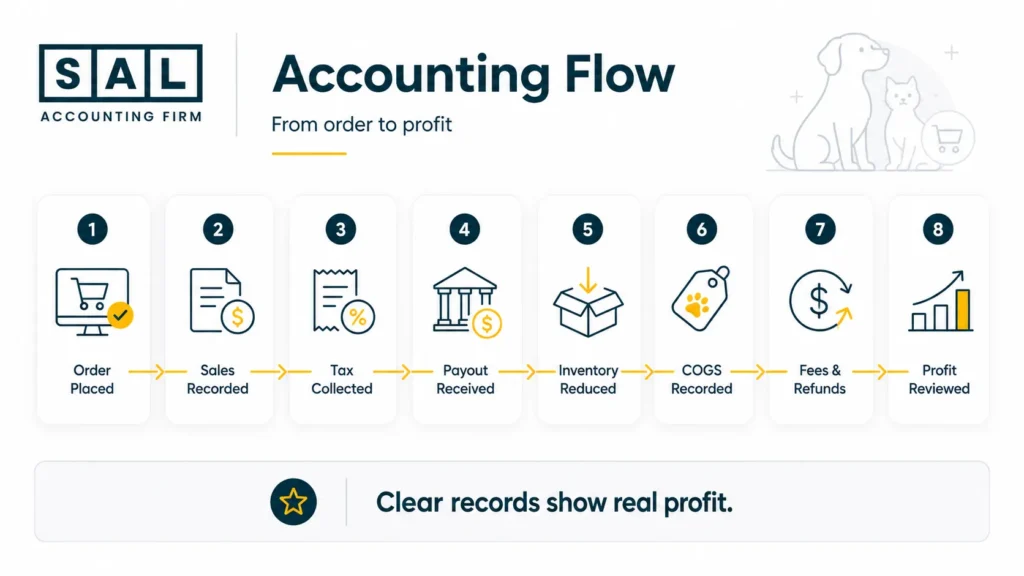
For an online pet store, that means your sales, inventory, product costs, taxes, fees, refunds, shipping, and payouts all need to line up. If those pieces sit in different places, your reports may look complete but still feel hard to trust. If your books are already hard to follow, clean e-commerce accounting and bookkeeping can make your reports match what actually happened in the store.
| Accounting Area | What It Covers | Why It Matters | Common Problem |
| Sales | Shopify, Amazon, WooCommerce | Shows order activity | Deposits treated as sales |
| Inventory | Food, treats, toys, supplements | Shows stock value | Expired stock still counted |
| Product costs | Supplier cost, freight, duties | Shows real margin | Supplier price used alone |
| Payouts | Fees, refunds, reserves, tax | Explains bank deposits | Platform activity not split |
| Sales tax | GST/HST, PST, U.S. sales tax | Keeps tax out of income | Tax counted as revenue |
| Subscriptions | Boxes, renewals, prepaid orders | Matches cash to fulfillment | Cash counted too early |
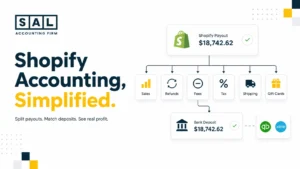
A lot of confusion starts with e-commerce payment reconciliation, because the bank deposit usually shows what was left after the platform removed fees, refunds, taxes, shipping labels, and other adjustments.
Why Pet Products Make the Numbers Harder
A regular ecommerce store might sell mugs, candles, or phone cases. Those products can often sit in storage without much changing. Pet products are different. Food, treats, supplements, grooming products, and raw items can expire, leak, spoil, break, or be recalled. The FDA says lot numbers help identify specific pet food batches when a recall happens, which is why batch tracking matters for more than warehouse control.
So your accounting cannot be completely separate from inventory. If your books show $30,000 in stock, but part of that stock is expired or damaged, your numbers are not giving you the full picture.
How to Separate Food, Treats, Hard Goods, and Subscription Boxes
Not every product in your store should be treated the same way. A bag of dog food, a chew toy, a crate, and a monthly subscription box all create different accounting issues. If everything gets grouped into one inventory category, you lose the details you need for pricing, buying, and cash flow decisions.
This is where pet store bookkeeping needs to be more specific than general ecommerce bookkeeping.
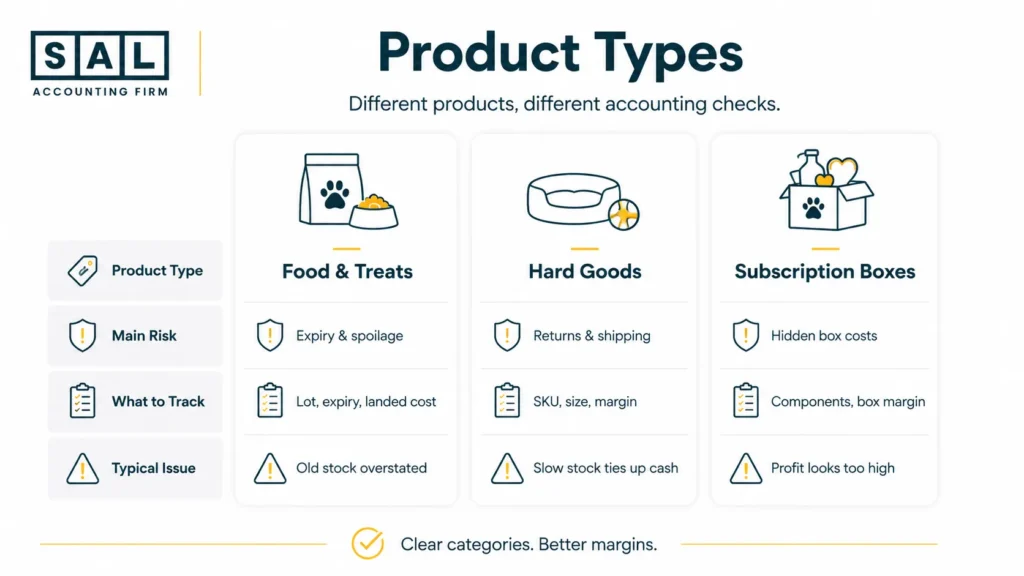
| Product Type | Examples | Main Risk | What to Track | Useful Report |
| Food and treats | Kibble, wet food, treats | Expiry, spoilage, recalls | Lot, expiry, landed cost | Expiry report |
| Supplements | Oils, powders, chews | Expiry, tax review | SKU, batch, category | Product margin report |
| Raw or frozen items | Raw food, frozen treats | Storage loss, waste | Batch, storage notes | Waste report |
| Hard goods | Toys, collars, beds, crates | Returns, damage, slow stock | SKU, size, colour | Inventory ageing |
| Subscription boxes | Treat and toy boxes | Hidden item costs | Box SKU, item SKUs | Box margin report |
Consumables Need More Care
If you sell food, treats, supplements, or raw products, expiry tracking should be part of your normal routine.
Example: Let’s say you buy 500 bags of freeze-dried treats. You sell 300 quickly. The other 200 sit in storage. Six months later, 80 are close to expiry.
Those 80 bags should not sit in your books as full-value inventory if you need to discount, donate, or write them off. You want to track:
- supplier
- lot number
- received date
- expiry date
- quantity received
- quantity sold
- quantity written off
- reason for write-off
If you manage stock inside Shopify, your Shopify inventory accounting needs to handle variants, bundles, and stock movement without turning every month-end into a guessing exercise.
- Read More: “Best Shopify Store Examples and Ideas for 2026“
Hard Goods Have Different Problems
Hard goods usually do not expire, but they can still hurt your numbers. A dog bed might sell well but carry weak profit because shipping is expensive. A collar might come in several sizes and colours, which makes stock counts harder. Toys may have higher damage or return rates.
For hard goods, watch SKU-level margin, return rate, storage cost, slow-moving items, damaged returns, and shipping cost by size and weight. Heavy products can make cross-border ecommerce shipping more expensive than expected, especially when freight, duties, returns, and carrier surcharges show up after the sale.
Subscription Boxes Need Item-Level Tracking
Pet subscription boxes can be great for repeat revenue, but they can hide weak margins. A monthly box may sell as one product, but inside that box you might have two treat bags, one toy, a grooming sample, packaging, an insert card, fulfillment time, and shipping materials.
If the box is recorded as one product and the items inside are not tracked properly, you may not know which box themes are actually profitable.
Pro Tip: Track the box and the items inside it. The box tells you revenue. The items tell you margin.
How to Calculate the Real Cost of Pet Products
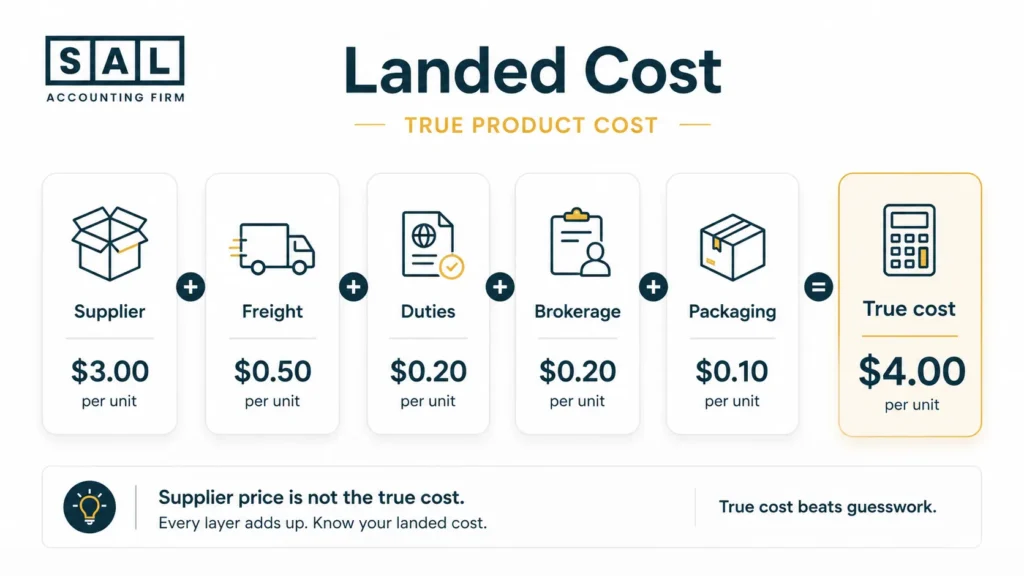
Product cost is where many pet stores lose clarity. The supplier invoice is only the starting point. If you import products, use a 3PL, ship heavy goods, assemble bundles, or sell subscription boxes, your real product cost can be much higher than the supplier price.
The CRA explains how inventory and cost of goods sold affect net income, which is why product cost needs to be tracked carefully. A simple formula looks like this:
Beginning inventory + purchases + direct product costs – ending inventory = cost of goods sold
The hard part is deciding what belongs in direct product costs.
What Usually Belongs in Product Cost
For pet ecommerce, product cost may include:
- supplier cost
- inbound freight
- duties
- brokerage
- import fees
- product packaging
- prep or kitting
- 3PL receiving costs tied to sale-ready inventory
Here’s a simple landed cost example:
| Cost Item | Amount | Include? | Why It Matters |
| Supplier invoice | $3,000 | Yes | Base product cost |
| Inbound freight | $500 | Yes | Gets stock to warehouse |
| Duties | $200 | Yes | Import cost |
| Brokerage | $200 | Yes | Border processing |
| Total landed cost | $3,900 | Yes | True inventory value |
| Cost per bag | $3.90 | Yes | Used for margin |
If you only use the $3 supplier cost, you miss $0.90 per bag. Across hundreds or thousands of units, that can change your pricing, reorder timing, and profit.
The same problem shows up in COGS tracking for ecommerce stores, but pet products add extra pressure because expiry and damaged stock can change the final cost even more.
What Should Stay Out of Product Cost
Some expenses are real, but they do not usually belong inside product cost. These are often treated as operating expenses:
- ads
- website apps
- general software
- accounting fees
- office costs
- owner payroll
- brand photography
- general marketing
Product costs and operating costs answer different questions. Product cost tells you whether the item itself makes money. Operating expenses show what it costs to run the business.
A clean split between product costs and ecommerce business expenses helps you see whether profit is being squeezed by inventory, operations, ads, or overhead.
Case Study: How a Queen West Pet Brand Fixed Its Treat Margins1
A small pet treat brand near Queen West in Toronto sells natural dog treats through Shopify and weekend pop-ups. Sales look strong, and customers love the product. But the owner still feels stuck. Every month, revenue looks decent, yet cash feels tight.
The Problem
The business prices treats using supplier cost only. Freight, packaging, duties, and damaged units sit in different expense accounts. So the owner thinks each bag costs around $4.25, when the true cost is closer to $5.10.
What We Do
We rebuild the product cost setup so landed cost is included by SKU. Then we separate treats, bundles, samples, and write-offs into clear categories. We also review Shopify payouts so fees, refunds, and taxes are not mixed into revenue.
The Result
The owner can see which treat sizes actually make money. Instead of raising prices across everything, they can adjust weak SKUs, reduce discounting on low-margin bundles, and reorder based on real numbers.
How to Handle Expiry, FIFO, and Inventory Write-Offs
Expiry is one of the biggest reasons pet ecommerce accounting needs more care than a standard online store.
If a product can expire, your accounting needs to show when inventory loses value. Otherwise, your reports may show profit that does not really exist. This usually happens when stock is still sitting on the shelf, but it can no longer be sold at full price. You do not need a complicated system. You need a consistent system.
FIFO and FEFO in Plain English
FIFO means “first in, first out.” The first stock you buy is usually the first stock you sell.
Example:
- Batch A arrives in January and expires in September.
- Batch B arrives in March and expires in November.
With FIFO, Batch A sells first. FEFO means “first expiring, first out.” This can work better when expiry dates do not match the order stock arrived.
For pet food, treats, supplements, and raw products, FEFO can sometimes give you better control because it focuses on shelf life, not just purchase date.
When to Write Off Inventory
If a product cannot be sold, do not leave it sitting in inventory. Remove it from inventory and record the reason clearly. Useful categories include:
- expired
- damaged
- recalled
- returned unsellable
- sampled
- donated
- warehouse error
Pro Tip: Do not put every inventory adjustment into one “shrinkage” account. If everything goes into one bucket, you cannot tell whether the issue is expiry, damage, overbuying, or warehouse handling.
How Sales Tax Works for Pet Products in Canada and the U.S.
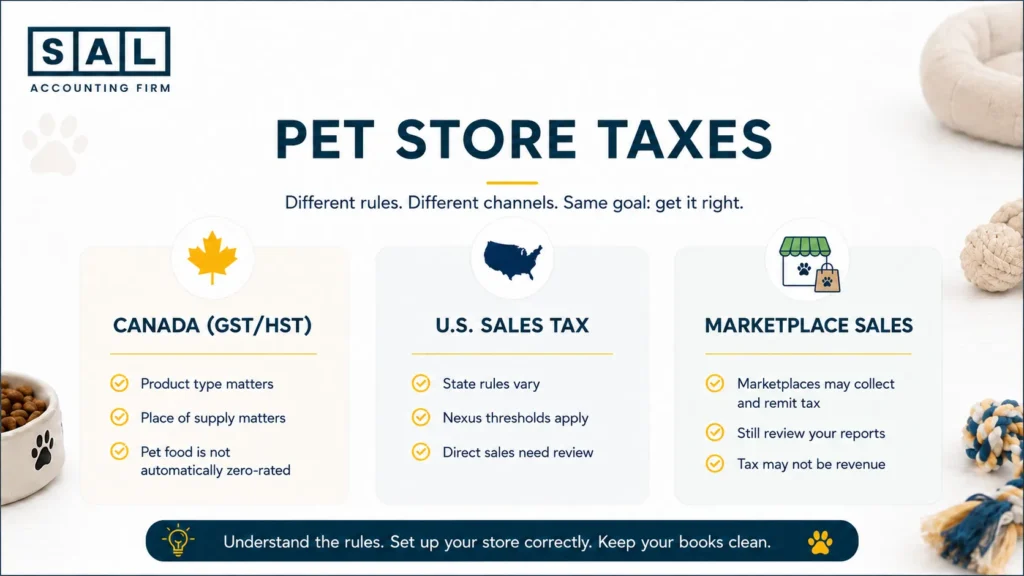
Pet product tax depends on what you sell and where your customer is. Food, supplements, toys, grooming products, and subscription boxes may not all be treated the same, especially across provinces or U.S. states.
Shopify, Amazon, and WooCommerce can help calculate tax, but the setup still needs to match your products and sales locations.
Canada: GST/HST and Product Type
In Canada, basic groceries for human consumption can be zero-rated for GST/HST. That does not automatically mean pet food gets the same treatment.
The CRA’s rules for basic groceries focus on human food products, so pet food, treats, supplements, toys, grooming products, and accessories need their own review. Do not assume:
- all food is zero-rated
- all supplements are treated the same
- all pet products follow one rule
- Shopify tax settings are correct for every SKU
GST/HST rates can also depend on the place of supply, which matters when you sell across provinces. For stores selling through Shopify, Shopify GST/HST setup is worth reviewing before tax settings quietly create messy reports.
U.S. Sales Tax and Marketplace Sales
The U.S. is different because sales tax is state-based. Most states now have economic nexus rules for remote sellers, which means growing U.S. sales can create registration, collection, and filing work. For pet stores, this matters because:
- pet food may be taxable in some states
- supplements may be treated differently from food
- prescription diet products may need special review
- shipping taxability can vary
- marketplace sales and direct website sales may not be handled the same way
Once U.S. orders start growing, sales tax nexus for ecommerce sellers becomes something to check before the filings pile up.
Marketplace Facilitator Rules
Amazon and some marketplaces may collect and remit sales tax on certain orders. That helps, but it does not mean tax can be ignored. You still need to know:
- which sales were marketplace sales
- which sales were direct website sales
- which taxes were collected
- which taxes were remitted
- which tax amounts should not be counted as revenue
For marketplace-heavy stores, Amazon seller taxes can affect how you review tax, fees, returns, reimbursements, and payout reports.
How to Set Up Pet Store Bookkeeping by Sales Channel
Your sales channel affects how clean or messy the accounting gets. Shopify, Amazon, WooCommerce, PayPal, Stripe, and marketplace platforms all report money differently. Some show gross sales. Some send net payouts. Some remove fees before the deposit hits your bank. Some collect tax on your behalf in certain cases.
That is why your bookkeeping setup should not be built only around the bank feed. It should start with the sales channel reports and then reconcile back to the bank.
Chart of Accounts for an Online Pet Store
A chart of accounts is the category list inside your accounting software. Here’s a simple version for a pet ecommerce business:
| Account Category | What Goes Here | Why It Matters | Example |
| Product sales | Food, treats, toys | Shows revenue by type | Shopify sales |
| Discounts | Codes, promos, bundles | Shows margin pressure | Bundle discount |
| Refunds | Returns, cancellations | Keeps revenue clean | Amazon return |
| Sales tax payable | GST/HST, U.S. sales tax | Keeps tax out of income | Shopify Tax |
| Inventory | Unsold products | Shows stock value | Warehouse SKUs |
| Cost of goods sold | Sold product cost | Shows gross margin | Treat cost |
| Shipping income | Customer shipping charges | Shows checkout charges | Paid shipping |
| Shipping costs | Carrier and 3PL fees | Shows delivery cost | Canada Post, UPS |
| Gift card liability | Unused gift cards | Tracks future obligation | Shopify gift card |
This gives you a clearer picture than one big “sales” category and one big “expenses” category.
- Read More: “Best Shopify Integrations for E-commerce“
Shopify Payouts
Shopify payouts are one of the easiest places to lose track of the real numbers. Shopify’s finance reports can show sales, payments, and gift card activity, while tax reports can help you review sales tax data before filing.
Example: Let’s say Shopify shows $40,000 in sales, but only $34,500 hits your bank. That does not mean revenue is $34,500. The difference may include:
- payment fees
- refunds
- discounts
- taxes collected
- chargebacks
- app fees
- reserves
- shipping labels
- adjustments
That is why Shopify payment reconciliation matters. The payout is usually a bundle of activity, not a clean sales number.
If Shopify is your main channel and the numbers are starting to feel messy, Shopify accounting can help you see what your store actually keeps after fees, refunds, tax, and product costs.
Amazon and Marketplace Payouts
Amazon can be even harder to follow because the payout may include product sales, referral fees, FBA fees, storage fees, returns, reimbursements, advertising charges, reserves, and tax handling.
For Amazon sellers, Amazon FBA bookkeeping often needs more detail because fulfillment fees, returns, storage, and inventory movement all affect the numbers.
If Amazon is a major channel, Amazon seller bookkeeping can help your marketplace reports tie back to actual bank deposits instead of leaving you with a payout number and no clear explanation.
Gift Cards, Store Credit, and Loyalty Points
Gift cards can make cash look better than profit. When a customer buys a gift card, the business receives money now. But you still owe the customer products later. That usually means the unused balance should be tracked as a liability, not treated like normal product revenue right away.
The same idea can apply to store credit and loyalty points. If customers can redeem them later, your books should show that future obligation.
How to Track Subscription Box Revenue and Costs
Subscription boxes can make revenue feel more predictable, which is great. But they can also hide costs if you only look at the selling price.
A pet box may include several products, packaging, inserts, kitting, shipping materials, and platform fees. If those costs are not tracked together, you may think the box is healthier than it really is. A simple box-level report can show what each box costs to build, ship, and sell:
| Box Item | Cost | Category | Why It Matters |
| Treats | $13 | Product cost | Main box item |
| Toy | $8 | Product cost | Adds value |
| Packaging | $3 | Direct packaging | Needed to ship box |
| Kitting | $2 | Fulfillment cost | Assembly cost |
| Shipping | $9 | Delivery cost | Major margin factor |
| Platform fees | $2 | Selling fee | Reduces payout |
| Total direct cost | $37 | Box cost | Before overhead |
If the box sells for $49, it is not making $49. It is making $12 before ads, payroll, software, and overhead. The point is, subscription revenue can be stable, but margin still needs checking.
Case Study: How a Port Credit Pet Box Brand Cleaned Up Subscription Accounting2
A subscription pet box brand in Port Credit, Mississauga sells monthly dog boxes with treats, toys, and grooming samples. Customers love the boxes, and revenue looks steady. But the owner cannot tell which box themes make money and which ones are too expensive to build.
The Problem
Each box is recorded as one product. The treats, toys, packaging, inserts, shipping materials, and kitting costs are not tracked by box theme. Some months look profitable, but cash feels tight after supplier bills and shipping.
What We Do
We set up item-level tracking for each monthly box. Each toy, treat, sample, insert, and packaging item is tied back to the finished box. We also separate prepaid subscription revenue from boxes already fulfilled.
The Result
The owner can compare box themes properly. They can see which boxes create stronger margin, which items should be swapped out, and whether prepaid subscription cash is safe to spend or needed for future fulfillment.
- Read More: “Best Accounting Practices for Shopify Stores“
Month-End Checklist for a Pet Ecommerce Store
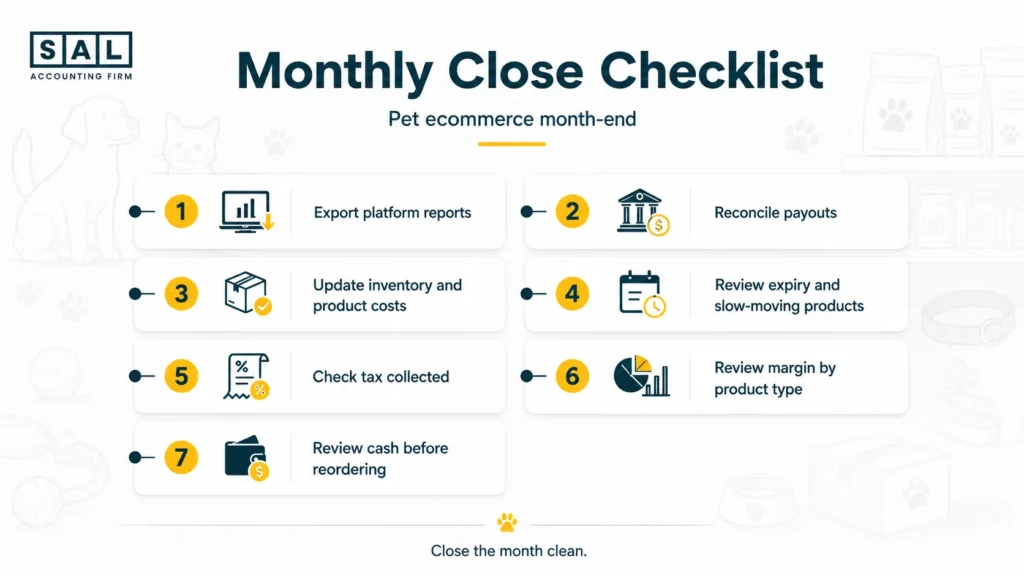
Month-end does not need to feel like a huge accounting project. It just needs to be consistent. The goal is to close the month before small problems pile up. If payouts are not reconciled, inventory is not updated, and tax is not separated, year-end cleanup becomes much harder than it needs to be. A simple monthly routine can make the business easier to manage.
1. Export Platform Reports
Pull reports from Shopify, WooCommerce, Amazon, payment processors, and any marketplace you use. You want reports for:
- sales
- refunds
- discounts
- taxes
- fees
- shipping
- gift cards
- payouts
2. Reconcile Payouts to Bank Deposits
Match each payout to your accounting software. Do not just code the deposit as sales. Break out:
- gross sales
- taxes collected
- refunds
- payment fees
- marketplace fees
- shipping labels
- adjustments
3. Update Inventory and Product Costs
Check whether your inventory still matches what you can actually sell. This is especially important for pet stores because stock can expire, get damaged, or get used inside bundles and subscription boxes. Review:
- beginning inventory
- purchases
- landed cost
- ending inventory
- expired stock
- damaged stock
- bundle components
- subscription box components
4. Review Expiry and Slow-Moving Products
Run an inventory ageing report. Look for:
- products close to expiry
- products not selling
- overstocked SKUs
- high-return products
- damaged items
- products that need discounting
For pet food and treats, this can protect cash before stock becomes a write-off.
5. Check Tax Collected
Sales tax collected is not your money. Make sure it is recorded separately from revenue.
Direct website sales should also be reviewed separately from marketplace sales, because tax handling may differ by channel. When your Shopify reports start showing sales across more regions, Shopify sales tax reporting becomes a regular part of month-end, not something to check once a year.
6. Review Margin by Product Type
Do not only look at total profit. Break margin down by:
- food
- treats
- supplements
- toys
- accessories
- bundles
- subscription boxes
- marketplaces
- direct website sales
7. Review Cash Before Reordering
Inventory eats cash before it creates profit. Before placing a big reorder, check:
- cash balance
- upcoming tax payments
- supplier bills
- ad spend
- payroll
- expected payout timing
- slow-moving stock
A simple cash flow forecast can help you avoid buying too much stock before the cash from current sales comes back.
Tools and Reports That Make Pet Store Accounting Easier
Software will not fix messy accounting on its own. But the right setup can make your reports much easier to trust.
The key is choosing tools based on how your store actually sells. A small Shopify-only store does not need the same setup as a multi-channel pet brand selling through Shopify, Amazon, subscriptions, and wholesale. Start with the reports you need, then choose tools that support those reports.
Accounting Software
QuickBooks Online and Xero are common choices for ecommerce stores. What matters most is not the software name. It is whether the setup gives you clean numbers.
If your store uses Shopify and QuickBooks, Shopify QuickBooks integration needs to handle sales, payouts, fees, taxes, and product costs without dumping everything into broad categories.
Ecommerce Connectors
Tools like A2X, Link My Books, Webgility, or similar connectors can help pull platform data into your accounting software. They can be useful when you sell through:
- Shopify
- Amazon
- WooCommerce
- Stripe
- PayPal
- Walmart Marketplace
- multiple currencies
For Shopify stores, A2X for Shopify can help split payouts into sales, tax, refunds, fees, and other adjustments instead of leaving one confusing deposit.
Inventory and Expiry Tools
Your inventory tool should support the way pet products actually move. Look for features like:
- SKU tracking
- lot numbers
- expiry dates
- bundles
- purchase orders
- landed cost
- multi-warehouse tracking
- stock ageing reports
- reorder points
If you import pet food, treats, or chews into Canada, the CFIA’s pet food import rules may matter, especially when products contain animal ingredients.
A good software choice should match how your store sells, ships, and gets paid. That is why ecommerce accounting software should be judged by reporting quality, not just app features.
Pet Store Numbers Worth Reviewing Every Month
You do not need a huge dashboard. You need a few numbers that tell you what is going on. For pet ecommerce, the most useful numbers usually connect to margin, inventory, shipping, subscriptions, tax, and cash. These numbers help you spot problems early, before they turn into tight cash or messy year-end books.
| Metric | What It Tells You | Why It Matters | How Often |
| Gross margin by SKU | Profit after product cost | Finds weak products | Monthly |
| Inventory turnover | How fast stock sells | Helps avoid expiry | Monthly |
| Expired stock rate | Stock lost to expiry | Shows buying issues | Monthly |
| Shipping margin | Shipping income vs carrier cost | Protects bulky products | Monthly |
| Return rate | Refunds and returns | Spots product issues | Monthly |
| Subscription churn | Cancelled subscribers | Shows retention health | Monthly |
| Average order value | Average customer spend | Helps cover shipping | Monthly |
| Cash on hand | Available working cash | Helps plan reorders | Weekly or monthly |
Pro Tip: For food and treats, do not only look at margin percentage. Look at gross profit dollars per order too. A product can look fine as a percentage but still leave too little cash after shipping.When tax season comes around, clean monthly reports make it much easier to prepare your ecommerce business for tax season without rebuilding the year from scratch.
Common Accounting Mistakes Online Pet Stores Make
Most bookkeeping problems do not happen because someone is careless. They happen because ecommerce has a lot of moving parts. Pet stores add even more layers: expiring products, heavy shipping, subscription boxes, product bundles, marketplace fees, and tax rules that change based on location. Here are the mistakes we see most often.
Mistake 1: Recording Net Payouts as Sales
You receive $8,200 from Shopify and record $8,200 as sales. But actual sales may have been $9,600. The difference could be fees, refunds, shipping labels, and tax.
Fix: Record gross sales first, then separate the deductions.
Mistake 2: Using Supplier Cost Instead of Landed Cost
If you ignore freight, duties, brokerage, and prep costs, your margins will look too high.
Fix: Build landed cost into your inventory process.
Mistake 3: Leaving Expired Stock in Inventory
If expired food stays in inventory, your balance sheet looks stronger than it really is.
Fix: Review expiry and damaged stock monthly. Write off items that can no longer be sold.
Mistake 4: Treating Gift Cards as Sales Too Early
Gift cards can make cash look good, but they also create an obligation.
Fix: Track gift cards as liabilities until they are redeemed, based on your accounting setup.
Mistake 5: Assuming Marketplaces Handle All Sales Tax
Amazon may collect tax on some marketplace orders, but that does not cover every possible channel or obligation.
Fix: Separate marketplace sales from direct website sales and review each province or state as needed.
Mistake 6: Mixing Consumables and Hard Goods
If all products sit in one category, you cannot see which products are causing expiry, damage, returns, or shipping problems.
Fix: Track food, treats, supplements, toys, accessories, bundles, and subscription boxes separately.
Most ecommerce accounting mistakes are not dramatic. They are small setup problems that make the numbers harder to trust over time.
Is Your Online Pet Store Accounting Showing the Real Picture?
Your accounting should help you understand your store, not make things more confusing. For pet ecommerce, that means knowing what your products really cost, which items are close to expiry, which channels are profitable, and whether taxes, payouts, and inventory are being tracked properly.
If your numbers feel harder to trust than they should, contact us at SAL Accounting and get a clearer sense of what needs to be cleaned up, tracked, or set up next.