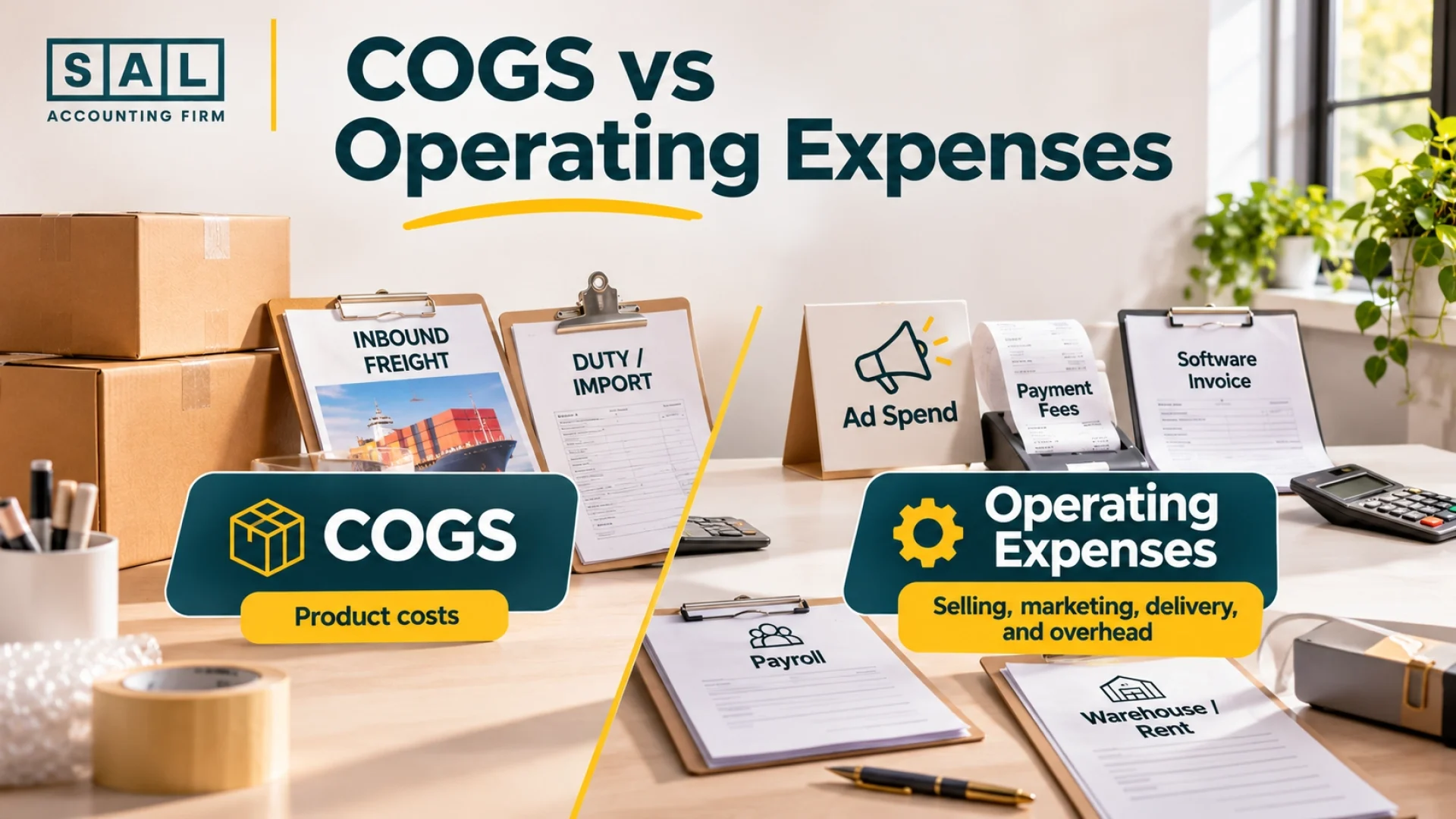
If your gross margin swings from month to month, or looks too low to be true, some costs may be sitting on the wrong side of the line. COGS is what the products you sold cost you. Operating expenses are what it costs to market, sell, and run the business.
SAL Accounting sorts these for ecommerce brands every month. The cost-by-cost table below shows exactly where shipping, fees, packaging, and returns belong.
Once your costs are sorted, see what your operating profit really looks like with the Ecommerce EBITDA Calculator.
Quick Takeaways
- COGS is the cost of the products you sold, including getting them to your warehouse.
- Operating expenses are the costs of marketing, selling, delivering, and running the business.
- Inbound freight and duty belong in COGS, while shipping to customers is usually a selling cost.
- Putting a cost on the wrong side changes your gross margin, not your total profit.
- Recording an inventory purchase as an expense distorts profit from month to month.
- Pick one set of rules and use them the same way every month.
Clean categories make every margin easier to trust. With monthly ecommerce bookkeeping, every cost lands on the right line, so your gross margin means the same thing month after month.
What’s the Difference Between COGS and Operating Expenses for an Ecommerce Store?
COGS is what the products you sold cost you, while operating expenses are the costs of running the business.
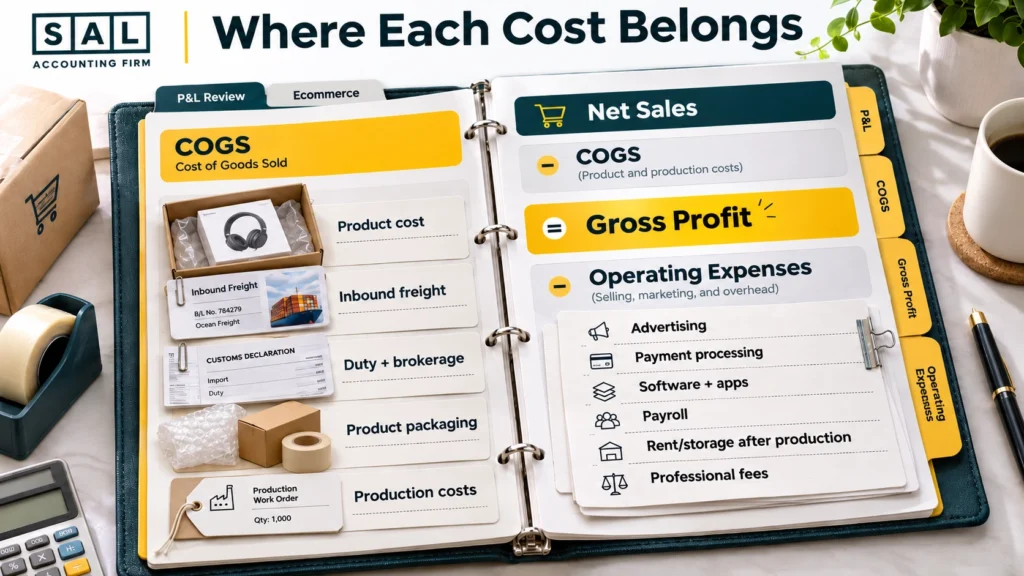
On your profit and loss statement (P&L), COGS comes first. Subtract it from net sales, and you get gross profit. Operating expenses come next. Subtract them from gross profit, and you get operating profit.
Net sales − COGS = Gross profit
Gross profit − Operating expenses = Operating profit
Gross profit tells you whether your products earn enough. Operating profit tells you whether the whole business does. If you need a refresher on the math behind the first line, start with how to calculate COGS for an ecommerce store. How both lines fit together on your statements is easier to see once you know how to read your ecommerce financial statements.
Which Ecommerce Costs Belong in COGS?
Include the costs of buying or making your products and getting them to your warehouse.
These usually belong in COGS:
| Cost | Example |
|---|---|
| Product cost | What your supplier or manufacturer charges per unit |
| Inbound freight | Shipping your inventory from the supplier to your warehouse |
| Duty and brokerage | Import charges to bring the goods into Canada |
| Product packaging | The box, bottle, or label that’s part of the product |
| Production costs | Costs to finish the product, such as assembly or printing before sale |
Under IAS 2, inventory cost includes the purchase price, import duties, non-recoverable taxes, transport, handling, and the costs of making the product. Those costs sit in inventory until the product sells, and then move into COGS. IAS 2 applies under IFRS, and many Canadian private companies use ASPE instead, so confirm your framework with your accountant.
Getting this number right starts with your full landed cost, not just your supplier’s price.
Which Ecommerce Costs Are Operating Expenses?
Costs to market, sell, deliver, and run the business are operating expenses, not product costs.
| Cost | Why It’s an Operating Expense |
|---|---|
| Advertising | It wins customers, not products |
| Payment processing fees | They come from taking payment, not making the product |
| Software and apps | They run the business |
| Payroll | It pays your team |
| Rent and storage after production | It houses the business and its finished inventory |
| Professional fees | Accounting and legal services run the business |
IAS 2 backs this up. It leaves selling costs, storage after production, and general admin costs out of inventory cost. These costs still reduce your profit, just one line further down. Many of them are easy to overlook, which is why it’s worth checking your books for hidden ecommerce expenses.
Is Shipping COGS or an Operating Expense for Ecommerce Sellers?
Shipping to your warehouse is part of COGS, while shipping to customers is usually a selling cost.
The direction matters:
- Inbound shipping, from your supplier to you, is part of what your inventory costs, so it goes into COGS.
- Outbound shipping, from you to your customer, is a cost of delivering the sale, so it’s usually an operating expense.
Some brands show outbound shipping and fulfillment as part of “cost of sales.” That’s a presentation choice, not a mistake, as long as you’re consistent. The real problem is switching from one month to the next, because your gross margin stops being comparable.
Pro Tip: Write your classification rules down once, and give a copy to whoever does your books. Every month’s P&L will then use the same lines.
Case Study: How Kayla’s Online Store in Riverdale, Toronto Finds Its Real Margin1
Kayla sells home goods online from a small studio in Riverdale, Toronto. Her P&L shows a gross margin of about 44%, and she’s worried her products cost too much.
The problem: Her bookkeeper has been putting outbound shipping, pick-and-pack fees, and payment fees into COGS. Kayla compares her margin to what she expected, assumes her supplier is overcharging, and starts looking for a new one.
What we do: We move outbound shipping, fulfillment, and payment fees out of COGS and into operating expenses, and write down the rules for every future month.
The result: Kayla’s product margin is actually about 60%, and her supplier is fine. The real drain is her free-shipping offer, so she raises her free-shipping minimum instead of switching suppliers.
Where Do Payment Fees, Fulfillment, Packaging, and Returns Go?
Most of these are selling costs, but product packaging belongs in COGS, and returns reduce your sales.
| Cost | Where It Usually Goes | Notes |
|---|---|---|
| Product packaging (part of the product) | COGS | The tub, bottle, or tag the customer receives |
| Shipping boxes and mailers | Operating (selling) expense | They deliver the product, not make it |
| Payment processing fees | Operating expense | They come from taking payment |
| Marketplace fees | Operating (selling) expense | Fees for selling on a platform like Amazon |
| Pick and pack | Operating (selling) expense | Some brands present it in cost of sales, which is fine if consistent |
| Refunds | A reduction of sales | Not an expense at all |
| Unsellable returned items | Inventory loss | The product’s cost is written off |
| Warehouse storage after production | Operating expense | Storage isn’t part of inventory cost |
Refunds trip up a lot of sellers. A refund isn’t a cost of running the business, so it reduces your sales instead of sitting in expenses. Sorting each transaction this way is much easier when you know how to categorize ecommerce transactions from the start.
How Does Putting a Cost in the Wrong Place Change Your Ecommerce Numbers?
It changes your gross margin, not your total profit, but it can still lead to bad decisions.
Here’s the same illustrative month, recorded two ways:
| Line | Sorted Correctly | Shipping, Fulfillment, and Fees in COGS |
|---|---|---|
| Net sales | $100,000 | $100,000 |
| COGS | $40,000 | $56,000 |
| Gross profit | $60,000 (60%) | $44,000 (44%) |
| Outbound shipping | $8,000 | in COGS |
| Fulfillment | $5,000 | in COGS |
| Payment fees | $3,000 | in COGS |
| Ads, software, and payroll | $29,000 | $29,000 |
| Operating profit | $15,000 | $15,000 |
Operating profit is $15,000 either way. But a 60% gross margin and a 44% gross margin tell very different stories about your products. That’s how a misplaced cost leads to the wrong fix, like changing suppliers when the real problem is shipping. It’s also one of the most common ecommerce profit calculation mistakes.
Selling costs like shipping and fees still matter. They’re the layer between gross profit and what each order really leaves, which is your ecommerce contribution margin.
What Happens When an Ecommerce Seller Records Inventory as an Expense?
Your profit swings, because the whole purchase hits one month instead of the months the products sell.
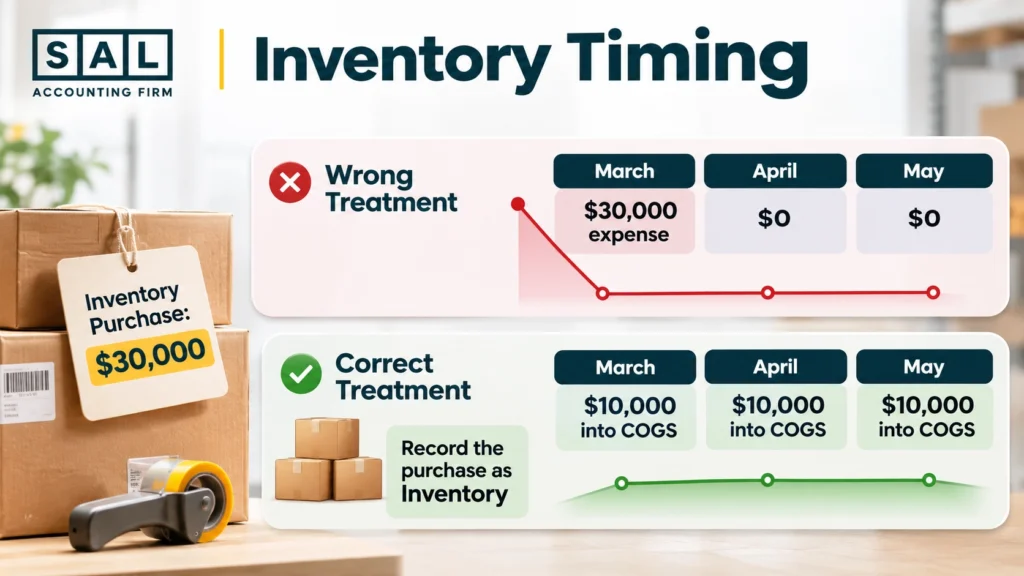
When you buy inventory, it’s an asset at first. Its cost only moves into COGS as each unit sells. If you record a big inventory order as an expense the day you pay for it, that month looks like a loss, and the months that follow look far too profitable.
When a cost should sit in inventory and when it becomes an expense is the focus of capitalized vs expensed inventory for ecommerce.
Case Study: How Ethan’s Online Brand in Cooksville, Mississauga Stops Its Profit Swings
Ethan sells kitchen tools online from a warehouse unit in Cooksville, Mississauga. In March, he places a $30,000 inventory order that he expects to sell over the next three months.
The problem: His books record the full $30,000 as an expense in March. March shows a big loss, while April and May look like his best months ever. Ethan can’t tell whether his business is actually doing well.
What we do: We record the order as inventory, and move $10,000 into COGS each month as the products sell.
The result: Ethan’s monthly profit steadies, and each month now shows what it actually earned. He can finally compare one month with the next and plan his next order with confidence.
How Do COGS Show Up in Shopify’s Profit Reports?
Shopify calculates gross profit from the cost per item you enter, so every product needs an accurate cost.
Shopify’s profit reports only show profit for products that had a cost recorded when they sold. If a product’s cost is missing or wrong, its gross profit in Shopify is too.
Enter your full landed cost per unit, not just your supplier’s price, and update it when a new order costs more or less. Shopify’s numbers are a quick check, but your accounting records are the ones that count. Keeping both in step is the idea behind COGS in Shopify.
Does the Difference Between COGS and Operating Expenses Affect Your Taxes?
It mostly affects timing, because inventory costs are deducted as the products sell, not when you buy them.
Most operating expenses are deducted in the period you incur them. Inventory works differently. CRA’s guidance on inventory and cost of goods sold explains that your inventory is valued at year-end, and its cost is deducted through COGS as goods are sold.
That means a big inventory buy late in the year doesn’t lower that year’s taxes on its own. Products still on hand at year-end stay in inventory until they sell.
How Can an Ecommerce Seller Keep COGS and Operating Expenses Consistent?
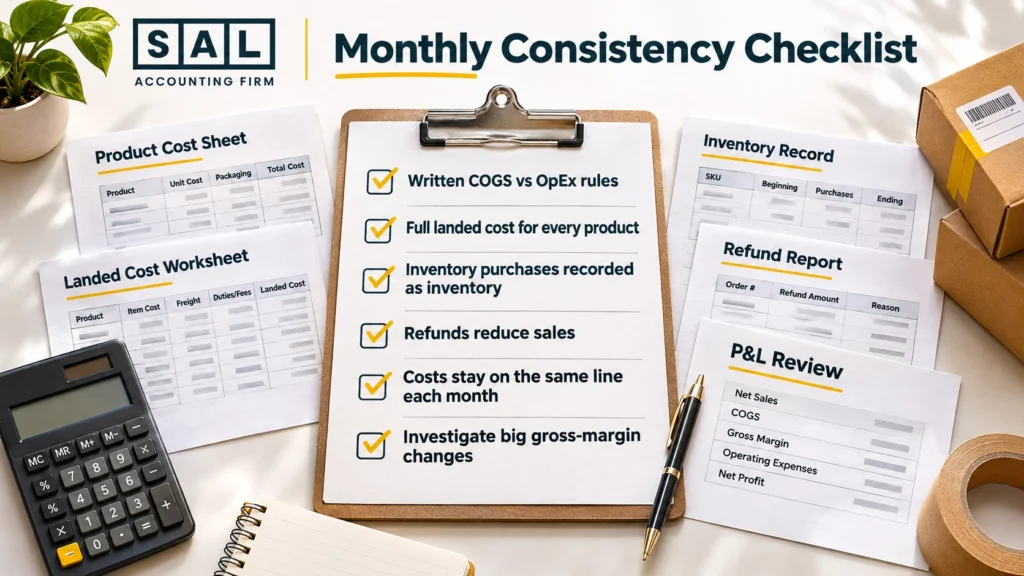
Set clear rules once, apply them every month, and check them before you close the books. A simple monthly routine:
- Keep a written list of which costs go in COGS and which are operating expenses
- Enter your full landed cost for every product
- Record inventory purchases as inventory, not expenses
- Treat refunds as a reduction of sales
- Check that each cost landed on the same line as last month
- Review any big change in gross margin before you accept it
Final Thought: Is Your Gross Margin Telling You the Truth?
COGS and operating expenses both cut into profit, but they answer different questions. COGS shows whether your products earn enough. Operating expenses show whether the business around them does. Put product, freight, duty, and packaging in COGS, keep selling and running costs below it, and use the same rules every month. Then both your gross margin and your operating profit tell the truth.
Once your numbers are sorted, our free roadmap for cleaner margins helps you decide where to improve first.
- Any case studies discussed are composites of scenarios handled, discussed or read about and may or may not reflect existing SAL Accounting clients. We take no responsibility for actions taken or inferences derived from any content on our online or printed materials. ↩︎