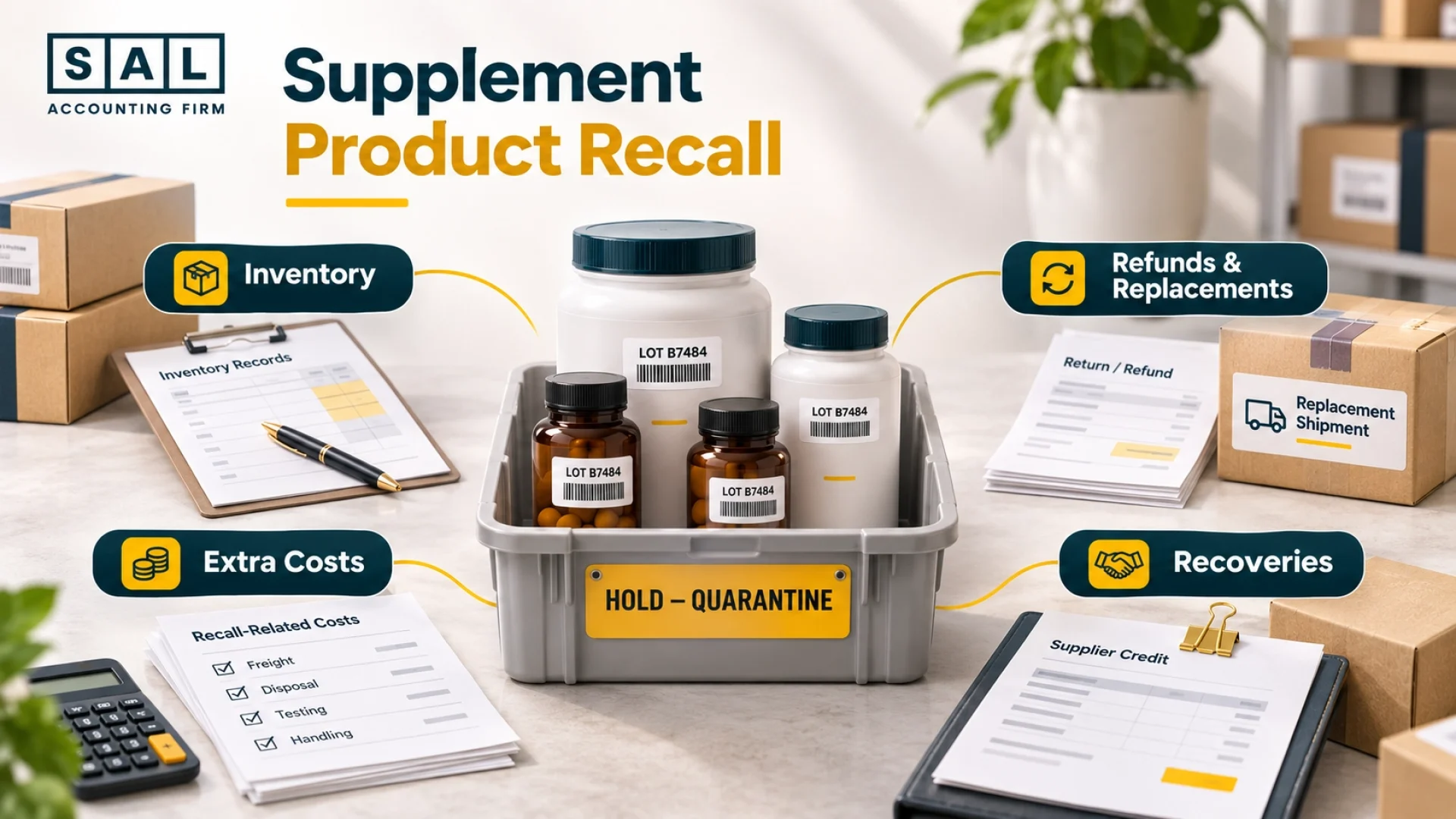
A product recall hits an online supplement brand’s books in four places at once: inventory you can’t sell, customer refunds and replacements, extra costs, and money you might recover. Record them separately, once each, and keep confirmed amounts apart from estimates.
SAL Accounting walks supplement brands through this when a recall lands. By the end, you’ll know exactly what your recall cost, before and after recoveries.
A recall can wipe out a month’s profit, so see how it changes your numbers with the Ecommerce EBITDA Calculator.
Quick Takeaways
- A recall affects four areas of your books: inventory, customer refunds and replacements, extra costs, and recoveries.
- Find every recalled unit by lot and location before you calculate anything.
- Quarantined inventory isn’t automatically a write-off. Check what it can still be worth.
- Record refunds against sales, not as a recall expense.
- Count a supplier or insurance recovery only once it’s virtually certain, not when you file the claim.
- Show the recall’s cost both before and after recoveries.
A recall puts your inventory, refund, and supplier records under pressure all at once. Our ecommerce bookkeeping team keeps those records connected, so you can see a recall’s real cost and every dollar you recover.
What Does a Product Recall Do to an Online Supplement Brand’s Books?
A recall touches inventory, sales, expenses, and possible recoveries, so each needs its own record. Your books should be able to answer five questions:
- Which products and lots are affected, and how many units?
- What’s the cost of the inventory you can no longer sell?
- How much will you refund or replace for customers?
- What extra costs did the recall create?
- How much can you recover from suppliers or insurers, and when does it count?
Health Canada has its own recall requirements for natural health products. This post covers the accounting side only, so follow those rules separately and get regulatory advice where you need it. How a recall fits into your wider records starts with solid online supplement business accounting.
Here’s the running example for this post. An online supplement brand recalls one lot of collagen powder, Lot C-2311. The lot had 2,000 units at a recorded cost of $35 each. When the recall starts, 1,200 units are still on hand and 800 have already been sold.
How Do You Find Every Recalled Unit in a Supplement Ecommerce Business?
Match the recall notice to your records by lot number, then sort every unit by where it is now. Compare the recalled lot against your inventory system, 3PL reports, Shopify, and any marketplace data. Then sort the units into groups, because each group gets different accounting:
| Where the Units Are | Example Units | What It Affects |
|---|---|---|
| Your own warehouse | 700 | Inventory on hand |
| Your 3PL | 500 | Inventory on hand |
| Already sold to customers | 800 | Refunds and replacements |
| Returned by customers | Counted as they arrive | Inventory status and refunds |
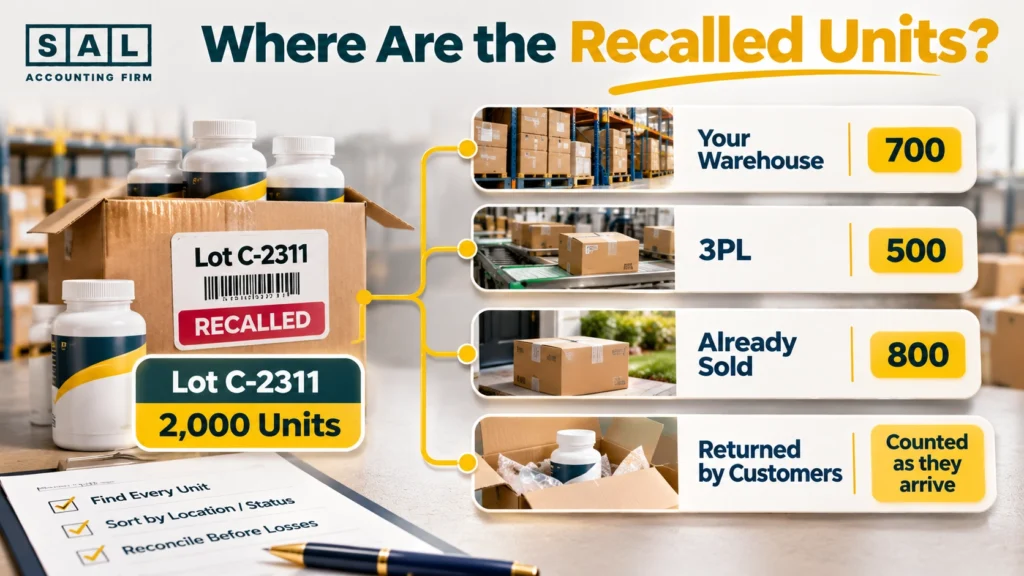
Reconcile the counts before you calculate any losses. Say your books show 1,240 units on hand, but your warehouse and 3PL confirm 1,200. Investigate the 40-unit gap first, instead of assuming it’s all part of the recall.
Finding every unit is much faster when your lot records are already in order, which is why batch and lot tracking for supplement brands pays off before a recall ever happens.
Should Quarantined Supplement Inventory Be Written Off Right Away?
No, quarantine sets units aside while you decide what they’re worth, which isn’t the same as a confirmed loss.
Under IAS 2, inventory is measured at the lower of cost and net realizable value, which is what you can expect to get for it, minus the costs to sell it. If a recall means the product can’t legally or safely be sold, its value may drop to zero. But if some units can go back to the supplier for credit, or be released after testing, the loss is smaller. IAS 2 applies under IFRS, and many Canadian private companies use ASPE instead, so confirm which framework your books follow.
| Inventory Status | What to Do |
|---|---|
| Quarantined, assessment pending | Separate and document the units. Don’t write them off yet. |
| Confirmed unsellable | Record a write-down to what you can still recover. |
| Returned to the supplier or destroyed | Record the final quantity, any costs, and the paperwork. |
Pro Tip: Keep the recall notice, lot details, and every inventory adjustment in one folder. When someone asks why your inventory dropped, the whole story is in one place.
How a write-down is recorded step by step is the same process used for expired supplement inventory.
How Do You Calculate the Inventory Loss From a Supplement Recall?
Multiply the units you can’t sell or recover by the cost recorded in your books.
Inventory loss = Unsellable units on hand × Recorded cost per unit
In the running example, all 1,200 units on hand are confirmed unsellable, and the supplier won’t take them back:
1,200 × $35 = $42,000
Use the cost already in your books, under your normal costing method, not the retail price. And don’t include the 800 units already sold. They left your inventory when they were sold, so they show up in refunds and replacements instead.
The $35 should include the full cost of getting the product ready to sell. If you’re not sure what’s in it, check how your landed cost was built.
How Should an Online Supplement Brand Record Recall Refunds and Replacements?
Record refunds against sales, and record replacements as new product and shipping costs.
In the running example, 450 of the 800 sold units are refunded at $40 each, which is $18,000. Another 200 customers choose a replacement from a different lot:
| Customer Remedy | Calculation | Amount | Where It Goes |
| Refunds | 450 × $40 | $18,000 | Reduces sales |
| Replacement product | 200 × $25 product cost | $5,000 | Cost of the replacement units |
| Replacement shipping | 200 × $10 | $2,000 | Fulfillment cost |
| Replacements total | $7,000 |
Refunds can create a hidden cost too. Shopify’s refunding orders page notes that if an order was processed through Shopify Payments, you don’t get any credit card fees refunded.
Watch for double-counting. A refund can appear in Shopify, in your payout, and in a manual entry, but it should only hit your books once. Matching each refund to your payouts is the same check used in revenue vs payout reconciliation.
Case Study: How Rebecca’s Supplement Brand in Leaside, Toronto Catches a Double-Counted Refund1
Rebecca sells collagen and protein powders online from a small office in Leaside, Toronto. When one of her lots is recalled, she refunds customers quickly through Shopify, and records each refund by hand in her books to be safe.
The problem: Her refunds now appear twice: once from her Shopify sales feed, and once from her manual entries. Her recall looks almost twice as costly as it really is, and her sales look too low.
What we do: We match every refund to its Shopify order and payout, remove the duplicate manual entries, and record the replacement units and shipping as separate costs. We also find a 40-unit gap between her books and her 3PL’s count, which turns out to be an unrecorded transfer.
The result: Rebecca’s books show the recall’s real cost, with each refund recorded once. Her inventory count matches her 3PL, and every adjustment has paperwork behind it.
How Does a Product Recall Affect GST/HST for an Online Supplement Brand?
When you refund a customer, you can usually adjust the GST/HST you collected on that sale.
Under CRA’s GST/HST Memorandum 12.2, when goods are returned for a full or partial refund, you may refund or credit the GST/HST to the customer and adjust your net tax. Doing so is optional, and you have up to four years after the end of the reporting period in which the price was reduced.
You document the adjustment with a credit note. What a credit note must show is set out in the Credit Note and Debit Note Information (GST/HST) Regulations. A recall doesn’t automatically create an adjustment. The adjustment comes from the refund or credit itself, backed by the right document.
What Other Recall Costs Should an Online Supplement Brand Record?
Record every extra cost the recall creates, in its own clearly labelled account. These usually include:
- Return shipping and reverse logistics
- Warehouse handling and storage of quarantined inventory
- Testing or inspection
- Disposal
- Customer communication
- Credit card fees you don’t get back on refunded orders
- Legal or professional fees tied to the recall
In the running example, these add up to $9,000.
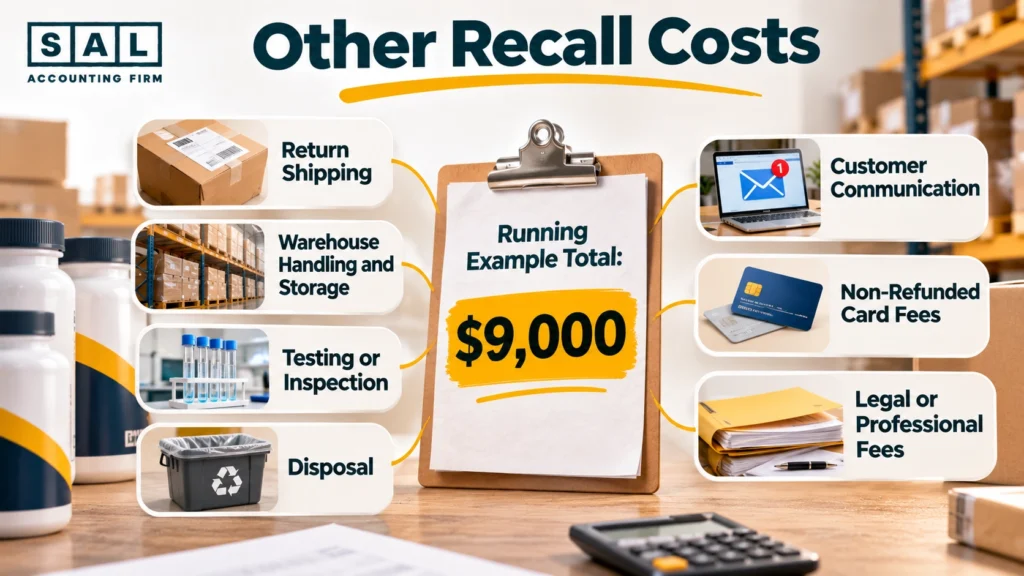
Timing matters. Record a cost when you owe it, even if you haven’t paid the invoice yet. Under IAS 37, you only set up a provision for a cost you haven’t been billed for when three things are true: you have a present obligation from a past event, paying it is probable, and you can estimate the amount reliably. Expected future running costs don’t qualify on their own. Under ASPE, confirm the treatment with your accountant.
Labelled accounts make all of this easy to see later, which is one reason to keep a clear chart of accounts for supplement brands.
Can an Online Supplement Brand Count Supplier or Insurance Recoveries Before They’re Paid?
Not just because you expect them; a recovery counts once it’s virtually certain, not when you file the claim.
Under IAS 37, an expected recovery isn’t recorded as an asset until it’s virtually certain. Track every claim through three stages:
| Stage | What It Means | Record It? |
|---|---|---|
| Claim submitted | You’ve asked the supplier or insurer to pay | No, track it only |
| Approved or virtually certain | A credit note or written approval confirms it | Yes |
| Received | The cash arrives, or the credit is applied to what you owe | Yes, settle it |
In the running example, the supplier issues a credit note for $25,000, so it’s recorded. A $15,000 insurance claim is still under review, so it’s tracked but not recorded yet.
Supplier recoveries often depend on your contract and production records. If your co-packer is responsible, the paperwork you keep to reconcile each co-packer production run can support your claim.
Case Study: How Steven’s Supplement Brand in Erindale, Mississauga Keeps Its Recoveries Honest2
Steven sells sleep and magnesium supplements online from a warehouse unit in Erindale, Mississauga. After a recall, his co-packer offers a credit for the affected inventory, and he files an insurance claim for his other costs.
The problem: Steven wants to subtract both amounts from his recall costs right away. But the co-packer’s offer is still only an email, and the insurer hasn’t responded yet.
What we do: We record the co-packer credit only once the signed credit note arrives, and we check it against his supply agreement. The insurance claim stays on a tracking list, not in his books, until the insurer approves it.
The result: Steven’s month-end numbers show what the recall really cost, plus the recoveries he can count on. When the insurer approves part of the claim two months later, it’s recorded then, with the approval letter as support.
What Is the Total Financial Impact of a Supplement Product Recall?
Add up every recall effect, then show the result both before and after recoveries. Here’s the full picture for the running example:
| Recall Item | Amount | How It’s Recorded |
|---|---|---|
| Unsellable inventory on hand | $42,000 | Inventory write-down |
| Customer refunds | $18,000 | Reduces sales |
| Replacement product and shipping | $7,000 | Product and fulfillment costs |
| Other recall costs | $9,000 | Recall cost accounts |
| Impact before recoveries | $76,000 | |
| Supplier credit (credit note received) | −$25,000 | Recovery recorded |
| Impact after recoveries | $51,000 | |
| Insurance claim under review | $15,000 | Tracked only, not recorded |
The $76,000 and $51,000 are management totals. In your financial statements, each item stays in its own line based on what it is, so refunds reduce sales, and the write-down and costs are expenses.
Always look at both numbers. The after-recoveries figure on its own can hide how much the recall actually cost before anyone paid you back.
How Do You Close the Books After a Supplement Product Recall?
Reconcile every recall record before you close the month, so nothing is missing or counted twice.
| Record | What to Check | Supporting Evidence |
|---|---|---|
| Inventory | Affected units, write-downs, returns, and remaining inventory | Lot reports and inventory adjustments |
| Sales and refunds | Refunds and credits, each recorded once | Shopify and payout reports |
| Recall costs | Invoices, accruals, and provisions | Supplier invoices and service records |
| Recoveries | Claims, approvals, credits, and payments | Credit notes and insurer letters |
| General ledger | Every recall entry | Journal entries and calculations |
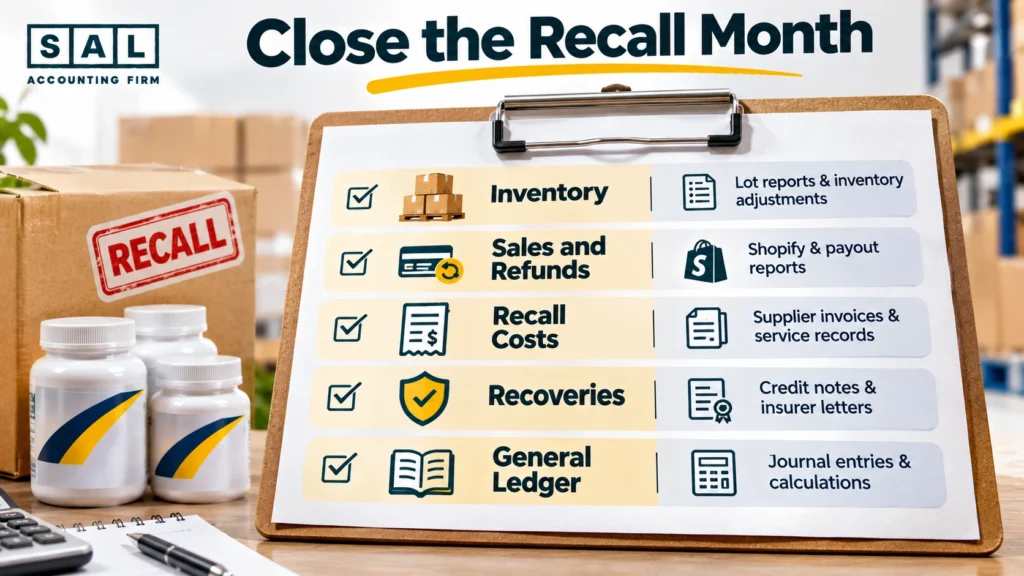
Keep the paperwork together too: the recall notice, lot details, counts, refund and replacement records, invoices, credit notes, insurer letters, and the calculations behind each entry. Give the recall one reference code, and use it on every document and journal entry. Building these checks into your regular month-end close for supplement brands means the recall gets closed out properly instead of lingering.
Final Thought: Do You Know What Your Supplement Recall Really Cost?
A recall feels chaotic, but the accounting doesn’t have to be. Find every unit by lot and location, value what’s still recoverable, record refunds and costs once each, and count recoveries only when they’re virtually certain. Then show the impact both before and after recoveries.
Once the books are clean again, our free roadmap for steadier growth helps you plan the next stage with fewer surprises.