
Hiring your first packer and wondering if BC’s employer health tax applies? Almost certainly not. The tax only applies once your total BC payroll passes $1 million a year. Hiring still brings costs you can’t skip, like WorkSafeBC coverage and CRA payroll deductions.
Below, SAL Accounting lays out where the line sits and what to plan for instead.
Quick Takeaways
- Surrey online stores with BC payroll of $1,000,000 or less don’t pay employer health tax (EHT).
- Between $1,000,000 and $1,500,000, EHT is 5.85% of the amount over $1,000,000.
- Above $1,500,000, EHT is 1.95% of your total BC payroll.
- The old $500,000 threshold was replaced by $1,000,000 starting with the 2024 return.
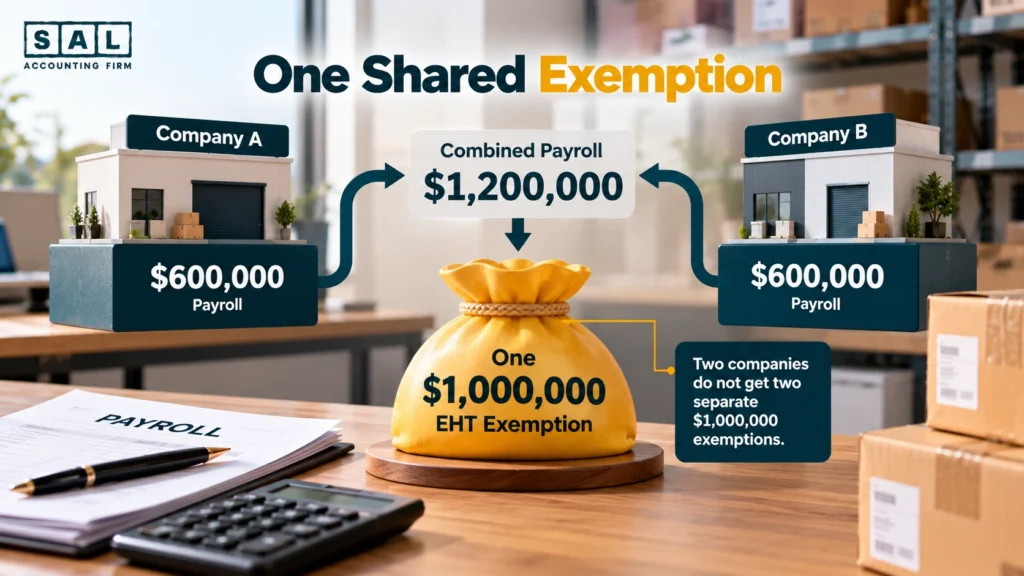
- Associated companies share one $1,000,000 exemption.
- Hiring anyone means registering with WorkSafeBC and opening a CRA payroll account, even if you never owe EHT.
Hiring your first employee is a good moment to tighten up your records. Seeing how ecommerce bookkeeping handles payroll alongside everything else shows what to track from day one.
Does Your Surrey Online Store Have to Pay BC Employer Health Tax?
Only if your total BC payroll is more than $1,000,000 in a calendar year. Starting with the 2024 return, employers with BC payroll of $1,000,000 or less are exempt from EHT. Only employers above the exemption amount have to register. The government’s employer health tax overview sets out the rules.
In EHT terms, payroll is called BC remuneration. It includes payments, benefits, and allowances that count as employment income for your employees, such as:
- Salaries and wages
- Bonuses and commissions
- Taxable benefits and allowances
It generally covers employees who report for work at your business location in BC. For a Surrey online store with a few packers and a part-time customer service person, total payroll is likely nowhere near $1,000,000.
How Is BC Employer Health Tax Calculated for Surrey Online Stores?
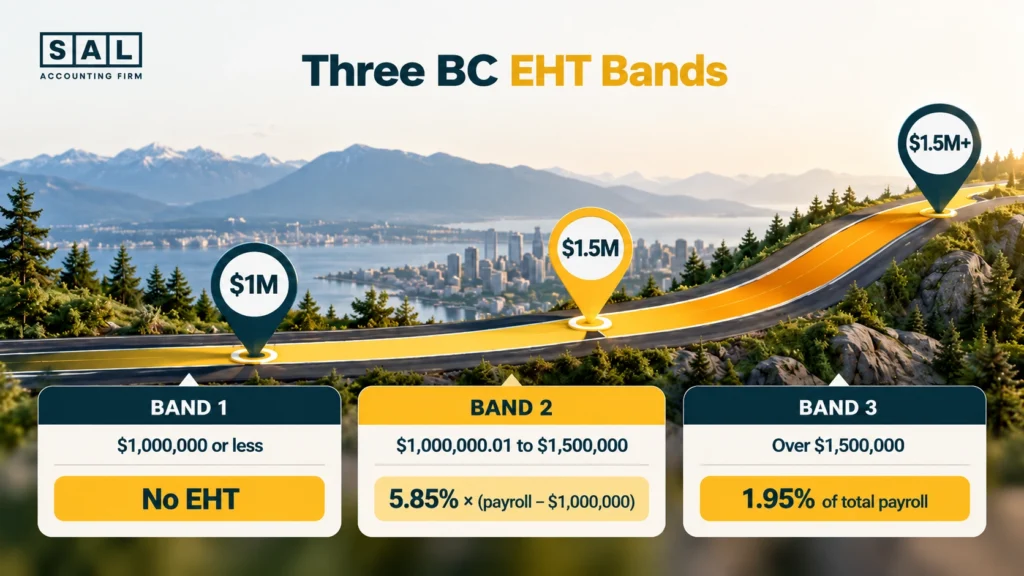
There are three bands: nothing up to $1,000,000, 5.85% on the amount over $1,000,000 up to $1,500,000, and 1.95% on all payroll above $1,500,000.
| Total BC Payroll | EHT |
|---|---|
| $1,000,000 or less | No EHT |
| $1,000,000.01 to $1,500,000 | 5.85% × (payroll − $1,000,000) |
| Over $1,500,000 | 1.95% × total payroll |
Here’s how the middle band works. A store with $1,200,000 of BC payroll pays:
5.85% × ($1,200,000 − $1,000,000) = $11,700
The middle band is called the notch. It feels steep because 5.85% is three times the regular 1.95% rate. That’s because the notch is built to catch up. At exactly $1,500,000, 5.85% × $500,000 = $29,250, which is the same as 1.95% × $1,500,000. Past that point, the whole payroll is taxed at 1.95%.
So the first dollars over $1,000,000 are taxed heavily, but the total amount stays small compared with your payroll.
Is the BC Employer Health Tax Threshold $500,000 or $1 Million?
It’s $1,000,000, starting with the 2024 tax year. The original threshold was $500,000. Starting with the 2024 return, the province raised the exemption to $1,000,000.
Many websites, payroll guides, and older articles still show the $500,000 number. If you read one of them, it can look like a growing store with $600,000 of payroll owes EHT when it doesn’t. Always check the year a source is talking about.
When Could a Growing Surrey Online Store Start Owing EHT?
When fast growth, seasonal staff, or bringing fulfillment in-house pushes your BC payroll past $1,000,000 in a year. What to watch as you scale:
- Moving packing or fulfillment in-house from a 3PL
- Hiring seasonal staff for the holidays
- Adding customer service, marketing, or warehouse roles
- Paying yourself a salary through an incorporated company
- Bonuses at year-end
EHT is based on a full calendar year, so a few months of heavy hiring can push the year’s total over the line. If your payroll gets close, you must register by December 31 of the first year you’re required to pay.
Once your team grows, the way you run payroll matters as much as the tax rules. Weighing whether to outsource payroll for an ecommerce business is a common step, and comparing payroll apps for Shopify stores shows what the options look like.
Case Study: How a Surrey Home-Goods Brand Lands in the Notch1
Priya runs an online home-goods brand from a warehouse unit in Cloverdale, Surrey. Last year, her payroll was about $820,000. This year, she brings packing in-house from her 3PL and hires a large seasonal team for November and December.
The problem: Nobody tracks payroll against the EHT threshold during the year. In December, her bookkeeper totals the year and finds BC payroll of about $1,180,000. That puts the store in the notch, with EHT of 5.85% × $180,000, or $10,530.
What she does: Priya registers for EHT before December 31, as the rules require for the first year an employer has to pay. She adds the EHT amount to her year-end numbers and plans to pay it with the return due March 31.
The result: The tax is an unplanned cost, but Priya catches it in time to register. She now checks payroll against the $1,000,000 line every quarter, and she builds EHT into her seasonal hiring budget for the next year.
Do Associated Companies Share the EHT Exemption in BC?
Yes, associated companies share one $1,000,000 exemption between them. If you own more than one company, the companies are often associated. When their combined BC payroll is between $1,000,000.01 and $1,500,000, they have to share the $1,000,000 exemption. If combined payroll is above $1,500,000, none of them gets an exemption.
This catches owners who split a business into separate companies. Two companies with $600,000 of payroll each don’t each get a full $1,000,000 exemption. Their combined $1,200,000 is what counts.
Running more than one company is a structural choice with tax effects like this one. Knowing how Canadian business structures work helps you see these effects before you set one up.
Case Study: How a Surrey Owner With Two Companies Misses the Shared Exemption2
Marcus runs two corporations from an office in Fleetwood, Surrey. One runs his online store, with payroll of about $650,000. The other sells his products wholesale, with payroll of about $520,000.
The problem: Marcus assumes each company gets its own $1,000,000 exemption, so neither needs to register. But the two companies are associated, and their combined payroll is about $1,170,000. That’s in the notch zone, so they must share one $1,000,000 exemption.
What he does: Marcus registers both companies and splits the $1,000,000 exemption between them. He then works out the EHT each company owes on the payroll above its share.
The result: The combined EHT is about $9,945, based on the $170,000 over the shared exemption. Marcus now tracks payroll for both companies together, and he checks the associated-employer rules before setting up any new company.
What Payroll Costs Does a Surrey Online Store Pay When It Hires?
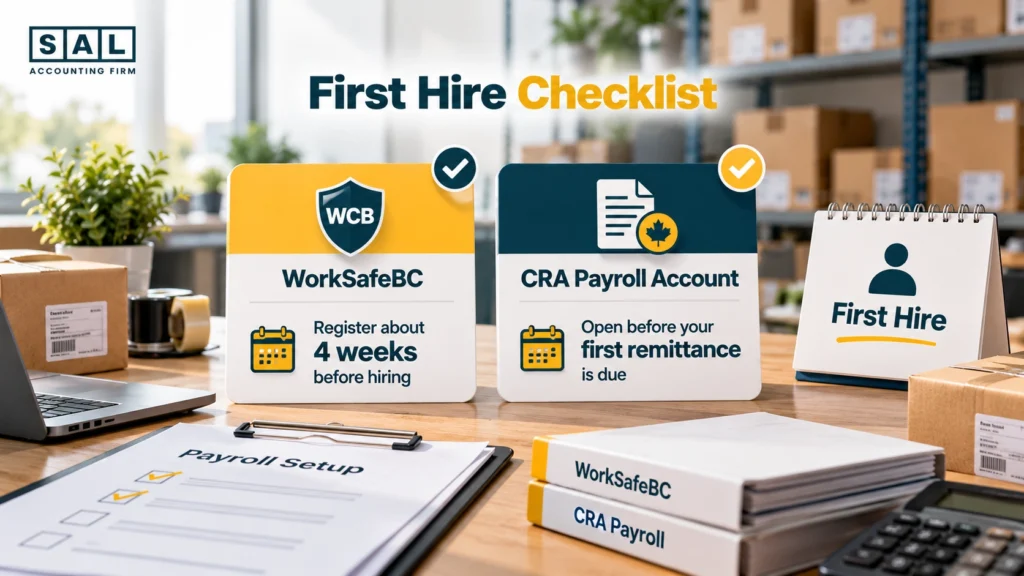
Even if you never owe EHT, hiring your first employee brings registration and payroll duties from day one. Two things to set up before your first pay:
- WorkSafeBC: register for coverage if you hire one or more employees on a full-time, part-time, casual, or contract basis
- CRA payroll account: register for a payroll program account before your first remittance is due
On WorkSafeBC, timing matters. Its small business guidance recommends applying about four weeks before you hire. If you own an incorporated company and are actively involved in it, you’re generally considered an employee and need coverage. If you’re self-employed and don’t hire anyone, you’re not required to register.
On the CRA side, a payroll account lets you deduct and remit CPP contributions, EI premiums, and income tax from your employees’ pay. You must register for a payroll account before your first remittance due date.
Pro Tip: Apply for WorkSafeBC coverage and your CRA payroll account in the same week you post the job. Both take time, and your first employee shouldn’t start before they’re in place.
Is BC Employer Health Tax Tax-Deductible for Online Stores?
Yes, EHT is deductible from business income for income tax purposes.
If your store does owe EHT, it reduces your taxable business income, like other business expenses. Recording it as its own expense line keeps it easy to find at year-end, alongside the other ecommerce business expenses you claim.
If you start operating partway through the year, your exemption is prorated. For example, a business that operated for 122 days of 2024 had a maximum exemption of $334,247 instead of the full $1,000,000. A new store with a big launch team should keep that smaller limit in mind.
Final Thought: Will Your Surrey Online Store Ever Pay Employer Health Tax?
Most Surrey online stores won’t pay EHT, because their BC payroll stays at or under $1,000,000. If you grow past it, the notch zone means a small but real bill, and associated companies share one exemption. Meanwhile, every store that hires has payroll duties from the first day: WorkSafeBC coverage and a CRA payroll account.
Track your payroll against the $1,000,000 line as you grow, and you’ll never be caught off guard. When you’re ready to plan your next stage of growth, start with our free growth roadmap.