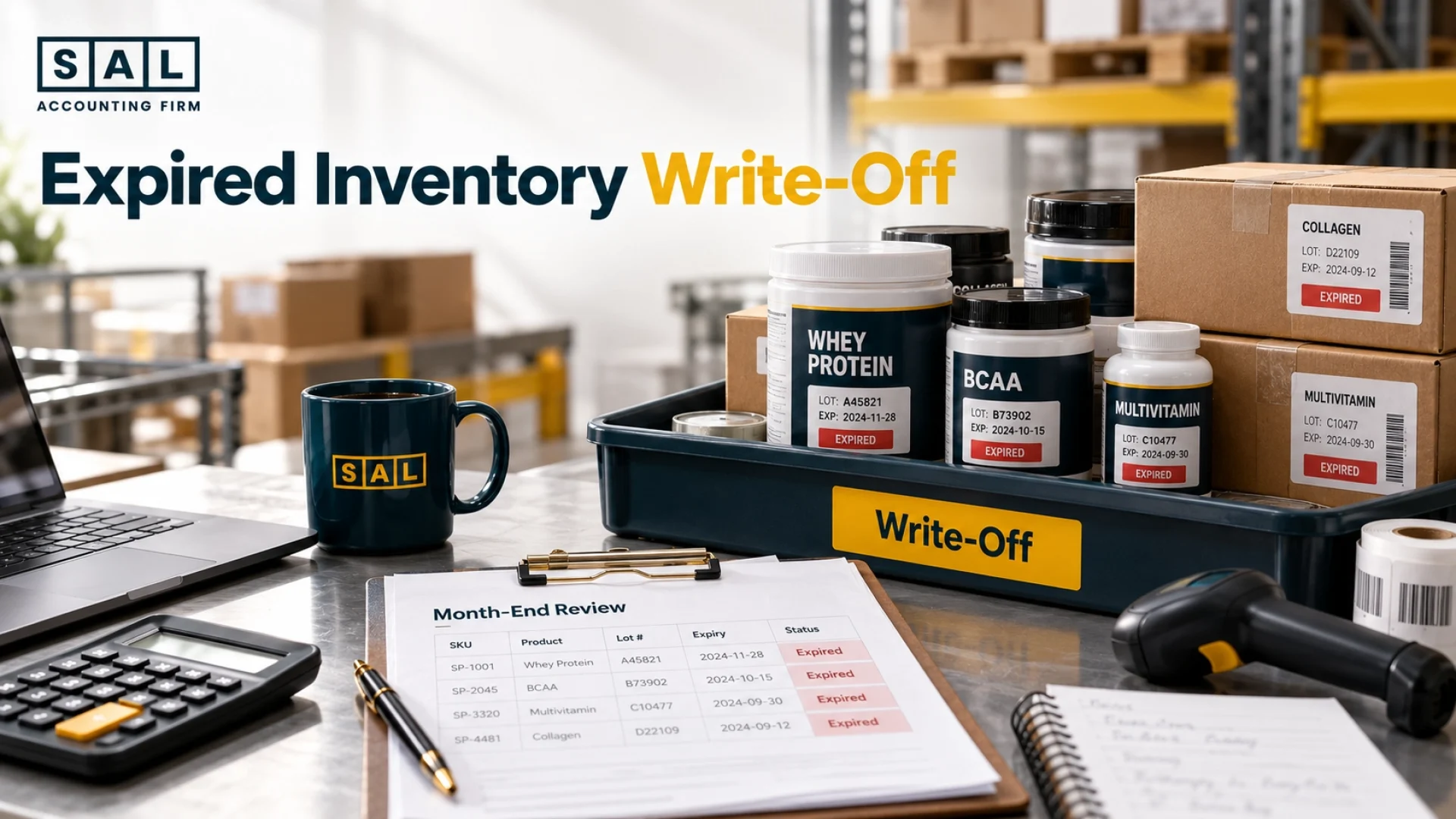
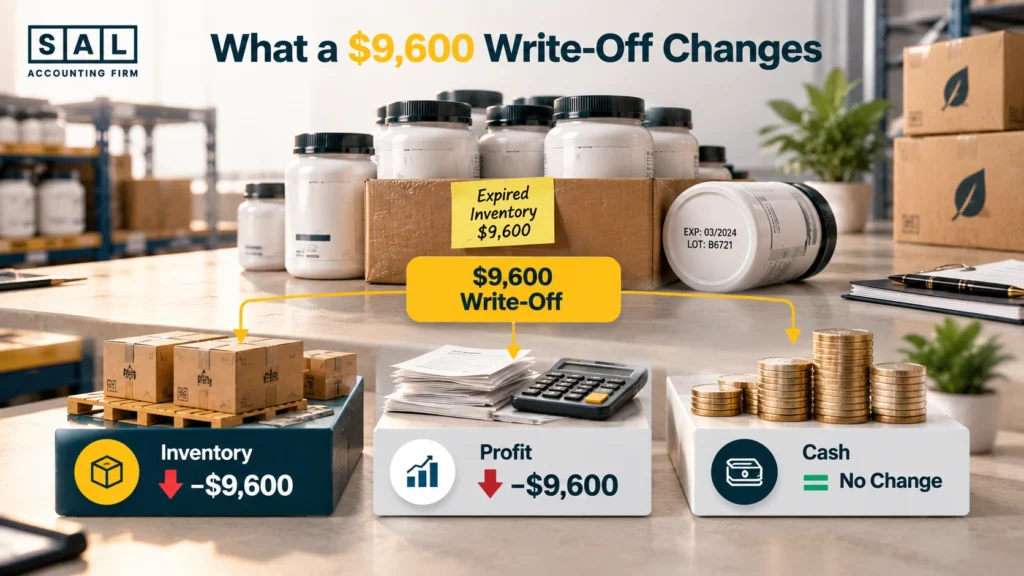
Your warehouse flags 800 protein tubs as expired, but your books still show them at their full $9,600 cost. That gap matters: overstated inventory makes your balance sheet look stronger and your profit look better than they really are.
Here’s how SAL Accounting approaches it: value what’s still recoverable, record the write-down or write-off, and keep the Canadian tax side separate from your financial statements. Give this five minutes before month-end, and your inventory numbers will hold up.
Want to see what a write-off does to your earnings? Run the numbers through the Ecommerce EBITDA Calculator.
Quick Takeaways
- Expired, damaged, or failed stock can stay in your books at full cost long after it stops being sellable.
- A write-down reduces inventory to what you can still recover. A write-off removes it entirely.
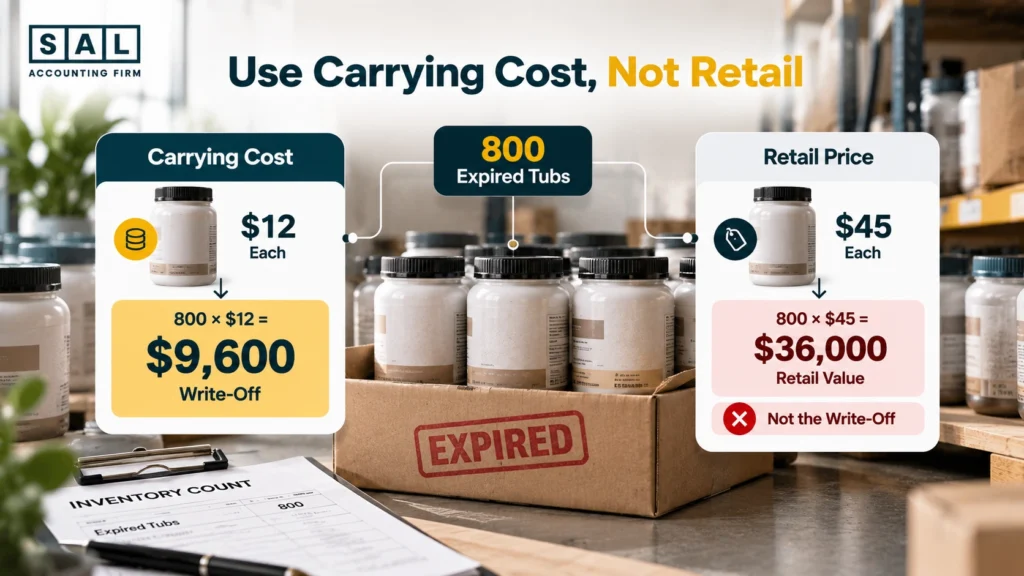
- Calculate the loss from carrying cost, not retail price.
- Marking stock unavailable in Shopify or Amazon doesn’t change your general ledger.
- A write-off reduces profit but doesn’t use any new cash.
- Income tax valuation follows its own rules, separate from your financial statements.
- Keep lot numbers, expiry dates, counts, and approvals for every adjustment.
Want inventory values you can trust at every month-end? Our ecommerce bookkeeping expert reconciles your stock records with your books, so expired products don’t sit on your balance sheet at full cost.
When Does Online Supplement Inventory Become Unsellable?
Supplement inventory becomes unsellable when its condition, expiry, or quality means you can no longer sell it as intended. Common examples for online supplement brands:
- Expired vitamin bottles, capsules, and protein powders
- Damaged containers, broken seals, or compromised packaging
- Products that fail quality checks
- Customer returns that can’t be resold
- Recalled batches that can’t go back on sale
- Near-expiry stock that can still sell, but only at a discount
It helps to separate three situations. Slow-moving stock still sells, just slowly. Temporarily unavailable stock, like a batch on quality hold, may return to sale. Genuinely unsellable stock won’t. Only the last group, and sometimes discounted near-expiry stock, raises a valuation question.
The key idea: inventory can still sit on a shelf while its recoverable value drops. For natural health products, Health Canada’s labelling rules require a lot number and expiry date on the label, which makes it easier to identify exactly which units are affected. Not every product sold as a supplement falls under those rules, though, so check how your products are regulated. How inventory is tracked and valued day to day is the wider job of supplement inventory accounting.
What Is the Difference Between an Inventory Write-Down and a Write-Off?
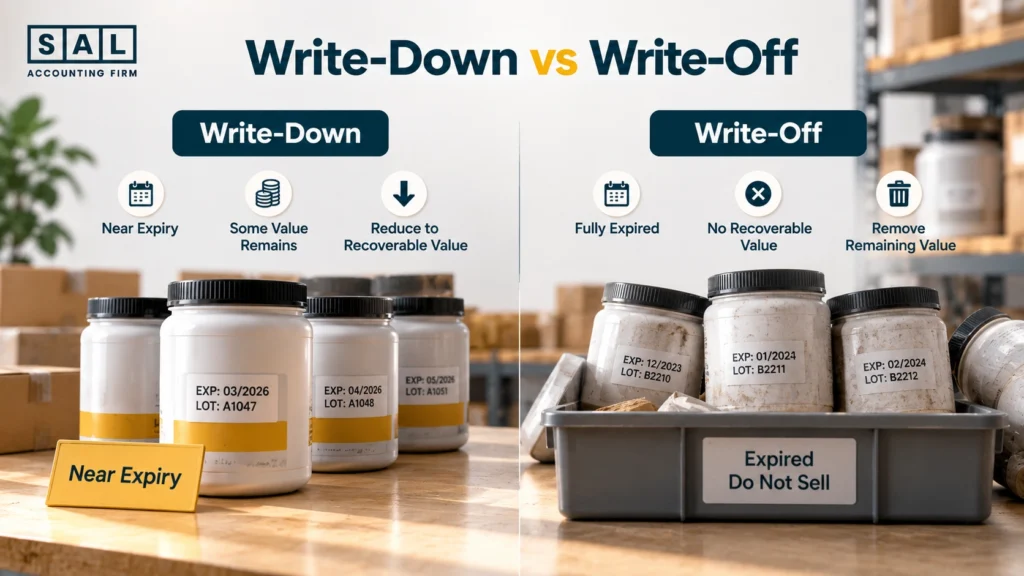
A write-down reduces inventory to what you can still recover, while a write-off removes its value entirely.
- Inventory write-down: you lower the carrying value because you expect to recover less than the recorded amount
- Inventory write-off: you remove the remaining carrying value because the inventory has no recoverable value
The deciding number is net realizable value (NRV). That’s the price you expect to sell at, minus the costs needed to complete and make the sale. Here’s how it plays out for a supplement brand:
- A near-expiry greens powder that can still be sold legally at a discount has a positive NRV, so it may need a write-down
- A fully expired batch that can’t be sold or recovered has an NRV of zero, so it needs a full write-off
Under the international standard IAS 2, inventory is measured at the lower of cost and net realizable value. That standard applies where IFRS is used. Many Canadian private companies report under ASPE instead, so confirm which framework your books follow.
Case Study: How Sarah’s Greens Brand in North York, Toronto Writes Down Near-Expiry Stock1
Sarah sells a greens powder online from a small office in North York, Toronto. At year-end, she has 1,200 tubs that expire in four months. Each tub cost $10, so her books show them at $12,000.
The problem: At four months from expiry, the tubs won’t sell at full price. Her plan is a clearance sale at $8 per tub, with about $1.50 per tub in fees and shipping. Her books still treat them as if they’re worth full cost.
What we do: We work out the net realizable value: $8 selling price minus $1.50 selling costs, or $6.50 per tub. Since that’s below the $10 cost, the tubs need a write-down of $3.50 each, or $4,200 in total. We record it and document the clearance plan behind it.
The result: Sarah’s inventory now shows $7,800 for those tubs, which is what she can realistically recover. Her year-end numbers reflect the real loss, and the clearance sale goes ahead with no surprises.
How Do You Calculate the Value of Expired Supplement Inventory?
Calculate the loss from the inventory’s carrying cost, never from its retail price. Carrying cost is what the inventory is recorded at in your books. For supplements, that usually includes:
- Purchase or manufacturing costs
- Eligible inbound freight and duties
- Packaging that’s part of the product
- Other eligible costs needed to bring the inventory to its current location and condition
Advertising and ordinary selling costs don’t become part of inventory cost. Here’s the running example:
- 800 expired protein tubs
- $12 carrying cost per tub
- No remaining recoverable value
800 × $12 = $9,600
That’s a $9,600 inventory loss. If those tubs retail for $45, the loss isn’t $36,000. You lose what the tubs cost you, not what you hoped to sell them for.
If some value remains, for example if a liquidator would pay $2 per tub, the loss shrinks. Value of $1,600 remains, so the adjustment becomes $8,000.
How Do You Record Expired Inventory in Your Online Store’s Accounting Records?
Record a journal entry that moves the lost value out of inventory and into an expense. Work through these steps:
- Identify the affected SKU, batch, and quantity
- Confirm the recorded carrying amount
- Decide whether any value is still recoverable
- Approve the adjustment and keep the supporting evidence
- Record the journal entry
- Reconcile the adjusted balance with your inventory records
For a full write-off of the 800 tubs, with no recoverable value, the entry is:
Debit: Inventory write-off expense, $9,600
Credit: Inventory asset, $9,600
The credit lowers your inventory asset, because those tubs no longer have value. The debit records the loss as an expense. The exact account names depend on your reporting framework and accounting policy.
One common gap: changing stock in Shopify, Amazon, or your 3PL doesn’t update your accounting records by itself. In Shopify, marking stock as damaged or failing quality control moves it to Unavailable, and your inventory adjustment history shows why the quantity changed. That’s useful evidence, but the journal entry still has to be made in your books.
Pro Tip: When you mark stock as damaged or unsellable in Shopify, export the adjustment history right away. Shopify only shows the last 180 days, and you’ll want it for your records.
How Does Expired Inventory Affect COGS, Gross Profit, and the Balance Sheet?
A write-off lowers your inventory and your profit by the same amount, without using any new cash. With the $9,600 example, the adjustment:
- Reduces your inventory asset by $9,600
- Records a $9,600 expense
- Reduces profit before income tax by $9,600, assuming nothing else changes
- Doesn’t create a new cash outflow when you post it
The cash was spent when you bought or manufactured the tubs. The write-off only recognizes that the money won’t come back.
Where the expense appears changes how your numbers look. If you include the write-off in cost of goods sold, your gross profit drops. If you show it as a separate expense, gross profit stays higher, but overall profit still reflects the loss. Pick one approach and use it consistently, so your margins stay comparable month to month. How product costs normally flow into COGS is covered in COGS for supplement brands.
Watch for double-counting, too. Expired stock often sits in a warehouse for weeks before disposal. If it’s already written off, make sure it isn’t counted again at your next stock count.
Can a Canadian Online Supplement Business Deduct Expired Inventory for Tax?
Often, yes, but the tax result comes from Canada’s inventory valuation rules, not from your write-off entry.
For income tax, your year-end inventory value directly affects your business income. Under section 10 of the Income Tax Act, inventory of a regular business is generally valued at the end of the year at the lower of cost and fair market value, or in a prescribed manner. CRA explains that you can value your inventory in one of two ways:
- Value your entire inventory at fair market value
- Value individual items, or classes of items, at cost or fair market value, whichever is lower
For items valued at the lower of cost and market, CRA will generally accept net realizable value as market, meaning the normal selling price less reasonable, predictable selling costs.
So a lower year-end inventory value can reduce taxable income. But a financial-statement write-off doesn’t automatically mean a separate tax deduction of the same amount. The tax result depends on your valuation method, your circumstances, and the evidence behind the value. You also generally need the Minister’s approval to change your valuation method, so keep it consistent.
What Records Should a Supplement Store Keep for an Inventory Write-Off?
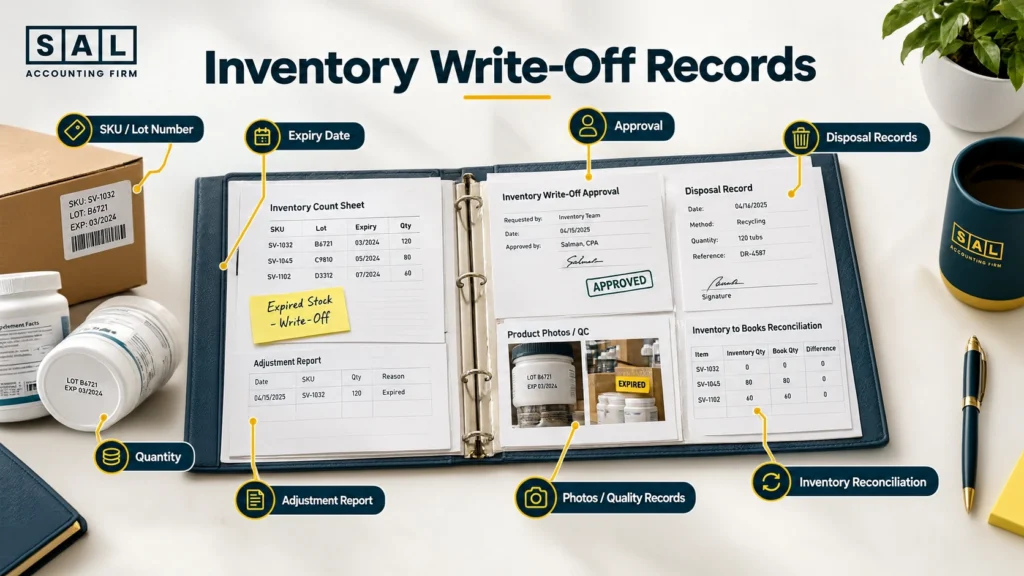
Keep enough evidence that someone else could trace exactly what was written off and why. For every adjustment, keep:
- Product SKU and batch or lot number
- Expiry date or the reason the product became unsellable
- Quantity affected
- Carrying value per unit
- Warehouse, Amazon, or Shopify adjustment reports
- Internal approval of the write-off
- Photos or quality-control records, where relevant
- Destruction, disposal, or supplier credit documents, where they apply
- The reconciliation between your inventory records and your books
A journal entry on its own, without this support, makes the loss hard to verify later. Lot-level tracking makes all of this much easier. If your system can’t show which lot sits where, it may be time to compare inventory software for supplement brands.
How Can Online Supplement Stores Keep Unsellable Inventory Out of Their Financial Reports?
Review inventory value against product condition before every period closes. A simple routine:
- Identify affected SKUs and batches regularly
- Compare product condition and saleability with the value in your books
- Decide which products need a valuation adjustment
- Approve and record the changes
- Reconcile inventory reports with your accounting records
- Review inventory balances before the period closes
This matters most when stock is spread across several places, like your own warehouse, a 3PL, and Amazon FBA. Each system reports differently, and expired units can hide in any of them. Building the review into a regular month-end close for supplement brands keeps it from slipping.
Case Study: How Mike’s Supplement Brand in Mississauga Finds Expired FBA Stock2
Mike sells collagen and sleep supplements online from a warehouse unit near Square One in Mississauga. Most of his stock sits at Amazon FBA. His books show inventory at full cost across all locations.
The problem: At quarter-end, his Amazon reports show 350 units marked unfulfillable because they’re past their expiry date. In his books, those units still sit in inventory at $14 each, or $4,900 in total. Nobody had connected the Amazon report to his general ledger.
What we do: We match his Amazon inventory reports to his books by SKU and lot. We confirm the 350 units have no recoverable value, record a $4,900 write-off, and file the Amazon report and disposal records as support. Tying FBA reports to the books each quarter is now part of what our Amazon bookkeeping team handles for him.
The result: Mike’s inventory balance now matches what he can actually sell. He reviews FBA unfulfillable stock every quarter, so expired units never pile up unnoticed again.
Final Thought: Can You Explain the Value of Your Remaining Inventory?
The real question isn’t how many expired units are still in storage. It’s whether your balance sheet shows a value you can actually recover. Identify unsellable products early, measure the loss from carrying cost, record the right adjustment, and keep the evidence behind it. Then treat the tax side on its own terms.
Clean inventory numbers make your next buying decision easier, and our free step-by-step roadmap helps you plan it with confidence.