
Not sure if your prices are leaving money on the table? You’re not the only one.
A lot of e-commerce founders we work with set their prices once when they launched, and haven’t really touched them since. Then margins drift, competitors undercut, and ad spend feels like it’s buying revenue instead of profit.
Basically, pricing is the most leveraged decision in your store. A small price change can make a big difference when fees, shipping, product costs, and ad spend are already tight. It’s where most of our e-commerce clients leave easy money behind. This guide from SAL Accounting walks through the top ecommerce pricing strategies, the math, and a 90-day plan.
Quick Takeaways
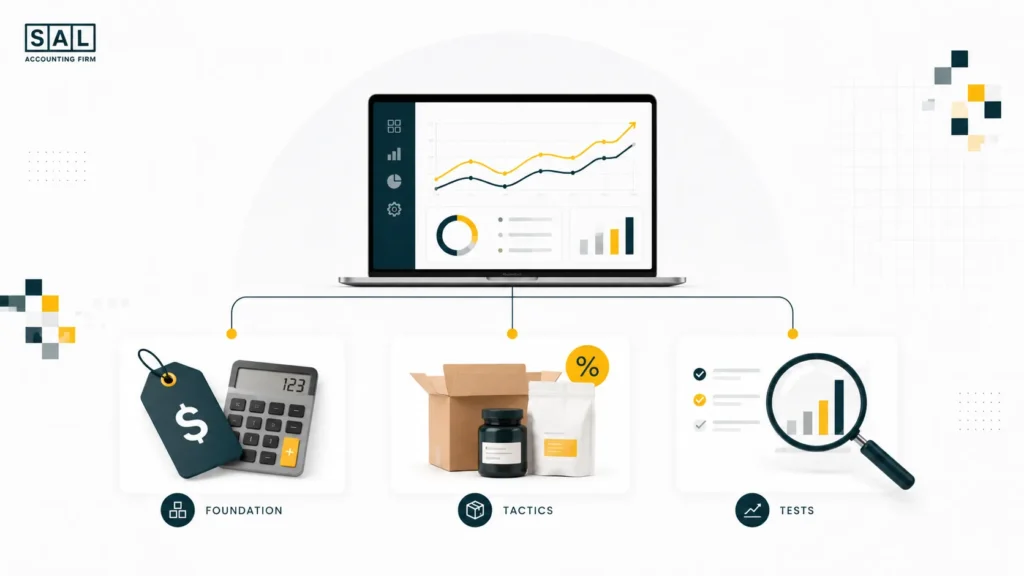
- The best pricing strategy for ecommerce isn’t one strategy, it’s a layered system: foundation + tactics + tests.
- Price off contribution margin (CM2), not markup. The number that matters is what’s left after fees, shipping, and ad spend.
- Dynamic pricing ecommerce is fine when it’s based on demand and inventory. It’s not fine when it’s based on personal attributes.
- Value-based pricing ecommerce beats cost-plus once you have brand, reviews and a clear reason people choose you.
- For Canadian sellers, FX and US sales tax change real margin before you even start. The GST/HST refund calculator is a useful starting point.
We boost ecommerce profits by 21% by saving taxes. Do you want a free tax strategy consultation call?
What Is an E-commerce Pricing Strategy?
An ecommerce pricing strategy is the system a store uses to decide what each product sells for, when to discount, and how to package offers. Basically, the strongest systems have three layers: a foundation method (cost-plus or value-based), tactics on top (bundles, anchors, charm pricing), and ongoing tests.
If your pricing is mostly “what competitors charge, minus a bit,” you’re not alone. A lot of stores start there. Easy fix once you know what to look for.
What Are the Best Pricing Strategies for E-commerce?
The best pricing strategy for ecommerce depends on your category, channel, and stage. Most brands run two or three pricing models at once.
| Strategy | Best For | Pros | Risks |
| Cost-plus | New SKUs, commodity products | Simple, protects floor margin | Ignores willingness to pay |
| Value-based | Branded DTC, differentiated products | Highest margins | Needs strong positioning |
| Dynamic | Marketplaces, seasonal products | Captures peak demand | Can feel unfair if rules aren’t clear |
| Penetration | New market entry | Builds reviews fast | Hard to raise price later |
| Skimming | Premium launches | High early margin | Smaller audience |
| Psychological | Mass-market, impulse products | 1–5% conversion lift | Diminishing returns |
| Bundle | Stores with attach rate | Lifts AOV, clears slow SKUs | Margin erosion if priced wrong |
| Tiered / subscription | Consumables, repeat purchases | Predictable revenue, higher LTV | Churn becomes the new problem |
Pro Tip: The right mix depends on what you sell, where you sell, and how much margin you actually keep after costs.
How to Price Products Online: 2 Formulas You Need
A lot of founders mix up markup and margin. They’re different numbers, and mixing them up is how stores quietly lose money. Easy fix once you see it.
Also for a quick read on your Shopify fees before you set price, the Shopify fee calculator gives you the exact deduction per order.
Markup vs. Margin
Let’s say your product costs $20 and you sell it for $50. The $30 you keep is the same, but the percentage looks very different:
- Markup % = (Price − COGS) / COGS = 150%
- Margin % = (Price − COGS) / Price = 60%
Same product. Same price. Two very different numbers. The point is, always talk margin internally, not markup. Markup can make your numbers look healthier than they actually are.
Contribution Margin (CM1 and CM2)
Margin is just the start. The number that actually drives the business is contribution margin: what’s left after every variable cost of selling that unit.
- CM1 = Price − COGS − payment fees − marketplace fees − shipping
- CM2 = CM1 − variable marketing cost (CAC on that order)
In simple terms, CM2 shows how much money is left from an order after the main costs of selling that order are removed. It helps you see whether a product is actually profitable after the real costs of selling it. A product can look good in sales, but if CM2 is low or negative, you may not be keeping much money from each order.
For the COGS side, the COGS guide for e-commerce stores covers landed cost, and the e-commerce financial statements guide shows where these numbers belong in your P&L.

Pro Tip: Build a CM2 view per SKU once a quarter. Most stores find that 20% of their SKUs are dragging the catalog down. Reprice or cut those, and blended margin can move fast.
Top 7 eCommerce Pricing Strategies for Online Stores
Before you pick a pricing tactic, it helps to understand the main ecommerce pricing strategies and where each one actually fits.
1. Cost-Plus Pricing vs. Value-Based Pricing
Every pricing system needs a foundation method. Really, there are only two.
Cost-Plus Pricing
Take your fully landed cost, add your target margin, and set the price. Simple, practical, and it’s where most stores start.
There’s nothing wrong with cost-plus pricing. The issue is that it tells you what you need to survive, not what customers may actually be willing to pay.
Value-Based Pricing Ecommerce
Here’s the difference. Say a supplement costs you $9 to make. Cost-plus might land you at $25. But if the brand, reviews, and packaging signal it’s worth $48, that’s your real price. Technically, you’re leaving money on the table at $25.
Value-based pricing in ecommerce works once you have reviews, differentiated positioning, and a clear before/after for the customer.
Pro Tip: If your reviews keep saying things like “worth every penny” or “wish I’d bought it sooner,” you’re probably underpriced. Test a small increase before assuming volume will fall.
2. Dynamic Pricing
Dynamic pricing in ecommerce means your price changes based on signals like demand, inventory, competitor pricing, timing, or stock-out risk. Amazon does this constantly. For Shopify and DTC brands, competitive pricing tools like Prisync, Repricer, and Intelligems handle the same logic.
Now, the important part: be careful with how you use it.
Pricing based on demand, inventory, time, or market conditions is fine in Canada and the US. The risk starts when pricing feels personal, unclear, or unfair to the customer.
The point is, used well, dynamic pricing can protect margin in peak demand. Used badly, it can train customers to wait for the next drop.
3. Psychological Pricing and Anchor Pricing
These are lightweight levers that work in almost every category. They’re useful, but they should sit on top of a stronger pricing foundation.
- Charm pricing (.99 endings): This is the classic .99 ending. For example, $49.99 instead of $50. It can work well for mass-market and impulse products. But the effect usually shrinks for premium products. A $9.99 bottle of wine, for example, can signal “cheap wine.”
- Anchor pricing: It means showing a higher-priced item first to make the next option feel more reasonable. The classic Good / Better / Best menu works because “Best” makes “Better” look like a bargain.
- Decoy pricing: $9 for 8oz, $14 for 16oz, $15 for 32oz. Most people pick the 32oz because it feels like the obvious deal.
Pro Tip: Psychological pricing can help conversion, but it is not the foundation. It supports the pricing system. It does not replace it.
4. Bundle, Tiered, and Subscription Pricing
These three tactics can lift AOV and LTV at the same time.
Bundle Pricing
Let’s say you sell three products at $20 each. Sold separately, that’s $60. If you bundle them for $54 and the total COGS is $21, you still have a strong margin.
Basically, a bundle pricing strategy works when the discount encourages a bigger order without eating too much profit. It can help move slower products, lift AOV, and make the offer easier for customers to say yes to.
Tiered Pricing
Tiered pricing usually means Good / Better / Best. Most customers default to the middle. So here’s the trick: make the middle option your highest-margin SKU. Anchoring does the work.
Subscription Pricing
Subscription pricing usually means giving customers a small discount in exchange for repeat orders. That can work well for products people buy again and again, like skincare, supplements, or coffee.
The trade-off is that you now need to watch cancellations closely, because monthly revenue only helps if customers keep coming back.

Pro Tip: Subscriptions change how the bookkeeping works. Revenue timing, refunds, and monthly reporting need to be set up correctly from day one. Our Shopify accounting services handle this.
5. Penetration Pricing vs. Price Skimming
Penetration vs skimming pricing comes down to how you want to enter the market.
- Penetration pricing enters under the competition to grab share and reviews fast. It can work well for commodity products or new stores that need early momentum.
- Price skimming launches at a higher price, captures more margin from early buyers, then drops over time. This works better when your product feels premium, differentiated, or hard to compare.
Keep in mind, this is mostly a launch decision.
No reviews + commodity → penetration.
Strong brand + premium → skim.
6. Marketplace Pricing and MAP Policies
Selling on both your own store and a marketplace? You need a clear rule for which channel gets what price.
- Channel conflict. When Amazon is cheaper than Shopify, customers buy on Amazon at a worse margin. When Shopify is cheaper, Amazon may see your listing as less competitive and reduce visibility. Either way, pricing gets messy fast.
- MAP policy. If you use resellers, a MAP policy ecommerce framework sets the lowest price they can advertise. It doesn’t set a minimum sale price (that’s price fixing), but it stops the race to the bottom on Google Shopping and Amazon.
- The practical rule. Most multi-channel brands set Amazon as the list price, then reward DTC customers with bundles, subscriptions, or free shipping instead of direct discounts.
For the accounting side, see our bookkeeping for Amazon sellers and tax planning guide.
7. Free Shipping Threshold Pricing
Free shipping is a pricing decision, not a marketing one.
Let’s say your average order value is $48 and shipping costs you $9. Setting free shipping at $60 can push more customers to add one more item instead of checking out too early. That can be a real lift.
Now, the rule of thumb: set your free shipping threshold around 20–30% above your current AOV, and make sure it is still high enough to protect your margin.
Pro Tip: For Canadian sellers shipping into the US, also factor in cross-border ecommerce shipping costs that can increase with customs, duties, and delivery zones.
How Can You Run E-commerce Price Testing?
Ecommerce price testing is not the same as testing a button colour. Different prices to different customers can break trust and, in some places, the law. Keep in mind, you cannot treat price like a small design experiment.
Three test types are usually safer and more practical:
- Sequential tests: Raise prices on day 1, measure conversion vs. baseline for two weeks.
- Cohort tests: Apply a new price to one traffic source or new customer group while keeping the existing price elsewhere.
- Bundle and offer tests: Bundles are new offers, so different bundle prices to different customers is fair game.
Competitive pricing tools like Intelligems and Prisync can help, but the tool is not the main thing. The main thing is clean margin data underneath the test.
The point is, track conversion, AOV, and CM2, not just revenue. Higher revenue with lower CM2 means you’re working harder for the same profit. See our best e-commerce accounting software guide for platforms that surface CM2 cleanly.
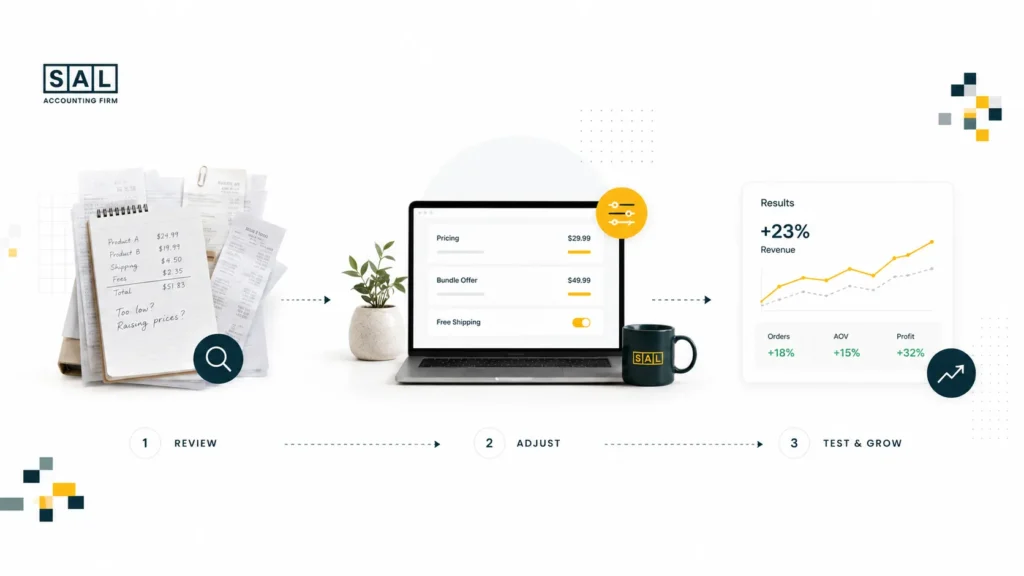
The 90-Day E-commerce Pricing Optimization Plan
You don’t need to fix every price at once. Start by finding the biggest leaks first.
Days 1–30: Baseline
Look at your main products one by one. Check the selling price, product cost, fees, shipping, and ad spend. The goal is to spot products that sell well but do not leave much profit behind.
Days 31–60: Foundation and Tactics
Start with the clearest fixes. You might raise the price on a strong product, create a bundle, adjust your free shipping threshold, or test .99 pricing. Basically, make small pricing changes you can actually measure.
Days 61–90: Test and Scale
Test one or two changes, then watch what happens to sales, order value, and profit. The point is, don’t judge by revenue alone. A pricing change only works if you keep more money after costs.
Case Study: Toronto Skincare Brand Lifts Net Margin 7 Points1
Maya runs a Toronto skincare brand on Shopify. She gets about 1,200 orders a month, and more than half of her sales come from the US.
The problem: sales kept coming in, but Maya couldn’t clearly see how much money she was actually keeping. Ads cost more, shipping cost more, and a few lower-priced products barely left any profit.
How We Helped: SAL helped Maya see which products were worth selling more of, and which ones needed a price change. Together, SAL and Maya raised the main product price, created a 3-pack bundle, added a subscription option, and increased the free shipping minimum.
The result: profit margin moved from 11% to 18% in 90 days. Sales dipped slightly, but Maya kept more money from each order because the prices finally matched the real cost of selling.
Please remember that you can always get a free consultation with our expert ecommerce stores tax accounting team.
How SAL Accounting Can Help
The best ecommerce pricing strategies are not just marketing decisions. They’re finance decisions too.
That’s where most e-commerce brands lose money. The brand picks a price. The bookkeeper records the sale. But nobody connects the price back to product cost, fees, shipping, ad spend, and real margin until the numbers already feel messy.
That’s the gap we close. SAL Accounting specializes in Canadian e-commerce brands selling cross-border, and pricing without a clear margin picture is one of the most common reasons our clients come to us.
Book a free tax strategy call and we’ll show you where pricing, fees, shipping, and ad spend may be squeezing your margin, so you know what to review first.
- Hypothetical scenario. Numbers are illustrative. ↩︎