
Apparel accounting gets tricky because fashion gets tricky because fashion does not move in a straight line. You buy inventory before you sell it, discount some pieces to clear space, take returns after the original sale, and still need to know which products actually made money.
At SAL Accounting, we help ecommerce sellers make sense of that full picture. This apparel accounting guide shows how clothing boutique bookkeeping should handle inventory, COGS, markdowns, returns, and cash flow without making your reports harder to understand.
Quick Takeaways
- Clothing boutique bookkeeping needs SKU-level detail because size, colour, season, and channel all affect profit.
- Online boutique accounting should connect inventory, COGS, payouts, refunds, tax, and cash flow.
- Apparel COGS and inventory should include the real cost of getting products ready to sell, not just the supplier price.
- Markdowns can make revenue look strong while quietly shrinking profit.
- Returns, exchanges, store credit, and damaged items need their own tracking.
If Shopify is your main channel, start with the Shopify Fee Calculator. It helps you see how fees affect what you actually keep from each sale.
What Makes Clothing Boutique Bookkeeping Different From Regular E-commerce Accounting?
Clothing boutique bookkeeping gets messy faster than many other product businesses. A candle store may sell one scent in one size. A boutique might sell one dress in five sizes, four colours, two seasons, and three sales channels. That means more SKUs, more returns, more markdowns, and more inventory decisions. The common trouble spots are:
- size and colour variants
- seasonal collections
- markdowns and clearance sales
- returns and exchanges
- landed cost
- Shopify, Amazon, wholesale, and POS sales
- GST/HST and US sales tax
- old inventory sitting too long
This often connects to e-commerce payment reconciliation, because the issue is not just the sale. It is what happened between the platform, the payout, and the bank.
If your numbers are already getting harder to trust, SAL can help with bookkeeping for ecommerce stores so your reports reflect what actually happened in the store.

How Should Online Boutique Accounting Track Inventory and COGS?
Online boutique accounting should treat inventory as an asset until the product sells. Once it sells, the cost moves into COGS, which means the cost of goods sold. The IRS explains that businesses that buy, make, or sell goods need beginning and ending inventory values to figure out cost of goods sold in its small business tax guide. A simple version looks like this:
Beginning inventory + purchases + landed costs – ending inventory = COGS
This tells you what the products you sold actually cost. But apparel needs more care than a basic formula.
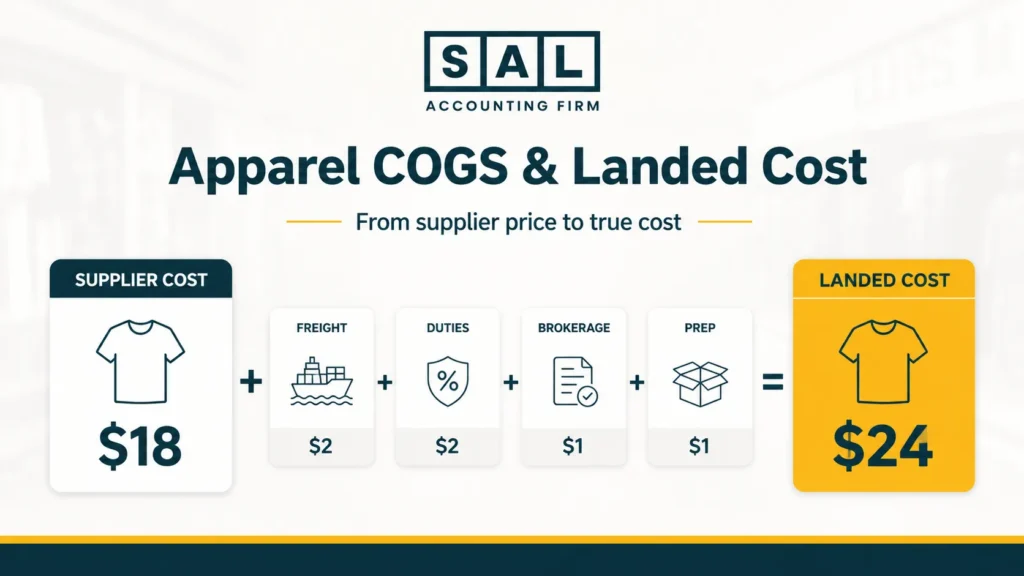
Example: If you buy a dress for $18, that may not be the real cost. Freight, duties, brokerage, and prep might push the real cost to $24. If your reports still use $18, your profit looks better than reality.
For Shopify sellers, this connects to COGS for Shopify, because product cost has to match what was actually sold. Broader stores may also need a clear method for calculating COGS for e-commerce so product costs do not get buried inside general expenses.
What Costs Should Be Included in Apparel COGS and Inventory?
Apparel COGS and inventory should include the costs needed to get products ready to sell. Not every expense belongs in COGS. Paid ads, software, and owner salary usually do not belong there. Freight, duties, brokerage, and prep often do. Here’s a simple view:
| Cost | Include? | Why | Example |
| Supplier cost | Yes | Product base cost | $18 dress |
| Inbound freight | Usually | Gets stock to you | $900 shipment |
| Duties/brokerage | Usually | Import cost | Customs fees |
| Paid ads | No | Selling cost | Meta ads |
This is where Shopify inventory accounting matters. If the inventory number is wrong, your margin will be wrong too.
Pro Tip: Do not wait until year-end to clean up COGS. If freight, duties, or supplier pricing changed this season, update your product costs before you review margin.
Case Study: How a Liberty Village Boutique Gets Clear on Apparel COGS and Inventory1
A clothing boutique in Liberty Village, Toronto sells seasonal dresses, basics, and accessories through Shopify and weekend pop-ups. Sales look healthy, especially during new collection launches. But when the owner checks profit, the numbers feel off. Some products look profitable in Shopify, but cash still feels tight after freight, duties, packaging, and leftover inventory are paid.
The Problem
The boutique tracks supplier cost, but not full landed cost. Freight, duties, brokerage, and prep sit in different expense categories, so the owner cannot see the real cost of each product.
What We Do
We rebuild the inventory setup around SKU-level costing. Each product variant gets a cleaner cost, including the right share of freight, duties, and brokerage. Shopify, pop-up sales, and accounting records are mapped so COGS follows what actually sold.
The Result
The owner can see which collections are truly profitable. Pricing decisions become clearer, markdowns feel less random, and cash flow makes more sense because inventory cost is no longer hidden across different expense lines.
What Is Landed Cost for Apparel, and How Do Duties and Freight Affect Margin?
The landed cost is the full cost of getting inventory into your hands and ready to sell. For apparel, landed cost duties and freight matter because imported products often carry extra costs that do not show up on the supplier invoice. A simple landed cost formula is:
Product cost + freight + duties + brokerage + insurance + prep = landed cost
Example: Let’s say you order 500 dresses:
- supplier cost: $9,000
- freight: $1,200
- duties and brokerage: $1,600
- handling: $200
Total landed cost: $12,000. That means each dress costs $24, not $18.
The CBSA has guidance for businesses importing goods into Canada under its commercial import resources. It also explains tariff classification and duty rates under its customs tariff page.
If your inventory system only carries the supplier cost, your gross margin can look stronger than it really is.
How Should Fashion E-commerce Accounting Handle Size and Colour Variants?
Fashion e-commerce accounting needs to handle variants properly. A SKU is just a product code. For apparel, a useful SKU tells you the season, product type, style, colour, and size.
Example:
SS26-DRESS-LINA-BLK-M
That could mean:
- Spring/Summer 2026
- Lina dress
- black
- medium
Now, here’s why that matters. The black medium dress may sell out in two weeks. The beige extra-small may sit for five months. If your books only show “Lina Dress,” you lose the detail that helps you buy better next time. Shopify says profit reporting depends on cost per item being recorded, and variants need their own cost data (profit reports guidance).
This is also where Shopify accounting best practices can help, because the goal is not just to connect Shopify to your accounting software. It is to send useful data into the right places.
How Should Apparel Brands Record Markdowns Without Hiding Profit Problems?
Markdowns are normal in fashion. Maybe a colour did not land. Maybe a size curve was off. Maybe winter stock is still sitting there in March. No judgment. This happens. The accounting problem starts when markdowns get mixed into sales with no context. A markdown lowers your selling price. Your product cost usually stays the same. Here’s what that does to margin.
| Sale type | Price | COGS | Margin |
| Full price | $100 | $40 | 60% |
| Light promo | $85 | $40 | 52.9% |
| Markdown | $75 | $40 | 46.7% |
| Clearance | $55 | $40 | 27.3% |
A product can “sell well” and still disappoint if most units moved only after discounts. Track markdowns by:
- product
- collection
- channel
- campaign
- season
This can connect to e-commerce tax deductions, but markdowns are not just a tax issue. They are a margin issue first. The point is simple: do not only ask, “Did it sell?” Ask, “What did we actually keep?”
How Should Clothing Boutiques Handle Returns, Exchanges, and Store Credit?
Returns are part of apparel. People buy two sizes and keep one. Colours look different on screen. Getting fit is hard. Some returned items can be resold, and others cannot.
Retailers expected 15.8% of annual sales to be returned in 2025, totaling $849.9 billion (NRFretail returns report). For returns management, apparel brands should separate:
- refunds
- exchanges
- store credit
- damaged items
- return shipping
- restocking fees
- inventory write-downs
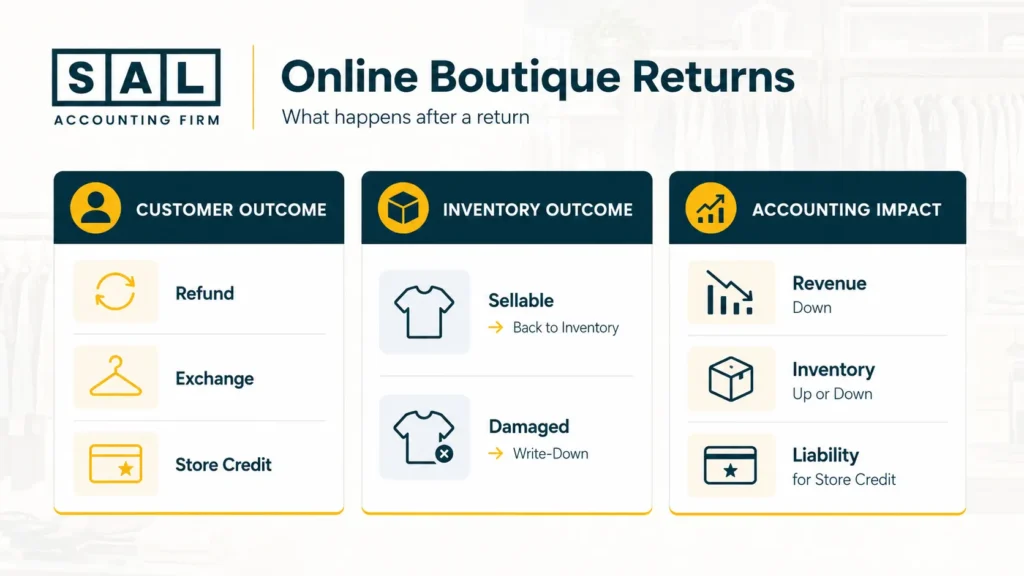
A refund reduces sales. A sellable return may go back into inventory. A damaged return may need to be written down. Store credit is different. If you issue a $120 store credit, that usually stays as a liability until the customer uses it.
This is why Shopify refund policy matters from an accounting angle too. A clear policy helps the customer, but it also helps your team handle refunds, credits, and exchanges consistently.
- Also read: “Shopify Payment Reconciliation Guide”
Case Study: How a Port Credit Apparel Store Handles Returns and Store Credit More Clearly2
An online clothing store in Port Credit, Mississauga sells activewear through Shopify and occasional local events. The store has strong repeat customers, but returns are common because shoppers often buy two sizes and keep one. The owner offers store credit to protect cash, but the monthly reports still look confusing.
The Problem
Refunds, exchanges, and store credits are being treated too similarly. Some returned items go back into inventory, some are damaged, and some customers use store credit weeks later. This makes sales look higher than they really are.
What We Do
We separate refunds, exchanges, store credit, and damaged returns in the bookkeeping flow. Store credit is tracked as a liability until used. Sellable returns go back into inventory, while damaged items are reviewed separately.
The Result
Month-end reports become easier to trust. The owner can see real sales, open store credit, return trends, and inventory value without mixing everything together. That makes it easier to plan cash, reorder stock, and spot products with sizing or quality issues.
What Should Apparel Brands Know About GST/HST and US Sales Tax?
Apparel sales tax depends on where you sell, where your customer is, and which platform handles the order. For clothing boutiques, the main question is not just “Do I charge tax?” It is which tax applies, where it applies, and how it should show up in the books.
GST/HST for Canadian Clothing Boutiques
In Canada, GST/HST usually depends on the customer’s location (GST/HST place-of-supply rules) For example, if your boutique ships orders across Ontario, British Columbia, and Nova Scotia, your tax setup needs to handle different provincial rates properly. Otherwise, your sales reports may look fine, but your GST/HST liability may be wrong.
This often connects to GST/HST return filing in Canada, especially if Shopify is your main sales channel.
US Sales Tax for Apparel Brands Selling Across the Border
If your Canadian boutique sells to US customers, sales tax can depend on nexus. Nexus means your business has enough connection to a US state that you may need to register, collect, and remit sales tax there. That connection can come from sales volume, transaction count, inventory location, or other state-specific rules.
This is where sales tax nexus for e-commerce sellers becomes useful. The goal is to know when US sales tax moves from “something to watch” to “something you need to handle.”
How Sales Tax Should Show Up in Online Boutique Accounting
Sales tax should not be treated like regular revenue. If you collect GST/HST or US sales tax from a customer, that money usually belongs to the tax authority until it is filed and paid. Your books should separate:
- product sales
- shipping income
- discounts
- sales tax collected
- refunds
- marketplace tax collected by Amazon or another platform
- tax still payable
Basically, you want your reports to show what you earned, what you collected for tax, and what still needs to be paid.
For Canadian sellers moving into the US, cross-border tax support can make the next step clearer before sales tax, filings, and reporting start piling up.
What Changes When You Sell Apparel Through Shopify, Amazon, Wholesale, or Pop-Ups?
Not every sale should be treated the same. DTC means direct to consumer. That is usually Shopify, WooCommerce, or POS. Wholesale means you sell to another retailer, often at a lower price and with payment terms. Consignment means another store sells your product, but you may still own the inventory until it sells.
Amazon adds another layer because marketplace fees, refunds, tax reports, and settlements all need to be separated. Amazon explains that its Marketplace (seller report guidance).
Here’s a simple channel view.
| Channel | Main issue | Track clearly | Watch for |
| Shopify DTC | Net payouts | Fees, refunds, tax | Deposits as sales |
| Amazon | Settlements | Fees, tax reports | Mixed deductions |
| Wholesale | Payment timing | AR, credit notes | Unpaid invoices |
| Pop-ups/POS | Daily close | Cash, card, stock | Missing deposits |
This can matter when you are comparing Shopify vs Amazon FBA, because each channel has different fees, payout timing, and reporting.
For Amazon-heavy stores, Amazon FBA bookkeeping is essential because the reports do not look like Shopify reports.
What Should an Online Boutique Month-End Accounting Workflow Include?
Online boutique accounting works best when the month-end follows the same rhythm every time. You do not need a complicated process. You need one you can repeat. Start with these steps:
- Reconcile Shopify, Amazon, POS, and bank deposits.
- Separate gross sales, discounts, refunds, tax, and fees.
- Update inventory received and inventory sold.
- Review landed cost changes.
- Check returns, exchanges, and store credit.
- Review GST/HST and US sales tax reports.
- Look at margin by product, collection, and channel.
- Flag old inventory before it becomes a cash problem.
For Shopify sellers, Shopify month-end close gives this process more structure. If your store uses QuickBooks, Shopify QuickBooks integration can help, but only if the mapping is clean. The point is not to send more data into your books. It is to send the right data into the right places.
- Also read: “Automate Shopify Accounting and Bookkeeping”
What KPIs Should Clothing Boutiques Track to Understand Profit and Inventory?
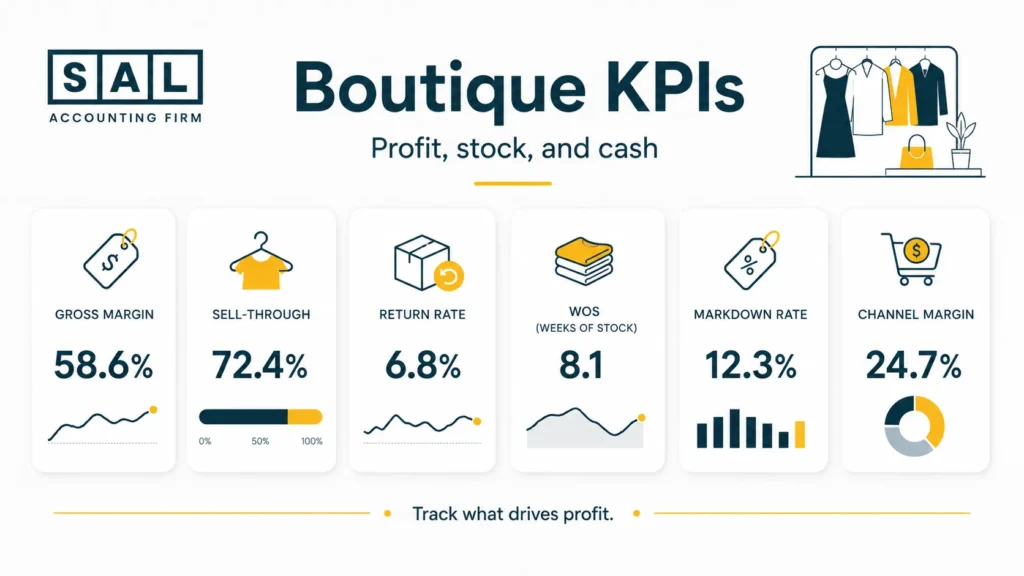
You do not need 40 dashboards. Start with the numbers that explain profit, inventory movement, and cash pressure. Once your inventory, COGS, and expenses are cleaner, the Ecommerce EBITDA Calculator can help you step back from daily sales and look at how the business is really performing. Here’s a simple KPI view.
| KPI | Shows | Why it matters | Watch for |
| Gross margin | Product profit | Pricing clarity | Weak margin |
| Sell-through | Stock sold | Buying accuracy | Slow movers |
| Return rate | Items returned | Fit/quality issues | High returns |
| WOS | Stock length | Cash pressure | Overstock |
Other useful KPIs include:
- AUR, which means average unit retail
- markdown rate
- inventory turnover
- channel margin
- gross margin by collection
Basically, revenue tells you what sold. These numbers tell you whether the sale was actually good for the business. This connects to Shopify cash flow reporting, because fashion stores can look profitable while cash is stuck in unsold stock.
Pro Tip: Review KPIs by collection. A summer accessories drop and a winter coat launch can have totally different return rates, margin, and cash needs.
What Is the Best Tech Stack for Fashion E-commerce Accounting?
The right tech stack depends on your sales channels, SKU count, return volume, and cross-border setup.
- Do not start with tools. Start with the problem.
- If your issue is payout confusion, you need cleaner reconciliation.
- If your issue is stock planning, you need better inventory data.
- If your issue is US sales tax, you need tax tracking.
QuickBooks Canada lists accounting plan options on its pricing page, and Xero Canada does the same on its pricing page. Shopify Tax pricing is listed in Shopify’s Shopify Tax pricing. A practical setup may include:
- Shopify or WooCommerce for orders
- QuickBooks Online or Xero for books
- A2X or Link My Books for payout mapping
- Stocky, Cin7, or Inventory Planner for inventory
- Loop, AfterShip Returns, or ReturnGO for returns
- Avalara, TaxJar, or Shopify Tax for sales tax
Before choosing software, it helps to understand the best e-commerce accounting software.
If Shopify is your main channel and the numbers are starting to feel messy, SAL can help with Shopify accounting so you can see what your store actually keeps after fees, refunds, tax, and product costs.
What Are the Most Common Apparel Accounting Mistakes?
Most apparel accounting issues are fixable once you know where the confusion starts. Here are the ones we see most often:
- recording payouts as total sales
- missing product costs on variants
- ignoring freight, duties, and brokerage
- mixing Shopify, Amazon, wholesale, and POS together
- treating store credit like a refund
- reviewing inventory only at year-end
- burying markdowns inside total sales
- treating Amazon reports like Shopify reports
This is where e-commerce accounting mistakes often show up. The mistake usually is not that the owner ignored the books. It is that the setup was not built for how the store actually sells.
For stores still choosing their setup, best business structure for online retail can also matter, especially if the brand is growing across channels or countries.
Conclusion
A good apparel accounting guide should help you see what your boutique actually keeps after inventory, returns, markdowns, tax, and fees. That clarity matters because fashion moves fast. One late reorder, one weak size run, or one messy return process can change your cash position quickly. Online boutique accounting works best when the numbers match how your store really runs.
If your reports are starting to feel unclear, contact us at SAL Accounting and get a clearer sense of what needs to be fixed next.