
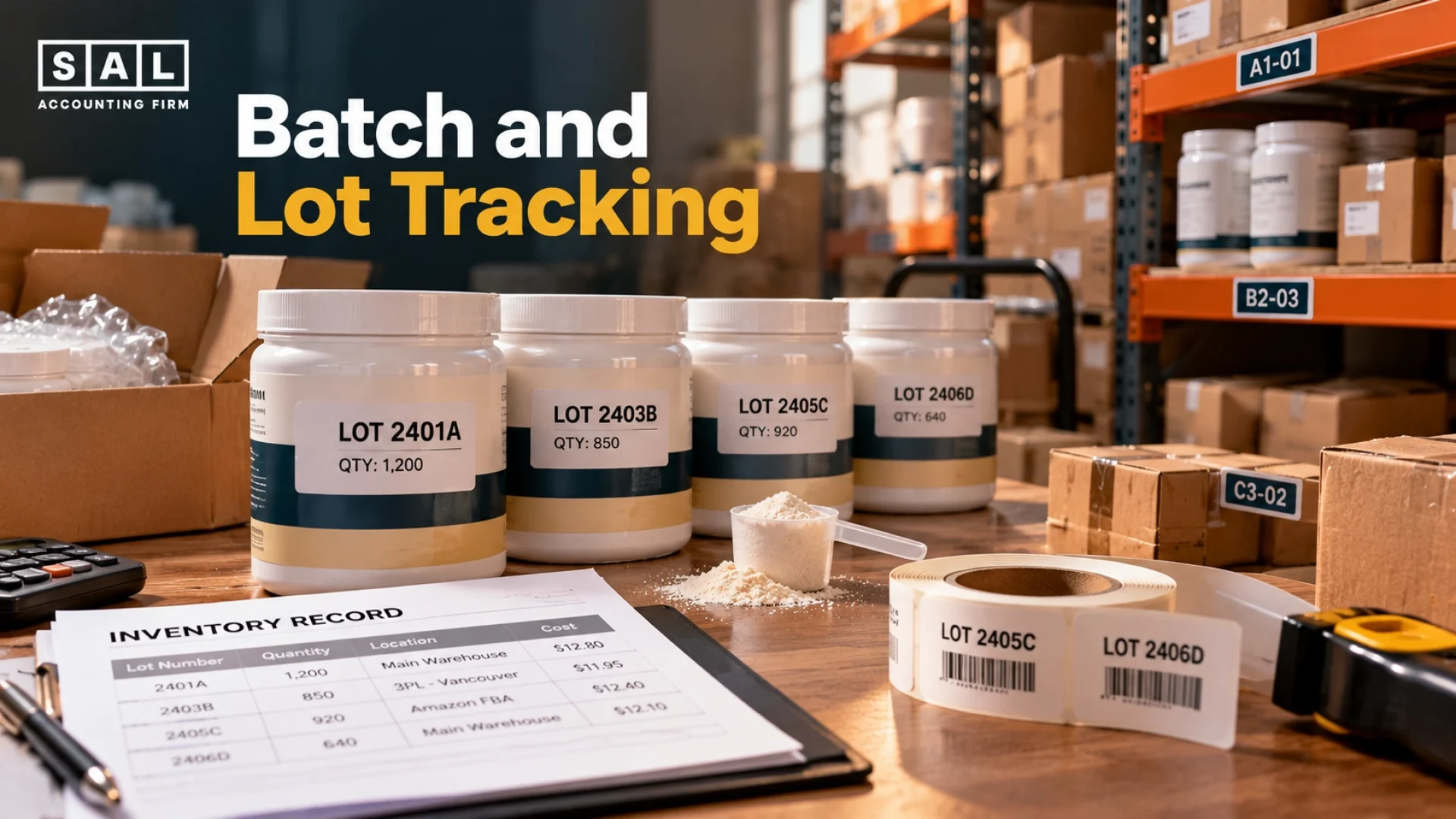
An online supplement store needs batch records that explain stock quantities, movements, and costs. Your 3PL may know exactly which production lot shipped, while your books only show one inventory balance.
At SAL Accounting, that gap is where inventory errors usually hide, even when total stock looks right. Give this five minutes before your next month-end close, and you’ll know which records your accountant needs.
Want to see how inventory costs affect operating profit? Try the Ecommerce EBITDA Calculator with your current figures.
Quick Takeaways
- Lot numbers identify which physical stock moved, sold, or was adjusted.
- Total SKU quantities don’t tell the whole accounting story.
- Batch-level cost records support your inventory value.
- Returns, transfers, samples, and adjustments all need clear records.
- Monthly reconciliation must explain both quantities and values.
Missing stock records can make monthly accounts hard to trust. SAL Accounting’s ecommerce bookkeeping keeps financial records organized across every selling channel.
Why Does Batch and Lot Tracking Matter for Online Supplement Accounting?
Batch and lot tracking gives online supplement stores the records needed to explain inventory movements and accounting balances. A SKU and a lot aren’t the same thing. A SKU identifies the type of product, like a 120-capsule vitamin D bottle. A lot identifies one production group of that product. One SKU can have several lots at once, often in different warehouses. For accounting, the lot record ties together six things:
- The lot number
- The quantity
- Where the product is stored
- Its status, such as available, damaged, or quarantined
- The date of each movement
- Its financial value
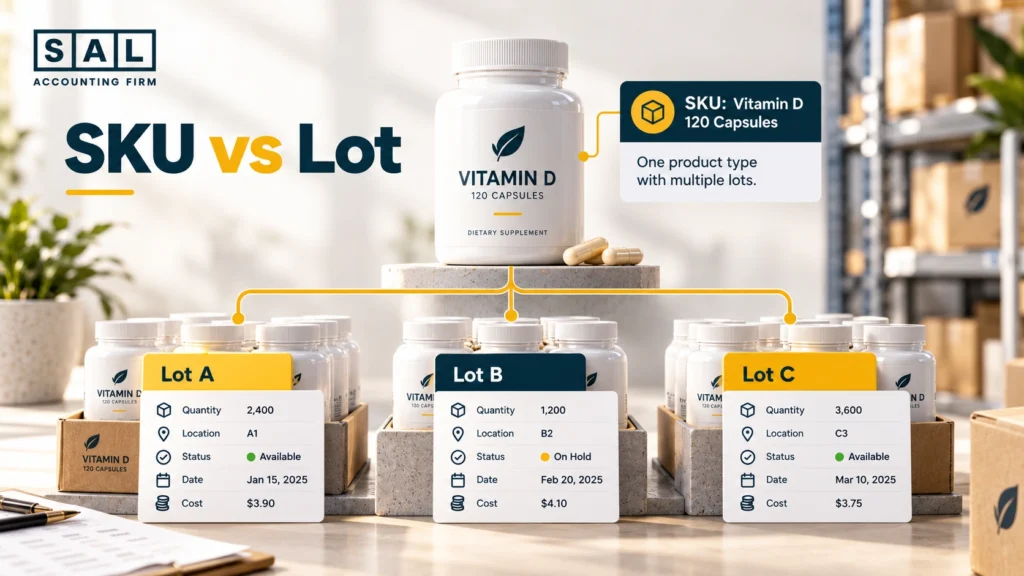
Your storefront may only show 4,000 bottles available. That total can’t tell you which lots were received, sold, returned, or written off, or which transactions changed your inventory balance.
Lot numbers also serve a traceability purpose for regulated natural health products. Health Canada’s GMP guidance for natural health products says each finished product sold in Canada must have a lot number and an expiry date on the label. That same lot number is what connects your physical stock to your records.
What Batch and Lot Details Must an Online Supplement Store Record for Accounting?
Online supplement stores need reliable lot details that support stock counts, inventory costs, and every important adjustment.
The Natural Health Products Regulations define a lot number as a code that lets a product be traced in manufacture and identified in distribution. For accounting, that code is only useful if the details around it are recorded too. Accounting should be able to retrieve these for each lot:
- SKU and product name
- Batch or lot number
- Manufacturing and expiry dates, where they apply
- Quantity received or manufactured
- Quantity sold
- Quantity transferred
- Quantity returned
- Damaged or quarantined quantity
- Remaining units
- Warehouse or 3PL location
- Recorded inventory cost
- References to invoices, receiving documents, and adjustment records
Most of this detail lives in your inventory system or your 3PL’s reports, not your accounting software. You don’t need a separate general ledger account for every lot. Your books record the financial values, while your inventory records hold the lot-by-lot detail behind them. What matters is that the two can be traced to each other.
Pro Tip: A useful lot report explains both where the products went and which transactions support their recorded value. If it only shows quantities, ask for the transaction references too.
How Do Different Production Batches Affect Inventory Costs for Supplement Ecommerce Stores?
Different supplement batches can carry different production costs, even when the products share the same SKU.
Here’s an example with one vitamin SKU:
| Batch | Units Received | Cost per Unit | Total Cost |
|---|---|---|---|
| Batch A | 2,000 | $10 | $20,000 |
| Batch B | 3,000 | $12 | $36,000 |
| Total | 5,000 | $56,000 |
The cost changed because production, packaging, and other eligible costs can differ from one manufacturing run to the next.
Here’s the key distinction. The physical lot you ship doesn’t automatically decide which unit cost goes into COGS. Lot tracking tells you which units moved. Your accounting cost method tells you what cost to assign. For interchangeable inventory under the international standard IAS 2, that’s usually a cost formula like FIFO or weighted average. IAS 2 applies to IFRS reporting, so businesses using ASPE need to follow their own framework’s rules.
So if you ship 500 units from Batch B, your COGS isn’t automatically 500 × $12. It depends on the method your books use.
- Read more: “FIFO vs. Weighted-Average Cost: Which Inventory Valuation Method Is Right for Your Ecommerce Store?”
How Should an Online Supplement Store Track Stock Movements Across Different Lots?
Every lot movement should leave a clear record of the units involved, the date, and the reason. These events need to be identifiable in your inventory records:
- Receiving new production or supplier deliveries
- Fulfilling customer orders
- Transfers between warehouses
- Customer returns
- Product samples and giveaways
- Damaged stock
- Documented adjustments
For each lot, the quantities should follow a simple roll-forward:
Opening units + Received units − Outgoing units ± Adjustments = Closing units
Transfers between locations you control are different from sales. Moving 500 units from your own warehouse to your 3PL changes where the stock sits, but not how much you own.
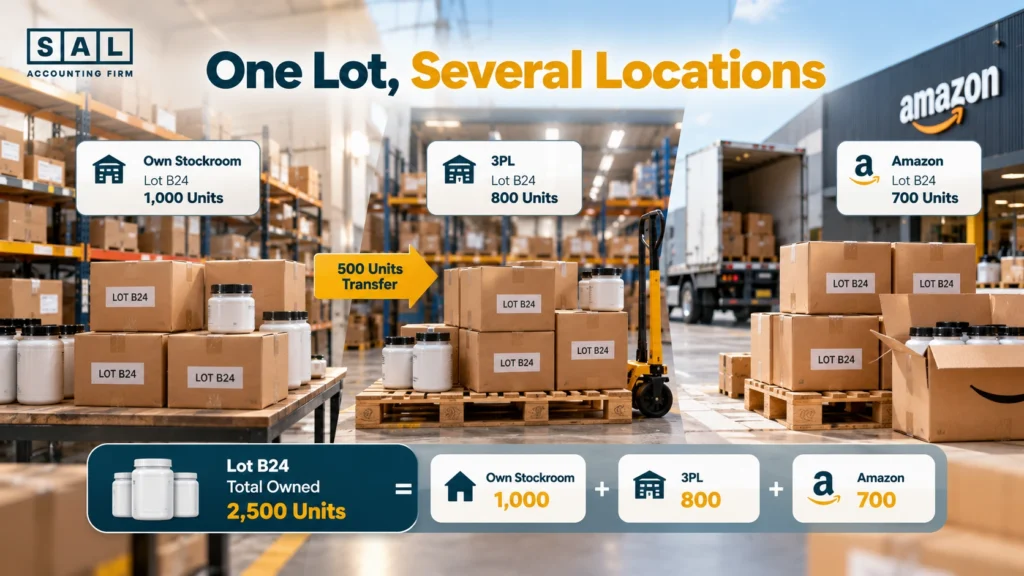
This matters most when the same SKU sits in several places at once, like a 3PL, Amazon, and your own stockroom. Each location reports separately, so a lot can look complete in one place and incomplete in another. Labelling cases with a GS1-128 barcode, which can carry the lot number, helps every warehouse scan and record the same lot the same way.
How Do Online Supplement Businesses Reconcile Lot Records With Their Accounting?
Lot reconciliation checks whether warehouse movements support the inventory quantities and financial values recorded in the books. Work through these steps each month:
- Confirm opening quantities by SKU, lot, and location
- Add production and purchase receipts
- Subtract sales and fulfilment movements
- Account for transfers between locations
- Account for returns and samples
- Record damage and other adjustments
- Confirm closing quantities
- Check the recorded inventory costs
- List any differences that still need investigating
Here’s how the roll-forward works for the two batches over one month:
| Line | Batch A | Batch B | Total |
|---|---|---|---|
| Opening units | 2,000 | 3,000 | 5,000 |
| Received | 0 | 0 | 0 |
| Sold and fulfilled | −1,200 | −800 | −2,000 |
| Transferred out to another location you own | 0 | 0 | 0 |
| Returns put back into stock | 20 | 0 | 20 |
| Damaged or adjusted | −20 | −10 | −30 |
| Closing units | 800 | 2,190 | 2,990 |
If the closing units in your records don’t match the warehouse count for a lot, that lot is where your investigation starts.
There are really two reconciliations here. A quantity reconciliation checks the units. A valuation reconciliation checks the dollars. You need both, because a stock count can be right while the value is wrong, and a balance can look reasonable while units are missing.
| Check | What It Confirms | Main Source | Common Gap |
|---|---|---|---|
| Quantity reconciliation | The units in each lot and location | Inventory system and 3PL reports | Unrecorded transfers or returns |
| Valuation reconciliation | The dollar value in your books | Accounting records and cost data | Missing or misposted cost invoices |
Take a simple example. Your 3PL reports 1,800 units left in one lot, but your inventory system shows 2,000. Don’t assume the 200 units were sold, lost, or stolen. The gap could come from an unrecorded shipment, a return, an adjustment, or a transfer. Your platform’s records can help. Shopify’s inventory adjustment history, for example, shows when quantities changed and why, for the last 180 days. Investigate the gap, document what you find, and only then correct the records.
Case Study: A North York Supplement Store Finds a Lot Transfer Error1
Sarah runs an online vitamin store from a small office in North York, Toronto. She moves 900 units of one vitamin SKU from one 3PL storage location to another to speed up delivery.
The problem: Both warehouses record the move, but the receiving warehouse logs the units under a different lot number. Her total SKU quantity still agrees, so nothing looks wrong at first. But the original lot no longer reconciles, and she can’t verify where those 900 units went.
What we do: We match the transfer documents, shipment references, and receiving reports from both warehouses. They show the 900 units are the same lot under a different label, so we correct the lot mapping based on that evidence.
The result: Sarah’s records show a clear trail from the original lot to its new location, without recording a false sale or loss. She now asks both warehouses to confirm lot numbers on every transfer.
What Happens When an Online Supplement Store Has Correct Stock Counts but Wrong Costs?
A correct stock count doesn’t prove the inventory value is right when cost records are incomplete. You can know exactly how many units you have and still carry the wrong value for them. Common causes include:
- Missing manufacturing costs
- Incomplete receiving cost records
- Missing import costs on batches made outside Canada
- Incorrect adjustments
- Differences between inventory detail and the general ledger
- Costs recorded outside your usual costing method
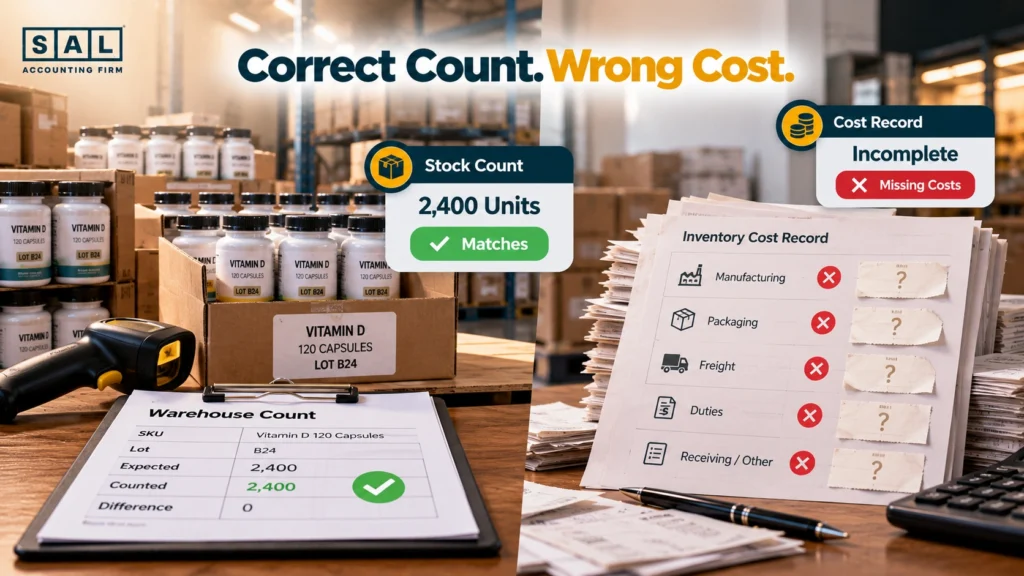
Imported batches are an easy place for costs to slip. CBSA notes that duties and taxes can apply at importation, and those charges often arrive on a separate broker invoice, not with the batch itself.
Don’t fix these differences with a balancing journal entry. Find the source first, then decide what the right treatment is. New production runs are a common trouble spot, because costs often arrive on separate invoices, which is why it helps to reconcile each co-packer production run as it’s received.
Case Study: A Port Credit Supplement Brand Finds an Unrecorded Packaging Cost2
Mike sells a protein supplement online from a warehouse unit near Port Credit, Mississauga. He receives 2,400 units from a new production run, and his physical count matches the warehouse report exactly.
The problem: Mike also has a $4,800 invoice for packaging used in that run, but the cost records for the new batch are incomplete. He can’t tell whether the $4,800 was included in inventory or recorded somewhere else.
What we do: We trace the supplier invoice, the production records, his accounting entries, and his inventory costing method. The invoice turns out to be recorded as a general expense. Since that packaging is part of the product under his costing method, it belongs in inventory, so we move it there, adding $2 to the cost of each unit.
The result: Mike’s inventory value is now backed by the right source records. He also has a simple check for new production runs: match every related invoice to the batch before the books close.
What Lot and Batch Reports Does an Online Supplement Store Need for Month-End Accounting?
Month-end accounting needs reports that explain stock changes, remaining quantities, and the costs behind recorded inventory. The goal isn’t more reports. It’s reports your accountant can rely on. Have these ready:
- Closing balances by SKU and lot
- Warehouse locations and inventory status
- Production and purchase receipts
- Fulfilment movements
- Transfer records
- Returns and samples
- Damage and adjustment reports
- Inventory cost data
- Supporting invoices and other source documents
- Explanations for any unresolved differences
Without these, your accountant has to rebuild product movements from scattered invoices, bank transactions, and warehouse emails. That takes longer, costs more, and leaves more room for errors.
How Can Supplement Ecommerce Stores Keep Lot Records and Accounting Accurate?
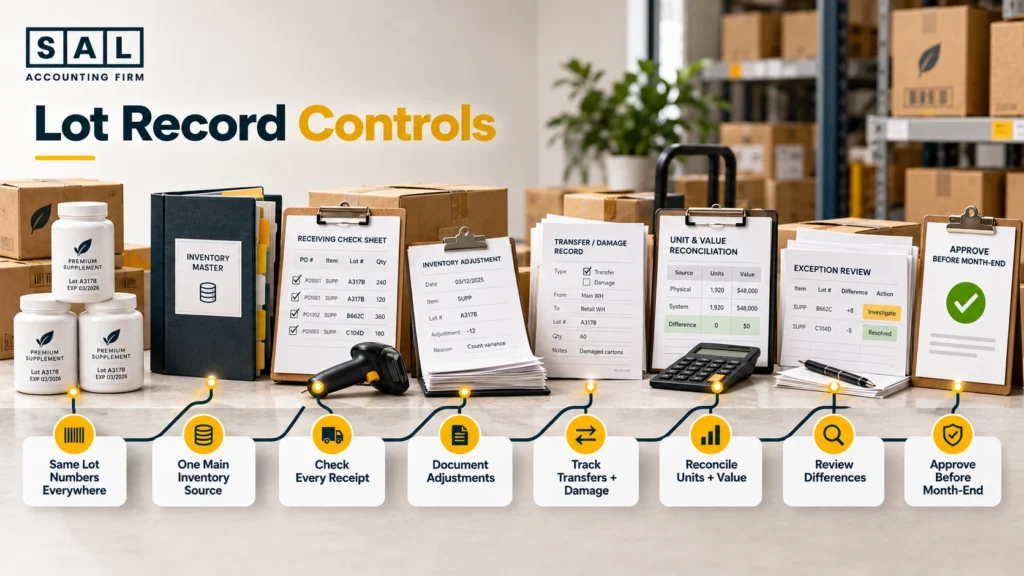
Online supplement businesses need a simple review process that keeps lot records and financial balances consistent. These controls do most of the work:
- Use the same lot numbers across every system and warehouse
- Choose one system as the main source for physical lot records
- Check every delivery against its paperwork when it’s received
- Document every inventory adjustment
- Keep clear records for transfers and damaged goods
- Reconcile quantities and values regularly
- Review unexplained differences in both units and costs
- Approve corrections before month-end
You don’t need more software or more reports. You need records that explain how many units you have and what they’re worth.
Final Thought: Can Your Online Supplement Store Explain Every Batch?
Accurate batch records let online supplement businesses explain what happened to their stock and what remains on the books. When every lot can be traced from receipt to sale, transfer, or adjustment, your inventory value is backed by evidence instead of estimates. That’s the base for every pricing, reorder, and growth decision you make next.
For a clearer next move, use our free profit clarity roadmap to set your financial priorities as your business grows.