

Accurate supplement inventory accounting means more than knowing how many bottles are on the shelf. Your quantity, location, status, cost, and accounting value need to tell the same story. That is the inventory discipline behind SAL Accounting‘s ecommerce approach.
If one piece drifts, COGS, margins, and reordering decisions can drift with it. Let’s look at where that mismatch comes from, the inventory count can look completely right while the value in your books is still wrong.
See what changing inventory costs can do to the bigger profit picture with the Ecommerce EBITDA Calculator.
Quick Takeaways
- Inventory accuracy is about more than counting units.
- Quantity, location, status, cost, and accounting value should agree.
- Sales are only one type of inventory movement.
- Transfers, samples, returns, damage, expiry, and bundles need to be tracked separately.
- A correct physical count does not automatically mean the inventory value is correct.
- Unit and value roll-forwards should explain the same underlying activity.
- Changing batch costs need to flow through inventory consistently.
- Large unexplained adjustments are a warning sign, not a fix.
What Does Accurate Inventory Accounting Need to Match?
Inventory accuracy is not one number. Knowing that you have 5,000 bottles is useful, but it does not tell you where they are, whether they can still be sold, what cost is attached to them, or what value belongs in the books.
A product can even physically exist without being available for sale. Shopify’s inventory states, for example, distinguish between available, committed, unavailable, incoming, and on-hand inventory. For supplement inventory accounting, four areas need to line up.
| Inventory Element | Question to Answer | Example | Common Problem | Why It Matters |
|---|---|---|---|---|
| Quantity | How many units do we own? | 5,000 bottles | Missing movements | Counts become unreliable |
| Location + status | Where are they and can they be sold? | 3PL, transit, damaged | Everything shown as available | Saleable stock is overstated |
| Cost | What cost is attached? | $8.50 per unit | Old batch cost remains | COGS may be wrong |
| Inventory value | What belongs in the books? | $42,500 | Quantity or cost is wrong | Balance sheet is inaccurate |
Basically:
Correct quantity + wrong cost = inaccurate inventory.
And:
Correct cost + wrong quantity = inaccurate inventory.
That wider connection between stock, COGS, expiry, manufacturing, and reporting is a core part of accounting for an online supplement business.
What Should Be Set Up Before Recording Supplement Inventory?
Before tracking new movements, make sure the starting inventory record makes sense. Each product should have consistent information such as:
- SKU or product identifier;
- unit of measure;
- inventory location;
- inventory status;
- lot or batch, where relevant;
- expiry date, where relevant;
- inventory cost information; and
- one clear system responsible for quantity records.
The same product should not become MAG-120 in Shopify, MAG120 at the 3PL, and MAGNESIUM1 in another spreadsheet unless those records are clearly mapped.
Using consistent identifiers becomes much easier when every product has its own SKU. Shopify specifically recommends using unique SKUs because they support inventory tracking, sales reporting, fulfilment, and third-party integrations.
For Shopify sellers, that consistency is part of keeping Shopify inventory accounting connected to the products actually moving through the store.
Location matters too. Once products sit across a warehouse, retail site, or 3PL, Shopify’s location-based inventory tracking can keep stock quantities separated by where the inventory actually sits. If your business already holds inventory, establish two starting numbers:
Opening Units
and
Opening Inventory Value
Both should be supportable. If you start with 10,000 units and $90,000 of inventory, you should be able to explain where both figures came from.
Pro tip: Don’t build new inventory movements on top of an opening balance nobody trusts. Establish the starting point first.
As SKUs, locations, lots, and expiry dates multiply, inventory software for a supplement ecommerce business becomes much more useful than disconnected spreadsheets.

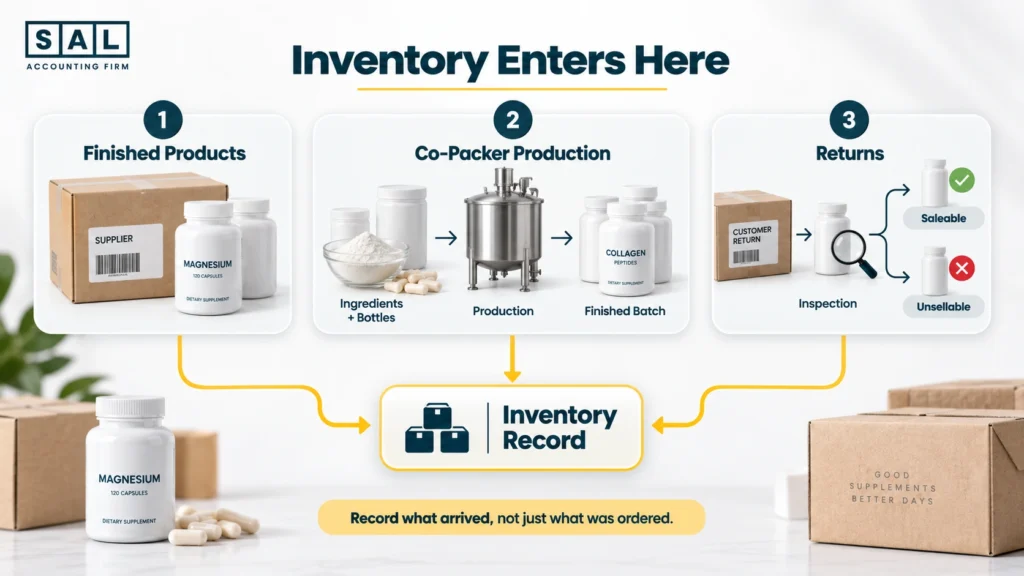
How Should New Supplement Inventory Enter the Records?
How inventory enters your records depends on how the products are sourced.
Finished Products Purchased From a Supplier
Record what actually arrived, not simply what was ordered. If the purchase order says 4,000 bottles but only 3,920 are received, inventory should start with 3,920 units.
The quantity received should then connect to the appropriate inventory cost. The full calculation of that product cost is a separate question. That’s covered in inventory and landed cost accounting.
Co-Packer Production
Co-packer inventory can move through several stages:
Materials sent → Production → Completed batch → Finished units received
You may also have rejected or unusable units. Those movements should remain traceable instead of jumping directly from “manufacturer paid” to “finished inventory.”
Ingredients and Packaging Owned by the Brand
Some supplement brands own ingredients, bottles, labels, caps, boxes, or other materials before finished products exist.
Sending those materials to a manufacturer does not make them disappear from the inventory story. Their movement still needs to be recorded while they move through production.
This article is not calculating what should form part of their inventory cost. The separate guide on when ecommerce inventory should be capitalized instead of expensed covers that distinction.
Customer Returns
Do not automatically return every product to normal saleable inventory. A returned unit might become:
- saleable;
- quarantined;
- damaged; or
- unsellable.
The record should reflect what can actually happen to that unit next.
Which Inventory Movements Need to Be Recorded Separately?
Inventory does not only change when somebody buys something. Transfers, samples, giveaways, damage, expiry, returns, and bundles can all move the numbers.
| Inventory Movement | Quantity Effect | Location / Status Effect | Revenue Event? | What to Check |
|---|---|---|---|---|
| Sale | Units decrease | Leaves saleable stock | Yes | Units + cost moved |
| Transfer | Total units usually unchanged | Location changes | No | Both sides recorded |
| Sample / giveaway | Units decrease | Leaves saleable stock | No normal sale | Usage recorded |
| Damage | May still physically exist | Becomes damaged | No | Status + value reviewed |
| Expiry | May still physically exist | Becomes expired | No | Affected stock identified |
| Return | Depends on outcome | Saleable, quarantine, damaged | Possibly | Correct status |
| Bundle | Several components decrease | Underlying SKUs move | Yes | Components recorded |
A transfer is a good example.
Say 800 bottles move from one company-controlled fulfilment location to another. You still own 800 bottles. Their location changed, but they were not sold.
Shopify’s inventory transfer process works on the same basic idea: inventory moves between locations without automatically becoming a sale. This matters even more in multichannel supplement ecommerce accounting, where stock can move separately from sales and payouts.
Samples and Giveaways
If 200 bottles go to influencers, those units have left normal inventory even though there was no customer sale. That movement still needs to be recorded.
Damage, Returns, and Other Adjustments
Damaged products, returned stock, losses, and promotional units should each have a clear reason behind the change. Shopify’s inventory adjustment reasons separate movements such as damage, returns, losses, counts, and promotions or donations.
The same principle applies in the books: ecommerce activity should be categorized by what actually happened, not just by what eventually appears in the bank.
How Do Lot Numbers and Expiry Dates Affect Inventory Accounting?
For supplement brands, lot and expiry information can help explain which inventory was affected, not just how many total units changed. Different production batches may:
- carry different costs;
- expire at different times;
- sit in different locations;
- experience different losses; or
- require different adjustments.
For natural health products in Canada, Health Canada’s current labelling requirements include both the lot number and expiry date.
That does not mean every ecommerce seller has identical regulatory responsibilities.
The business’s role matters. Health Canada’s recall record requirements distinguish between activities and responsibilities involving manufacturers, importers, distributors, packagers, and labellers.
From an accounting perspective, the practical point is much simpler: If an adjustment relates to Batch B, your records should let you identify Batch B.
You do not need a separate general-ledger account for every batch. Detailed operational information can remain in the inventory system while the accounting system holds the appropriate financial value.
That keeps the GL useful instead of turning the supplement ecommerce chart of accounts into a list of every SKU, location, and lot number.

How Do You Keep Inventory Quantity and Inventory Value in Sync?
This is the centre of the process. You need two connected roll-forwards.
Unit Roll-Forward
Start with:
Opening Units
+ Units Received or Produced
+ Saleable Returns
− Units Sold
− Samples / Giveaways
− Damage / Expiry / Disposal
± Supported Inventory Adjustments
= Ending Units
Transfers between company-controlled locations normally change where inventory sits rather than changing the total quantity the business owns.
Value Roll-Forward
Now follow the dollars:
Opening Inventory Value
+ Inventory Cost Added
− Cost Attached to Units Sold
− Relevant Inventory Losses / Write-Downs
± Supported Accounting Adjustments
= Ending Inventory Value
The two roll-forwards should explain the same underlying activity.
This matters because inventory is not only an operational number. The CRA’s guidance on inventory and cost of goods sold explains that inventory feeds into the calculation of COGS and business income.
Imagine your operational records show 5,000 units.
If the books effectively contain value for 5,500 units, there is a quantity/value disconnect.
Or both systems may show 5,000 units while the accounting system uses the wrong cost.
That is a valuation disconnect.
Pro tip: When inventory changes, ask two questions: What happened to the units? What happened to their value?
The full monthly reconciliation belongs in the supplement ecommerce month-end close. Here, the goal is to keep inventory clean enough that month-end does not become detective work.
Case Study: How a Leslieville Supplement Brand Finds a $5,000 Inventory Value Error1
This illustrative supplement brand in Leslieville, Toronto physically has 5,000 bottles remaining. The inventory system also says 5,000.
Everything looks right. The brand started with 3,000 units at $8 each, received another 2,500 units at $10 each, and then sold 500 of the older units.
The Problem
The quantity record is correct, but the newer batch cost never made it into the accounting record. All 5,000 remaining units are still being carried at $8 each:
5,000 × $8 = $40,000
But under the costing method already being used, the remaining inventory consists of:
2,500 older units × $8 = $20,000
2,500 newer units × $10 = $25,000
Supported ending value = $45,000
The warehouse is right.
The books are $5,000 low.
What We Do
We separate the quantity test from the value test.
Then we trace the receiving records, batch cost, and accounting entry to find where the $10 unit cost failed to enter the inventory record.
The costing method does not change just to make the correction easier.
Result
The business can see why a correct stock count does not prove that the accounting balance is correct.
From then on, each new production batch is checked for both units received and cost added before the inventory record is accepted.

How Should Different Production Batch Costs Be Handled?
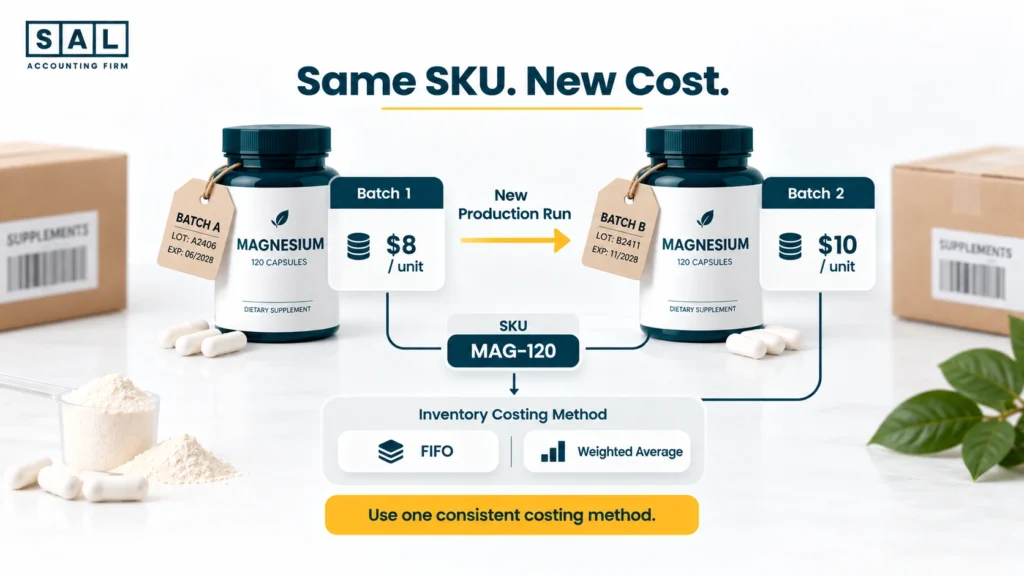
The same SKU supplement does not necessarily cost the same amount every time it is produced. Costs can change because of:
- ingredients;
- packaging;
- manufacturer pricing;
- freight;
- import costs; or
- production volume.
Suppose one production run costs $8 per bottle and the next costs $10. The SKU may still be identical, but the inventory cost has changed. Your records therefore need a consistent cost-assignment method.
Under IAS 2 inventory guidance, FIFO and weighted-average are among the cost formulas used for interchangeable inventory, and the chosen method determines how those changing costs flow through inventory and COGS.
We do not need to calculate either method here.
- Read more: “FIFO vs. Weighted-Average Cost for Ecommerce Sellers”
The takeaway is consistency. Changing the method whenever one produces a nicer margin would defeat the purpose of reliable inventory accounting.
What Should You Do When Physical Inventory and the Books Do Not Match?
First, work out what type of problem you have. Don’t jump straight to one large adjustment.
| Type of Difference | What It Looks Like | What to Investigate | Starting Point | Avoid |
|---|---|---|---|---|
| Quantity | Warehouse and books show different units | Receiving, samples, returns, transfers, damage | Last agreed count | Plug adjustment |
| Value | Units agree but dollars do not | Costs, batches, losses, COGS postings | Cost attached to units | Changing quantity |
| Quantity + value | Both differ | Movement + cost trail | Last point both agreed | Fixing only one side |
| Location / status | Total units agree but availability does not | Transfers, returns, quarantine, damage | Location reports | Treating all stock as saleable |
If Quantity Is Wrong
Look for:
- missing receiving;
- unrecorded samples;
- customer returns;
- warehouse adjustments;
- damage;
- expiry;
- bundle-component errors;
- duplicate movements;
- transfers; and
- shipment timing.
If Value Is Wrong
Look for:
- outdated product costs;
- missing batch-cost updates;
- adjustments entered at the wrong value;
- unrecorded inventory losses; or
- inventory-to-COGS posting errors.
If Both Are Wrong
Work backward. Find the last point where the quantity and value agreed, then trace the activity forward from there.
This is much safer than forcing a number to balance. The same logic sits behind ecommerce reconciliation best practices: the difference needs an explanation, not simply another journal entry.
Case Study: How a Streetsville Supplement Brand Explains a 700-Unit 3PL Difference2
This illustrative supplement business in Streetsville, Mississauga receives a 3PL report showing 12,400 units, while its accounting inventory records imply 13,100 units. There is a 700-unit gap.
The Problem
The team has been using one manual adjustment whenever the inventory does not match.
That makes the final balance look tidy, but nobody can explain where the products actually went. We trace the difference and find:
- 280 units sent as promotional samples;
- 190 expired units disposed of;
- 130 damaged units removed by the warehouse; and
- 100 units covered by a documented warehouse shortage.
Total explained: 700 units.
What We Do
Instead of posting one generic 700-unit adjustment, we record each movement according to what happened.
Samples stay identifiable as samples. Expiry stays identifiable as expiry. Damage stays separate from the warehouse shortage. Each movement is also connected to supporting documentation.
Result
The 12,400-unit ending balance now has a clear trail.
More importantly, the next difference becomes easier to investigate because inventory is no longer disappearing into one adjustment account.
Can the Inventory Count Be Correct While the Inventory Value Is Wrong?
Yes. Physical inventory accuracy answers: How many units do we have?
Accounting accuracy also asks: What should those units be worth? The quantity may be correct while the value is wrong because:
- an outdated cost is attached to the SKU;
- a newer batch has a different cost;
- an inventory-cost update was missed;
- damaged or obsolete inventory has not been reviewed appropriately; or
- the costing method was not applied consistently.
IAS 2 also recognizes that damaged or obsolete inventory may no longer recover its full cost, which is why the accounting value cannot be assumed to stay unchanged simply because the units still physically exist.
That is why inventory should be reviewed alongside the other financial reports a supplement ecommerce brand reviews each month rather than treated as a static balance-sheet figure.

What Records Should Support Inventory Adjustments?
Every material inventory adjustment should leave enough of a trail for somebody to understand what happened later. Depending on the movement, useful support may include:
- receiving records;
- supplier documents;
- co-packer or production reports;
- warehouse and 3PL reports;
- transfer records;
- customer-return records;
- sample and giveaway logs;
- damage or disposal records;
- lot or batch information;
- physical count sheets; and
- explanations for material adjustments.
For example:
Adjustment: −150 units
does not tell you much.
This is better:
Adjustment: −150 units — Batch MG0426, expired stock disposed of per 3PL report dated September 10
The system trail can help here too. Shopify’s inventory adjustment history records adjustment activity and the reason associated with quantity changes, which makes later investigation much easier. You do not need an essay behind every five-unit difference. But material changes should be explainable.
That documentation habit also belongs in a solid ecommerce bookkeeping checklist, especially when your storefront, 3PL, inventory system, and accounting file do not automatically share the same data.
When inventory, COGS, 3PL reports, and the books stop lining up cleanly, Ecommerce Accounting brings those moving pieces into one consistent monthly process.
What Are the Warning Signs That Inventory Accounting Is Becoming Unreliable?
Inventory usually gives you warning signs before the year-end adjustment becomes huge. Watch for:
- negative inventory on products that are still selling;
- frequent unexplained adjustments;
- inventory value changing without a matching quantity or cost explanation;
- samples being tracked outside the inventory process;
- expired or damaged stock remaining in normal saleable inventory;
- the 3PL, store, and accounting records showing conflicting quantities with no explanation;
- the same SKU changing cost without supporting information;
- inventory value increasing while physical stock is flat or falling;
- unusual COGS movement that cannot be connected to sales or product-cost changes; and
- nobody being able to explain how opening inventory became ending inventory.
One of the clearest warning signs is:
“We just adjust it to the warehouse report every month.”
An adjustment may be completely legitimate.
You should still know why it happened.
Large unexplained corrections are one reason DIY or generic ecommerce bookkeeping can distort the numbers even when the final reports appear to balance.
Conclusion: Can You Trust Your Supplement Inventory Numbers?
Accurate supplement inventory accounting comes back to one thing: The units and the dollars need to tell the same story.
Know what you started with. Record what came in. Track sales, transfers, samples, returns, damage, and expiry separately. Keep new batch costs attached to the right inventory. Then make sure both your ending quantity and ending value can be explained.
You do not need inventory records with zero differences forever. You need differences that make sense.
Want a clearer view of the financial system behind a growing ecommerce business? Get the Financial Growth Blueprint for Ecommerce Brands.