
Your supplier invoice is only the starting point. Freight, duty, brokerage, insurance, and receiving costs can push a product’s real cost higher. That full unit cost is central to how SAL Accounting approaches e-commerce bookkeeping: pricing and profit should start with what inventory truly cost, not only what the supplier charged.
You’ll see what belongs in landed cost and how it becomes COGS. Read it before your next order. One missing cost can follow every unit you sell.
Put your revised COGS into SAL’s Ecommerce EBITDA Calculator to see what the new unit cost does to operating profit.
Quick Takeaways
- Landed cost includes the supplier price, inbound freight, customs duty, brokerage, insurance, and other direct costs required to bring products into inventory.
- Recoverable GST/HST is usually recorded separately rather than added to product cost.
- A product’s real margin should be calculated using its complete landed cost, not only the amount paid to the supplier.
- Mixed-SKU shipment costs should be allocated using a reasonable method, such as weight, volume, product value, or actual duty by SKU.
- Unsold product costs remain in inventory and move into COGS only when the related units are sold.
- Shopify, Amazon, 3PL, and accounting records should be reconciled regularly so quantities and inventory values agree.
- Final unit costs should use actual units received and completed invoices rather than estimates or quantities ordered.
What Should E-Commerce Sellers Include in Inventory Cost?
Inventory cost generally includes the direct expenses required to purchase products and bring them to the location and condition where they’re ready to sell.
A common accounting principle reflected in IAS 2 inventory guidance is that inventory cost includes purchase costs and other costs required to bring goods to their present location and condition. The CRA also uses inventory when calculating COGS and business income. The basic formula is:
Landed cost = Supplier cost + inbound freight + duty + brokerage + insurance + direct inbound handling
This short table separates the main costs:
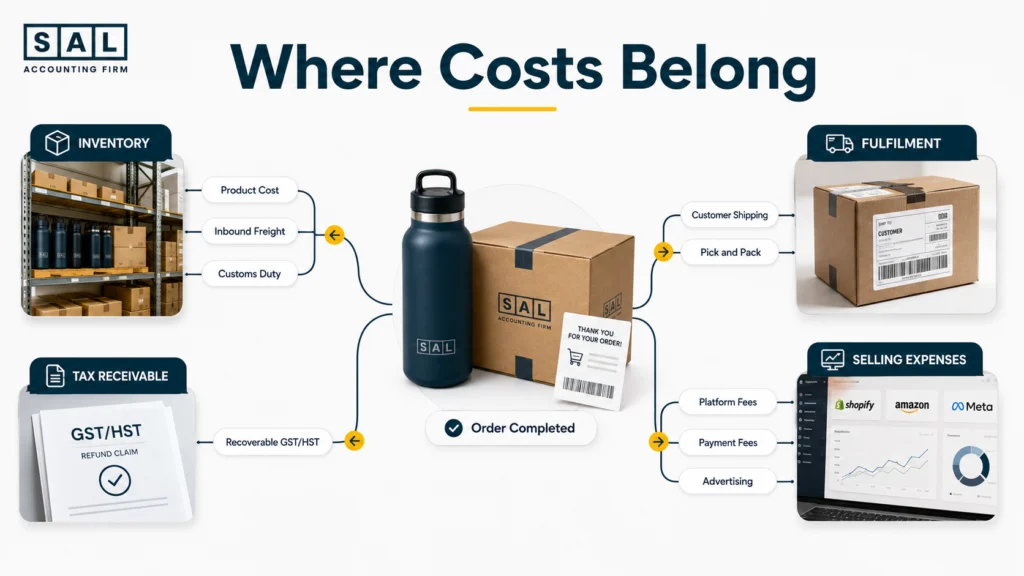
| Cost | Include in landed cost? | Usual treatment | Main watch-out |
|---|---|---|---|
| Supplier product cost | Yes | Inventory | Use the final cost after discounts |
| Inbound freight | Usually | Inventory | Include final surcharges |
| Customs duty | Usually | Inventory | Allocate by SKU where possible |
| Brokerage and insurance | Usually | Inventory | Separate fees from tax |
| Direct receiving costs | Sometimes | Inventory | Include only shipment-related charges |
| Recoverable GST/HST | Usually no | Tax receivable | Keep eligible ITCs separate |
| Customer delivery | No | Fulfilment expense | This occurs after the sale |
| Platform and payment fees | No | Selling expense | Do not mix them with inventory |
Eligible GST/HST paid on commercial purchases may generally be recovered through input tax credits by registered businesses. That is why recoverable tax should not automatically be buried inside product cost.
Bring supplier bills, inventory, payouts, and COGS into one monthly process with SAL’s e-commerce accounting and bookkeeping services in Toronto.
Why Does Landed Cost Change Your Product Margin?
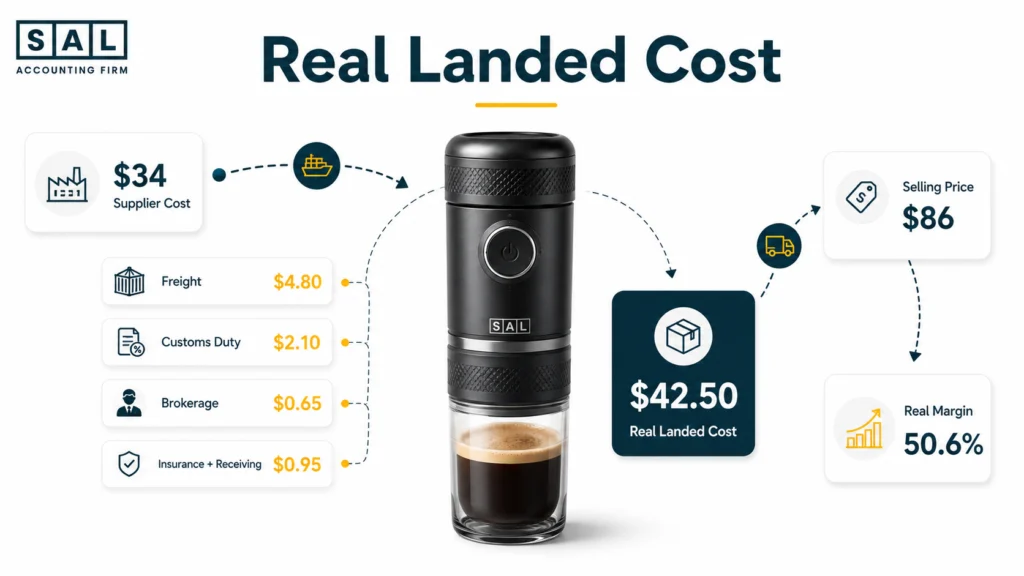
Imagine you sell a portable espresso maker for $86. The supplier charges $34, so the product initially appears to generate:
- Gross profit: $52
- Gross margin: 60.5%
Now include the costs required to bring it into inventory:
- Inbound freight: $4.80
- Customs duty: $2.10
- Brokerage: $0.65
- Insurance and receiving: $0.95
The actual landed cost is $42.50. Gross profit falls to $43.50, and the margin becomes 50.6%. The sale did not change. The business simply stopped leaving $8.50 of cost outside the product.
That difference affects discount limits, advertising budgets, wholesale pricing, and how much cash is available for the next order. It is also one reason an online store can generate sales without producing the expected profit.
How Do You Calculate Landed Cost per Unit?
Calculate landed cost shipment by shipment rather than guessing one permanent cost for every product.
1. Collect the Shipment Records
Gather the supplier invoice, freight bill, customs paperwork, broker statement, insurance charge, and warehouse receiving report.
Organize the supporting files with SAL’s Tax Document Checklist for Ecommerce Stores before completing the calculation.
2. Convert Foreign-Currency Amounts
Convert supplier and logistics invoices into Canadian dollars using one consistent method.
Keep the rate and transaction date with the shipment records. The Bank of Canada exchange-rate lookup provides indicative daily rates.
3. Add the Direct Inbound Costs
Add freight, duty, brokerage, insurance, and other charges directly connected to bringing the products into inventory.
Carrier estimates may change after dimensional adjustments or surcharges. Those final charges should be reviewed separately from the later cost of shipping customer orders. SAL’s comparison of e-commerce shipping providers focuses on that fulfillment stage.
4. Divide by the Units Received
For a shipment containing one product:
Total landed shipment cost ÷ units received = landed cost per unit
Use the quantity actually received and accepted, not automatically the quantity ordered.
Pro tip: Save the landed-cost worksheet with the shipment documents. The calculation should be easy to trace without rebuilding it several months later.
How Should Landed Cost Be Divided Across Different Products?
A mixed shipment needs an allocation method that reflects what created the cost. Unit count may work when the products are similar. Weight or volume is usually more useful when products have very different sizes. A practical approach might be:
- Freight allocated by weight or volume
- Insurance allocated by product value
- Duty assigned using the actual customs calculation
- General brokerage allocated consistently across the shipment
You do not have to use one method for every charge.
Pro tip: Do not divide duty evenly when SKUs have different tariff classifications or duty rates.
- Also read: “Import vs Export for Canadian Ecommerce Brands”
Case Study: How Maya in Leslieville, Toronto Finds the Real Cost of Her Best Seller1
Maya runs a Shopify skincare brand from Leslieville, Toronto. Her bestselling serum sells for $36, while Shopify shows a product cost of $14.60. Orders continue to grow, but the cash available for new inventory is consistently lower than she expects.
The Problem
The $14.60 includes only the manufacturer’s price. Freight, duty, brokerage, insurance, and warehouse receiving fees are recorded separately when the shipment arrives.
What We Do
We match each shipment to its supplier, customs, freight, and warehouse records. The qualifying costs are allocated across the units received, increasing the serum’s landed cost to $18.20.
Result
Maya sees the margin she is actually earning. She adjusts the standalone price, limits broad discounts, and uses the complete unit cost when planning bundles and new orders.
Keep Shopify inventory, payouts, fees, and COGS inside the same monthly close with SAL’s Shopify accounting and bookkeeping services.
Is Landed Cost the Same as COGS?
No. Landed cost and COGS are connected, but they represent different stages.
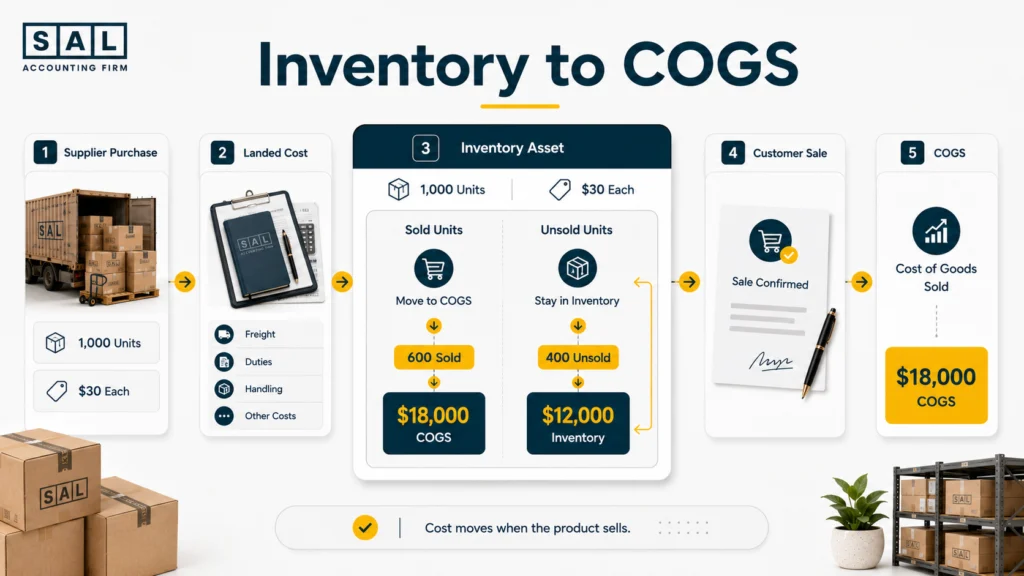
Landed cost is assigned to inventory when products are acquired. It becomes COGS when the related units sell.
The flow looks like this:
Product purchased → Landed cost calculated → Inventory recorded → Product sold → Cost moved to COGS
Suppose you receive 1,000 units with a landed cost of $30 each. After 600 units sell:
- $18,000 moves into COGS.
- $12,000 remains in inventory.
Buying $30,000 of inventory does not automatically create a $30,000 expense. The unsold portion remains an asset.
The wider formula is:
Beginning inventory + purchases and landed costs − ending inventory = COGS
A complete e-commerce COGS calculation keeps the cost of unsold stock from distorting current profit.
A single Shopify order’s financial lifecycle can affect sales, inventory, COGS, tax, fees, and cash. Recording only the bank deposit misses most of that movement.
How Do You Reconcile Inventory Across Shopify, Amazon, and a 3PL?
Start with one master SKU list. Each Shopify variant, Amazon listing, and warehouse product code should map to the same product in your accounting records. Then reconcile:
- Units received
- Units sold
- Customer returns
- Damaged or missing units
- Inventory moving between locations
Shopify explains that its standard cost per item may reflect the manufacturer price without taxes, shipping, or other costs. The field is also static, so it may not reflect changing shipment costs over time.
That means Shopify’s product cost should not automatically become the final accounting value of inventory.
A regular e-commerce bookkeeping checklist keeps inventory review alongside sales, refunds, fees, payouts, and tax.
Amazon sellers should also separate settlement activity from physical inventory. Amazon FBM settlement tracking explains the money inside each payout, while inventory records show which units remain available, returned, or damaged.
Pro tip: Reconcile inventory by both location and status. “In stock” is not specific enough when units may be available, committed, in transit, returned, or unsellable.
Case Study: How Daniel in Port Credit, Mississauga Fixes His Inventory Balance2
Daniel runs a home-organization brand from Port Credit, Mississauga. He sells through Shopify and Amazon and stores products with a Canadian 3PL. His inventory system shows 8,400 units, but the warehouse reports only 7,910 available units.
The Problem
Incoming shipments are added before the warehouse receives them. Returns are counted as sellable before inspection, and damaged units are not removed consistently. Some warehouse transfers also appear in two locations at once.
What We Do
We create one master SKU list and separate available, committed, in-transit, returned, and damaged inventory. Purchase orders are matched to warehouse receipts, and confirmed shortages are recorded.
Result
The review identifies $19,600 of overstated inventory. Daniel’s balance sheet and COGS are corrected, and purchase orders are no longer based on products that are damaged, committed, or still in transit.
What Should You Check Before Finalizing Landed Cost?
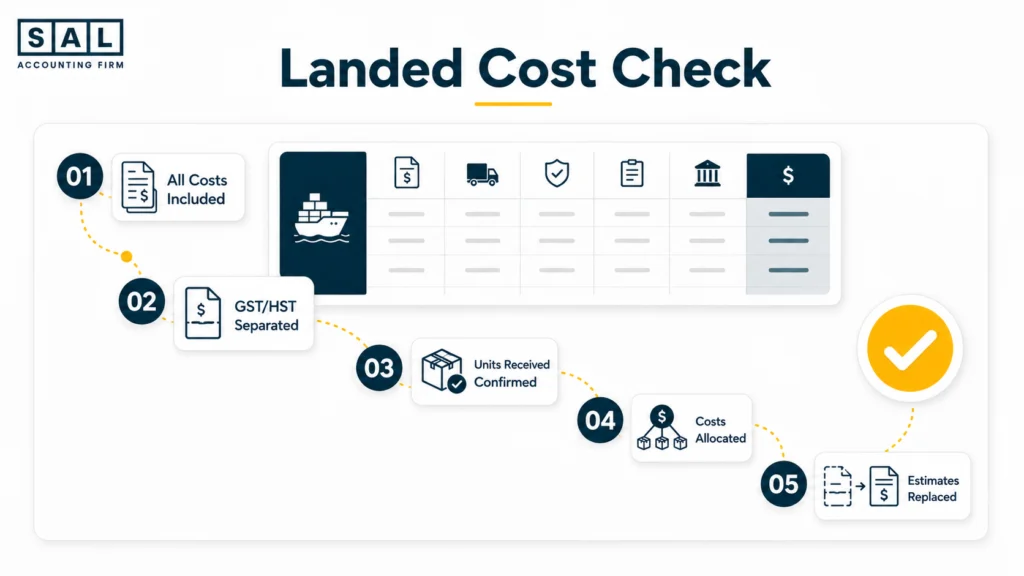
Before using the final unit cost, confirm that:
- All supplier, freight, customs, insurance, and receiving invoices are included.
- Recoverable GST/HST is recorded separately.
- The calculation uses units actually received.
- Mixed-SKU costs follow a reasonable allocation method.
- Estimates have been replaced with final invoices.
The current CBSA commercial importing information also provides access to customs valuation, tariff, classification, and commercial import resources.
Pro tip: Compare the new landed cost with the previous shipment. A large change should be explainable through price, freight, currency, duty, or quantity.
When Do You Need Better Inventory Accounting?
You may need a better process when inventory reports do not match, margins feel unreliable, or nobody can clearly explain how COGS was calculated.
This becomes more important when you import products, use several warehouses, or sell through multiple channels. These gaps often appear alongside the risks of DIY or generic e-commerce bookkeeping.
Changing accountants also requires a reliable opening inventory balance. A clean transfer of e-commerce accounting records should include SKU costs, stock by location, incoming shipments, and unresolved warehouse differences.