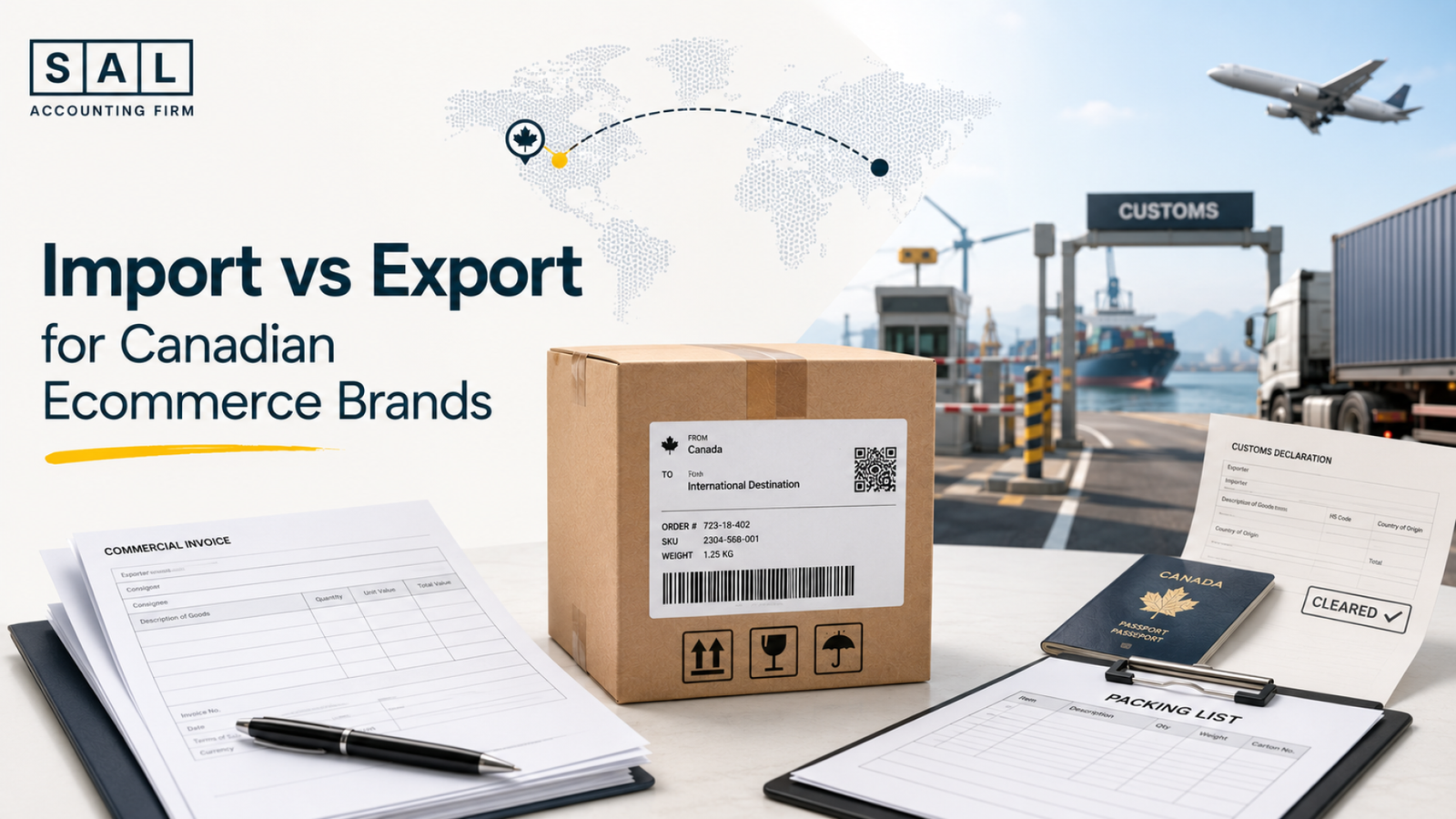
Importing and exporting may look like one shipping process, but they place different responsibilities on the seller, buyer and importer of record. A missed HS code, unexpected brokerage charge or wrongly recorded import tax can turn a profitable order into a loss.
At SAL Accounting, we see this when border costs never reach the right accounts. Read this before your next shipment, because fixing the setup early is far cheaper than fixing a held order or vanished margin.
Before your next cross-border order: Use SAL’s Tax Document Checklist for Ecommerce Stores to keep your customs and tax records organized.
Quick Takeaways
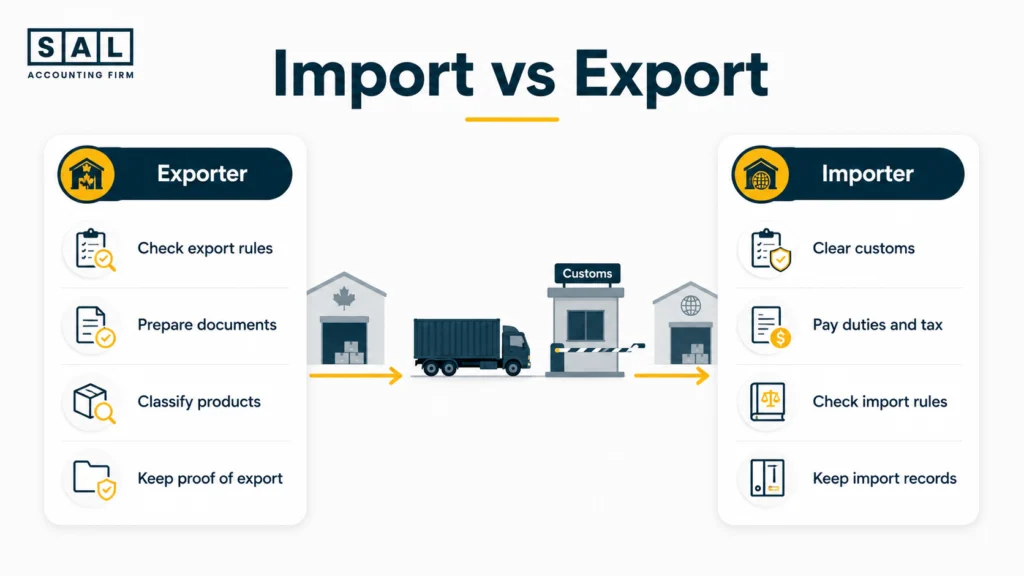
- The exporter manages the departure side of the shipment.
- The importer manages entry into the destination country.
- The importer of record carries important customs responsibilities.
- DDP usually puts import costs on the seller. DAP usually leaves them with the buyer.
- Duties, freight and brokerage can change the real product margin.
- Customs and accounting records should tell the same story.
How Importing and Exporting Work in Ecommerce
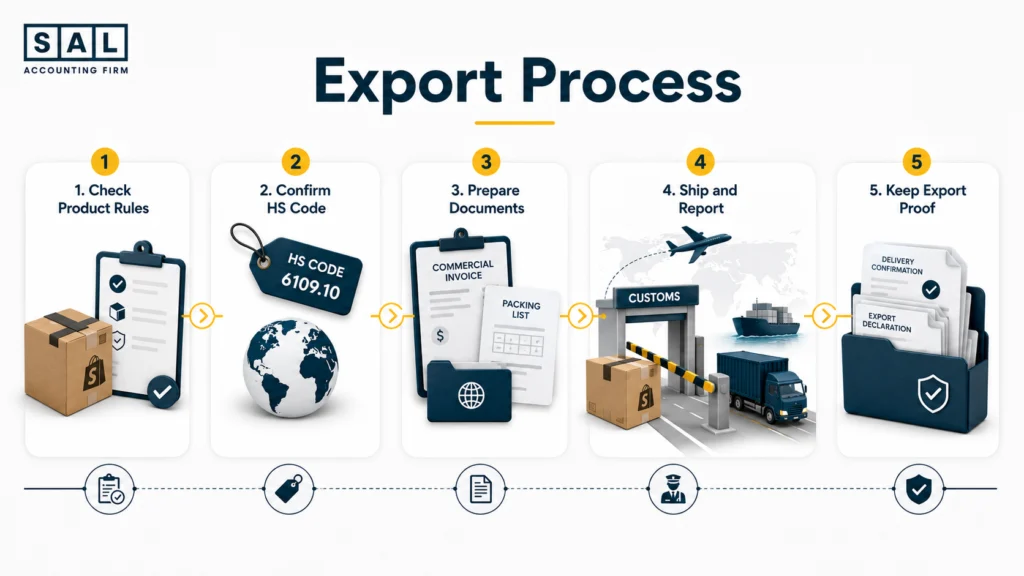
A typical cross-border ecommerce order follows five steps:
- The seller confirms the product can cross both borders.
- The seller and customer agree on who handles import charges.
- The exporter prepares the shipment and customs information.
- The importer or customs broker clears the goods.
- The business records the sale, freight, duty, tax and other costs.
Here is what that can look like in practice.
A Toronto ecommerce brand sells a three-piece kitchenware set to a US customer for CAD 164. The product costs CAD 46, international delivery costs CAD 21, duty is CAD 9 and brokerage is CAD 7.
Before border costs, the order appears to produce CAD 118 above product cost. If the seller absorbs shipping, duty and brokerage, that amount drops to CAD 81 before platform fees, advertising and overhead.
Basically, the sales number did not change. The responsibility for border costs did.
- Also read: “Cross-Border Ecommerce Shipping for Canadian Sellers”
What Are the Exporter’s Responsibilities?
The exporter is responsible for preparing the goods to leave the origin country correctly. Here’s what needs to be handled before and after the shipment departs.
Confirming the Product Can Be Exported
The exporter should confirm that the product can legally leave Canada and enter the intended destination.
Most ordinary ecommerce goods do not require a special Canadian export permit. However, controls may apply to certain technologies, chemicals, military or strategic products and restricted destinations. Goods listed on Canada’s Export Control List may require authorization. A courier accepting the box does not automatically confirm that every legal requirement has been met.
Preparing Export Documents
The exporter normally provides the information used for:
- The commercial invoice
- The packing list
- The shipping document
- Export declarations, when required
- Certificates or statements of origin
- Export permits, when required
Descriptions should be specific. “Stainless-steel insulated bottle, 750 mL” is far more useful than “accessory.”
Classifying the Product
International goods use Harmonized System codes, usually called HS codes.
The first six digits are common across countries that use the Harmonized System. Canada adds four more digits for its complete import classification. Classification and origin help determine the applicable duty rate. The CBSA classification guide explains how Canadian tariff numbers are structured.
Pro Tip: Do not copy a supplier’s HS code without reviewing it. The supplier may be using its country’s export code, while the destination requires a longer local classification.
Following Export-Control Rules
The exporter may need to check:
- What the product contains
- Where it is going
- Who will receive it
- How it will be used
- Whether a permit is required
This should happen before the shipping date. Permit problems discovered after dispatch can lead to storage charges, delays or returned goods.
Keeping Proof of Export
Proof of export may include carrier tracking, export declarations, bills of lading, commercial invoices and foreign delivery confirmation. Canadian commercial exporters generally need to keep complete export records for six years. The CBSA exporter record guide lists the main retention requirements.
These documents may also support the GST/HST treatment of exported goods.
What Are the Importer’s Responsibilities?
The importer takes responsibility for bringing the goods into the destination country. Here’s what that role usually involves and where the biggest risks appear.
Acting as the Importer of Record
The importer of record is the party named on the customs accounting documents. That role can include responsibility for:
- Customs declarations
- Duties and taxes
- Record keeping
- Corrections
- Customs reviews and reassessments
Since January 1, 2026, the party named as importer of record on Canadian customs accounting documents can be jointly liable with the owner and importer for duties, including reassessed amounts.
A customs broker may complete entries on the importer’s behalf, but using a broker does not automatically remove the importer’s responsibility.
Registering for Commercial Imports
Businesses importing commercial goods into Canada generally need a business number and an import-export program account.
The CARM Client Portal is now the official CBSA system for commercial import accounting and duty payments. Importers must register their own business and can then delegate authority to a broker.
Paying Duties and Import Taxes
The importer normally pays or arranges payment for:
- Customs duties
- Import GST, VAT or similar taxes
- Brokerage
- Clearance fees
- Other applicable customs charges
Goods imported into Canada are generally subject to GST or the federal part of HST unless a specific exception applies. The owner or importer of record is responsible for paying the tax at importation.
Confirming Classification and Customs Value
The importer should confirm the product’s:
- Tariff classification
- Country of origin
- Customs value
- Applicable tariff treatment
- Duty rate
In many Canadian imports, value for duty starts with the price paid or payable to the vendor, although customs law provides several valuation methods and possible adjustments. A discounted replacement or free promotional unit may still require a supportable customs value.
Meeting Import Restrictions
The importer must confirm that the goods meet the destination country’s requirements. Extra rules may apply to cosmetics, supplements, food, electronics, batteries, medical items, children’s products and goods containing plant or animal materials.
A product being legal to export does not automatically mean it is legal to import.
Keeping Customs and Purchase Records
Import records should connect:
- The supplier invoice
- The shipment
- The customs declaration
- The duty and tax payment
- The inventory received
- The accounting entry
Canadian importers generally need to keep records related to origin, purchase, importation, costs, value and payment for six years.
Border costs already scattered across several accounts? Clean up your ecommerce books before the next shipment makes the gap harder to trace.
Importer vs Exporter Responsibilities
The exporter and importer support the same shipment, but they do not perform the same job. The comparison below makes the difference clear at a glance.
Comparison Table: Documents, Costs, Taxes and Compliance
| Area | Exporter | Importer | Main Record | Main Risk |
|---|---|---|---|---|
| Product rules | Checks export controls | Checks import rules | Permit or product file | Shipment rejected |
| Classification | Supplies product details | Confirms destination code | Commercial invoice | Wrong duty |
| Customs filing | Handles export reporting | Handles import entry | Customs declaration | Delay or reassessment |
| Border charges | Pays if terms require it | Usually pays at entry | Customs statement | Unplanned cost |
| Records | Keeps proof of export | Keeps import support | Shipment file | Weak audit trail |
The simple version is this: The exporter manages departure. The importer manages entry.
Who Is Responsible for Duties, Taxes and Customs Clearance?
The answer depends on:
- Who is named as the importer of record
- What the seller and buyer agreed in the shipping terms
The shipping agreement may decide who absorbs the cost, but customs authorities still look at the legally responsible parties.
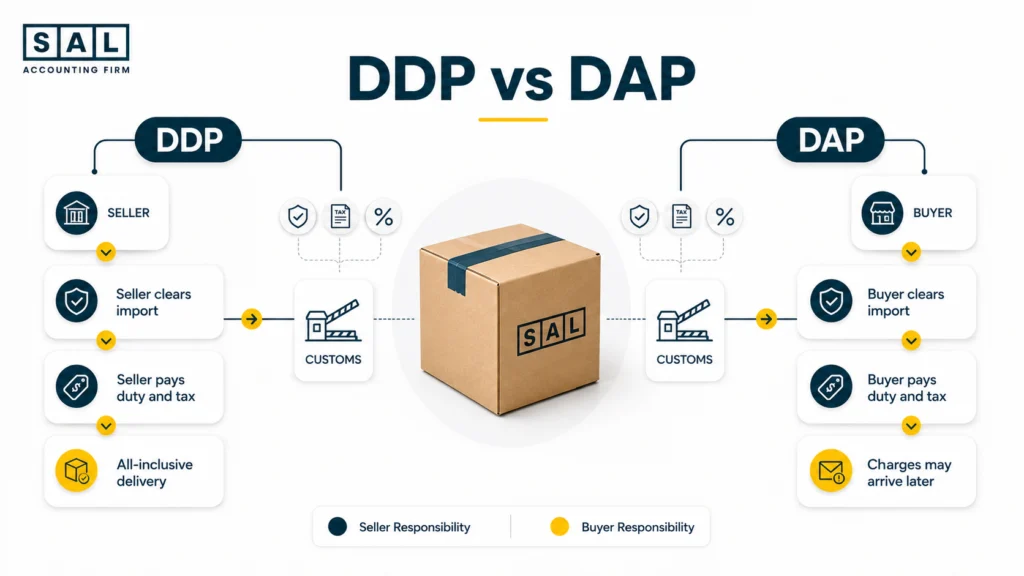
Delivered Duty Paid
Under Delivered Duty Paid, or DDP, the seller generally handles:
- Export clearance
- Transportation
- Import clearance
- Duties
- Import taxes
- Delivery to the named destination
The International Chamber of Commerce describes DDP as placing maximum responsibility on the seller. The seller handles both export and import formalities, subject to destination-country rules.
DDP can produce a smoother customer experience because the buyer is less likely to receive an unexpected customs bill.
It also creates more work for the seller. Before offering DDP, confirm that the business can legally complete the import process and estimate the charges reliably.
Pro Tip: Do not offer “duties included” because a courier app makes it look simple. Test the importer-of-record arrangement, duty calculation and accounting flow first.
Delivered at Place
Under Delivered at Place, or DAP, the seller arranges transportation to the named destination, but the buyer normally handles import clearance and import charges.
The ICC identifies import clearance as the main difference between DAP and DDP. Under DAP, the buyer handles and pays for import formalities. Under DDP, the seller does.
DAP reduces the seller’s customs burden, but it can create customer frustration if charges are not explained before checkout.
Customer as the Importer of Record
When the customer is the importer of record, the customer may need to:
- Pay duties and import taxes
- Respond to the courier
- Provide identification
- Approve customs clearance
- Meet permit requirements
This should be clear in the checkout and shipping policy.
A surprise CAD 38 customs request on a CAD 115 order can quickly turn into a refused package, refund and expensive return shipment.
Seller as the Importer of Record
When the seller takes responsibility for importing, it may need:
- Customs registrations
- A broker or authorized agent
- Local tax registrations
- A non-resident importer structure
- A process for corrections and returns
For Canadian brands expanding south, customs is only one part of the setup. US sales tax, payment processing, inventory locations and reporting also need review.
US sales tax is separate from customs duty. If your US order volume is growing, SAL’s US Economic Nexus Threshold Checker gives you a quick state-by-state screening point.
Case Study: How Maya in Liberty Village Prices Duty-Paid US Orders1
Maya runs a Shopify home-organization brand from Liberty Village, Toronto. She offers duty-paid US delivery because she wants customers to see one final price at checkout. Shopify records the order, but her courier combines freight, duty, brokerage and later adjustments on one monthly invoice.
The Problem
Maya records the whole courier invoice as shipping. She cannot tell whether the duty estimate collected from the customer covers the final customs cost or which products remain profitable.
What We Do
We separate freight, duty, brokerage and carrier adjustments. Each charge is matched to the related order or shipment, and the importer-of-record arrangement is documented.
Result
Maya can see the real margin on duty-paid orders and identify products that need different US pricing.
Selling internationally through Shopify? Review your Shopify accounting setup.
What Documents Do Ecommerce Brands Need for Imports and Exports?
Good customs records should explain what was shipped, where it came from, what it was worth and how it crossed the border. These are the documents that create that trail.
Commercial Invoice
The commercial invoice normally identifies:
- The seller and buyer
- Product descriptions
- Quantities and prices
- Currency
- Country of origin
- Shipping terms
The product description and value should agree with the actual transaction.
Packing List
The packing list shows what is physically inside each package.
It may include SKUs, quantities, package count, weight and dimensions. The totals should match the commercial invoice.
Shipping and Customs Documents
These may include:
- Air waybills
- Bills of lading
- Courier labels
- Export declarations
- Import accounting documents
- Customs statements
- Delivery confirmations
Together, they create the trail from the warehouse to the customer.
Certificates of Origin
Origin documentation supports where the product was made and whether preferential tariff treatment may apply.
A product shipped from Canada is not automatically Canadian-origin. Goods manufactured abroad do not become Canadian-origin simply because a Canadian seller stores and resells them.
Import or Export Permits
Some controlled or regulated goods need permits.
Confirm the requirement before accepting the order. Waiting until customs asks for the document can lead to delays, storage charges or rejection.
Pro Tip: Create one digital folder for every major shipment. Use the purchase order or customs entry number as the folder name, then save every invoice, freight bill, customs document and payment record inside it.
What Costs Should Ecommerce Brands Consider?
The supplier price is only the starting point. Here are the other costs that can change what a product really costs before it is ready to sell.
International Shipping
International shipping may include factory pickup, ocean or air freight, fuel surcharges, final-mile delivery, remote-area fees and returns.
The amount on the courier label may be only one part of the full transportation cost.
Customs Duties and Tariffs
Duty depends on the product’s classification, customs value, origin and tariff treatment.
A trade agreement does not make every shipment duty-free. The product must meet the applicable origin and documentation rules.
Import GST, VAT or Sales Tax
Import tax should be separated from customs duty.
A GST/HST-registered Canadian importer may generally claim an input tax credit when it imported the goods for commercial activities and holds the required support.
Use SAL’s GST/HST Refund Calculator for Ecommerce Stores to compare tax collected with tax paid on business purchases. It is an estimate, but it gives you a useful starting point.
Brokerage and Clearance Fees
A customs broker or courier may charge for entry preparation, advancing duty and tax, additional product lines, corrections and document handling.
A product can be duty-free and still create a brokerage bill.
Insurance and Storage Charges
Storage charges can appear when:
- Documents are missing
- A permit is unavailable
- Customs requests more information
- Duties remain unpaid
- The importer does not respond
These are easy to overlook because they may arrive after the goods have been released.
How Importing and Exporting Affect Ecommerce Accounting
The supplier invoice shows what you bought. Customs records show what crossed the border. Your books should show what the inventory actually cost.
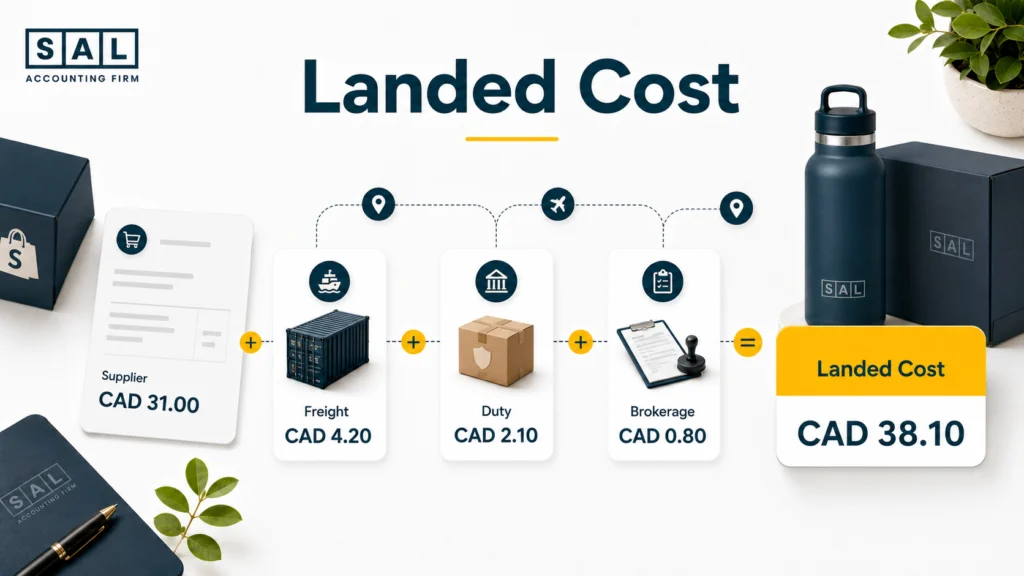
Landed Cost and Inventory Value
Landed cost is the cost of bringing inventory to the location and condition where it can be sold.
For example:
- Supplier cost: CAD 31.00
- Inbound freight: CAD 4.20
- Customs duty: CAD 2.10
- Brokerage allocation: CAD 0.80
- Landed cost: CAD 38.10
If the product sells for CAD 72, the starting gross profit is CAD 33.90, not CAD 41.
Cost of Goods Sold
Imported inventory does not normally become cost of goods sold just because it arrived.
The cost is generally recognized as the related units are sold. If you import 800 units and sell 250, the unsold units should remain in inventory.
Read more: “How to Calculate COGS for Ecommerce Stores”
Duties and Import Taxes
These amounts should not all enter the same account:
- Non-recoverable duty may form part of landed inventory cost.
- Recoverable import GST/HST is normally tracked separately.
- Brokerage may be allocated to inventory or the related shipment.
- Customer-delivery charges may belong in fulfilment expense.
Foreign-Currency Transactions
A foreign purchase may involve different exchange rates on the invoice date, customs date and payment date.
Suppose a USD supplier invoice is recorded at CAD 18,420 but costs CAD 18,690 when paid. The CAD 270 difference may be a foreign-exchange difference rather than an additional supplier cost.
Separating the two keeps inventory and currency results easier to understand.
Refunds, Returns and Duty Recovery
An international return may create:
- A customer refund
- Return freight
- Brokerage
- Customs duty
- Import tax
- Inventory damage
- Currency differences
The return should be tied back to the original order and customs entry. Without that trail, possible tax or duty recovery becomes much harder.
Compact Cross-Border Accounting Table
| Cost | Typical Treatment | Recoverable? | Margin Effect |
|---|---|---|---|
| Supplier cost | Inventory | No | Direct product cost |
| Inbound freight | Landed cost | No | Reduces margin |
| Customs duty | Landed cost | Usually no | Reduces margin |
| Import GST/HST | Tax receivable if eligible | Potentially | Cash-flow effect |
| Brokerage | Inventory or import expense | No | Often missed |
| Customer delivery | Fulfilment expense | No | Reduces order margin |
If international charges are already mixed together, ecommerce bookkeeping built around online-stores gives you a clearer monthly process for inventory, tax, currency and margins.
Once those costs are properly separated, SAL’s Ecommerce EBITDA Calculator can give you a broader view of operating performance beyond gross sales.
Case Study: How Arjun in Meadowvale Rebuilds the Cost of Amazon Inventory2
Arjun runs a kitchenware brand from Meadowvale, Mississauga. He imports inventory from Vietnam and sends part of each shipment to Amazon fulfilment centres. His books include the factory invoice in inventory, but freight, duty and brokerage are posted as general monthly expenses.
The Problem
Arjun’s Amazon products appear more profitable than they really are. Large import months also show unusually high expenses, while import GST is mixed with non-recoverable duty.
What We Do
We connect supplier invoices, freight bills, customs statements and Amazon inventory records. Landed costs are allocated across the units, while import GST and currency differences are tracked separately.
Result
Arjun can compare products using their real cost, and shipment months no longer distort operating expenses.
Sending imported stock to Amazon? See what Amazon bookkeeping should track.
Common Import and Export Mistakes Ecommerce Brands Make
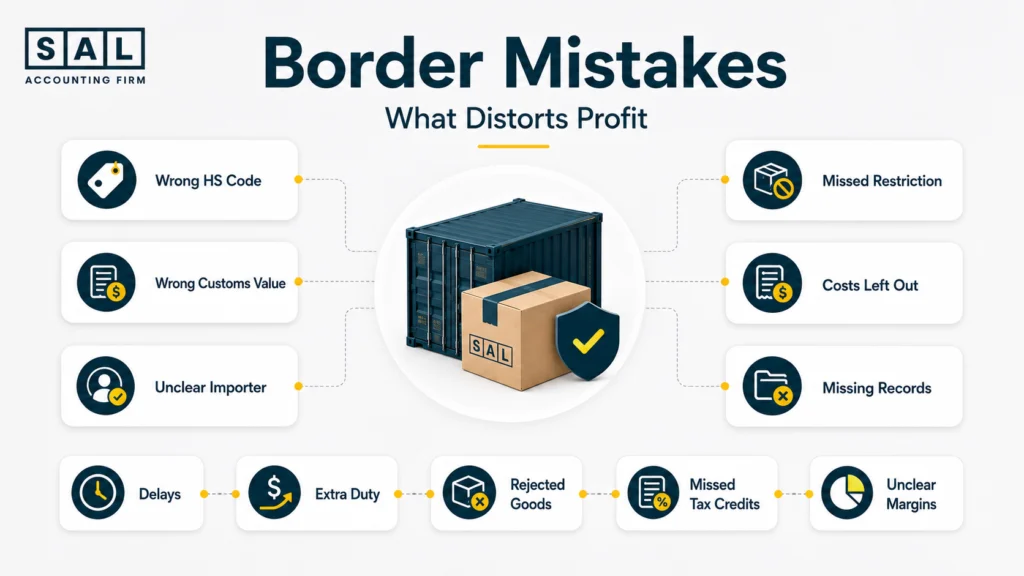
Most cross-border problems begin with a small detail that was missed early. Here are the mistakes that most often lead to delays, extra costs and unreliable margins.
Using the Wrong HS Code
The wrong classification can produce the wrong duty rate, permit requirement or customs treatment. Use product composition and function, not whichever code produces the lowest duty.
Declaring the Wrong Customs Value
Common problems include using an arbitrary low value, the wrong currency or an unsupported manufacturing cost. The customs value should follow the destination country’s valuation rules.
Choosing the Wrong Importer of Record
Do not name a customer, warehouse, courier or broker without confirming that party understands and accepts the role. This decision can affect duties, records and post-entry responsibility.
Missing Product Restrictions
Products sold normally in Canada may face different rules abroad. Cosmetics, food, supplements, batteries, children’s products and medical items deserve particular attention.
Leaving Border Costs Out of Margins
A product sold for CAD 86 with a CAD 29 supplier cost appears to produce CAD 57. Add CAD 6 freight, CAD 4 duty and CAD 3 brokerage, and the amount falls to CAD 44 before selling fees and advertising.
Keeping Incomplete Customs Records
A broker invoice is not a complete shipment file. You should be able to follow the transaction from the supplier purchase to the customs entry, inventory receipt and accounting record.
When Should an Ecommerce Brand Get Professional Cross-Border Help?
Professional support becomes useful when:
- You want to offer DDP shipping
- You plan to act as a non-resident importer
- Your HS classifications are uncertain
- You import regulated products
- Import GST does not match your tax records
- Border charges materially affect margins
- You use several warehouses or fulfilment centres
- International returns are difficult to reconcile
A customs broker handles customs clearance and filing. A trade specialist may advise on permits and restrictions. An ecommerce accountant connects the shipment to inventory, tax, foreign currency and profit.
For a wider view of managing sales, tax, currency and reporting across markets, read SAL’s global ecommerce accounting guide.
Know Your Responsibilities Before the Order Crosses the Border
The exporter gets the goods out. The importer gets them in. For ecommerce brands, the expensive problems usually begin when no one has clearly confirmed who handles customs clearance, duties, import taxes and records. Those gaps eventually reach your inventory, tax returns and product margins. Before shipping, make sure every order can answer three questions:
Who is exporting it? Who is importing it? What will it actually cost?
When international activity becomes part of every month, talk to SAL Accounting about putting a cross-border accounting process behind it. The goal is simple: know what each shipment costs before another “profitable” order quietly turns into a loss.
This guide focuses mainly on Canadian ecommerce brands. Requirements may differ by product and destination.