

Selling into the US, getting USD payouts, maybe shipping inventory from overseas. Things are moving, but your books are starting to feel messy.
Sound familiar? A lot of Canadian ecommerce sellers hit this point once they go cross-border. Shopify shows one number. Amazon shows another. Your bank account shows something else. And somewhere in the middle, you’re trying to figure out what you actually sold, what got deducted, what tax applies, and whether your profit is real.
That’s what this guide from SAL Accounting is for. We’ll break down what changes when your store starts selling across borders, what to set up, and what usually trips sellers up.
Quick Takeaways
- Your bank deposit is not your revenue. It’s the payout after fees, refunds, tax, and adjustments.
- If you sell in USD but report in CAD, you need to track currency changes properly.
- Landed cost matters. Freight, duty, brokerage, and import costs affect your real profit.
- Amazon may collect tax on some marketplace sales. Your Shopify store is different.
- If your Canadian company and US company move money between each other, you need clean records.
- The goal is simple: know what your numbers are actually telling you.
We boost ecommerce profits by 21% by saving taxes. Do you want a free tax strategy consultation call?
What Is Global Ecommerce Accounting?
Basically, global ecommerce accounting is how you track your store’s money when sales, customers, currencies, inventory, or tax rules cross borders. For a Canadian seller, cross-border accounting usually means keeping your books in CAD while getting paid in USD, tracking GST/HST and US sales tax, and separating sales, fees, refunds, tax, and payouts.
Let’s say you sell a product for $100 USD, but only $82 lands in your bank after fees, tax, refunds, and conversion. Technically, that $82 is not your revenue. It’s your payout.
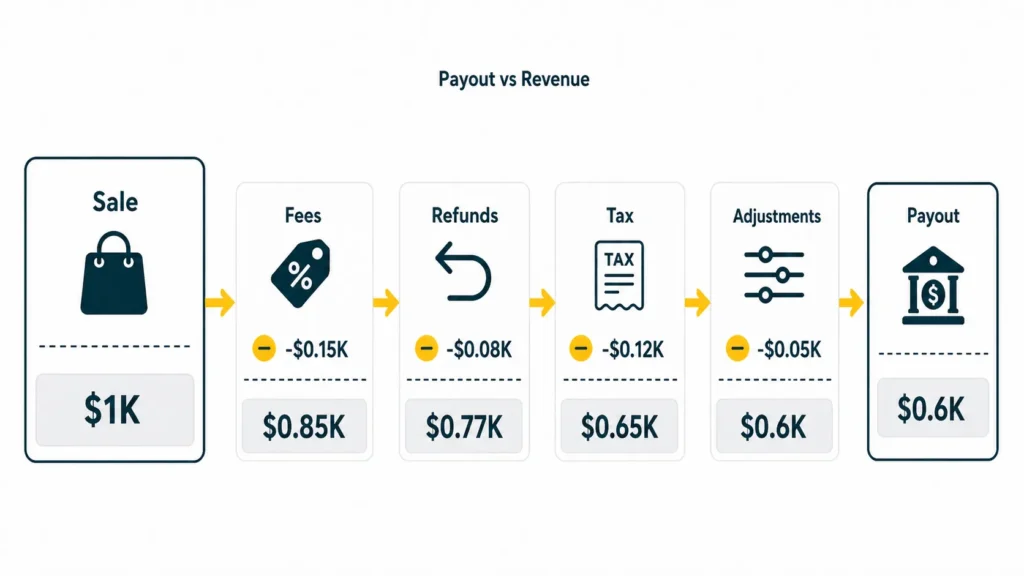
Your books should still show the full sale and what got deducted. Otherwise, you lose the real story and end up making decisions from numbers you can’t fully trust.
If your cross-border numbers are hard to understand, getting your ecommerce accounting setup cleaned up can help you see what actually happened and what needs to be fixed first.
- Also read: “Ecommerce Financial Statements Guide”
Why Is Cross-Border Ecommerce Accounting Complicated?
Most basic accounting setups are built for one country, and one tax system. That works for a while, then a few things get messy at the same time.
- Payouts that don’t match sales: Shopify, Amazon, Stripe, and PayPal deduct fees, refunds, tax, chargebacks, and other adjustments before money reaches your bank. So if $4,200 lands in your account, you may have sold $5,000. Your payout is not your sales number.
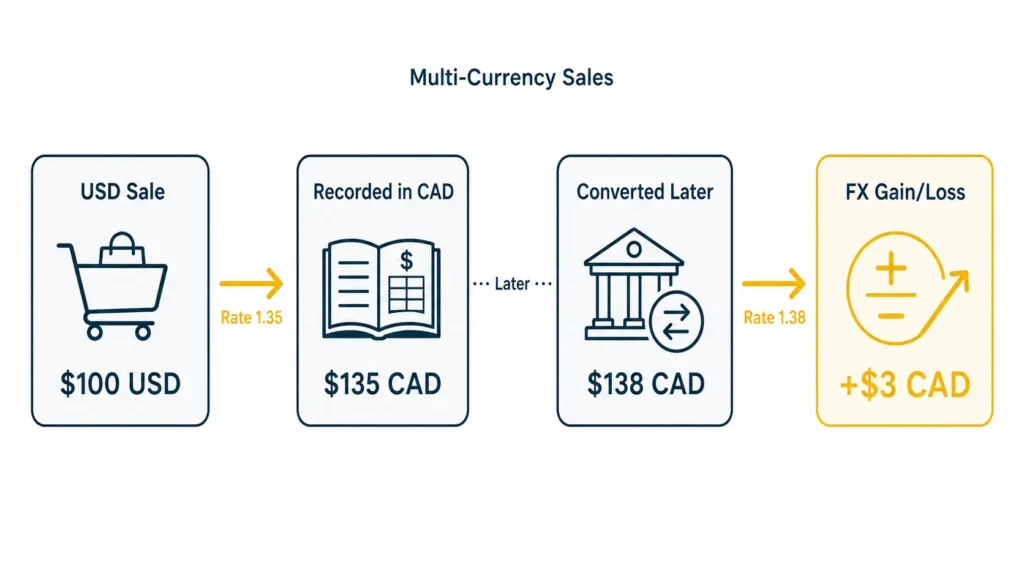
- Exchange rates that keep moving: If you sell in USD and report in CAD, the sale, payout, and conversion can all happen at different rates. That difference is a foreign exchange gain or loss. It means your store did not sell more, the currency moved. Many stores use Bank of Canada rates according to CRA guidance to keep the exchange rate consistent.
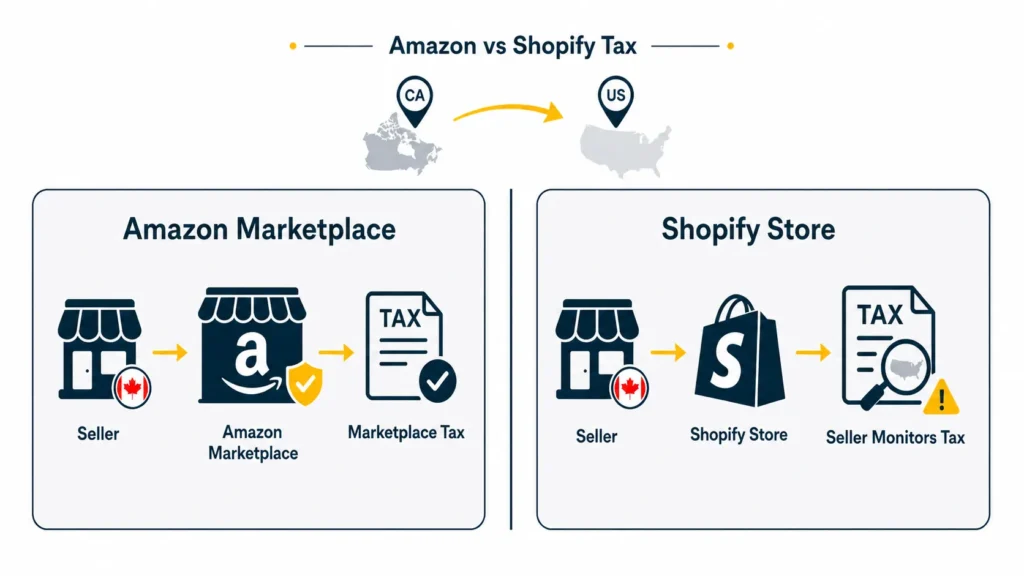
- Tax rules that change by channel: Under Amazon Marketplace Tax Collection, Amazon may collect tax on some marketplace sales, but your Shopify store is different. If you mix Amazon and Shopify sales together, it gets harder to see the clear picture of your financial situation.
- Landed cost that gets missed: Your product cost is not just the supplier invoice. If you buy a product for $20, then pay another $4 for freight, duty, brokerage, and import fees, your real cost is $24. If your books only show $20, your profit looks better than it really is.
Also read: “Ecommerce Payment Reconciliation: How to Match Sales, Fees, and Payouts“
How to Set Up Your Books for Multiple Countries and Currencies
You don’t need complicated accounting. You need clear books that answer: what did we sell, what got deducted, what tax did we collect, and which market is actually making money?
A. Pick a base currency and stick to it
For most Canadian sellers, your base currency is CAD. Even if the sale happens in USD, your books should clearly show:
- the original sale amount
- the CAD value
- the exchange rate used
- the payout received
- any FX gain or loss
That way, currency movement stays separate from actual product sales.
B. Track FX gains and losses
If you earn USD $5,000 at a 1.35 exchange rate, your books show $6,750 CAD. If you convert later at 1.38, you receive $6,900 CAD. That extra $150 is not more sales. It’s currency movement.
This sounds technical, but it’s simple. If you don’t track it, your income can look wrong and you may not know why.
C. Use a multi-currency account
Converting every USD payout right away can cut into your margin. A multi-currency account helps you hold USD, pay USD suppliers, and convert more intentionally. Basically, currency needs a system. Otherwise, fees and exchange rate changes can quietly eat into profit.
If Shopify fees are hard to handle, SAL’s Shopify Fee Calculator can help you see whether your current plan still makes sense at your sales volume.
D. Build landed cost into your inventory
This is one of the most common things we see. A seller records the supplier invoice as inventory cost, then puts freight, duty, and brokerage somewhere else. Sounds harmless, right? Technically, it can throw off your margins, and your profit looks better than it really is.
Let’s say you buy $10,000 of inventory and pay $1,550 in freight, duties, and brokerage, your real cost is $11,550. If your books only show $10,000, your profit looks better than it really is.
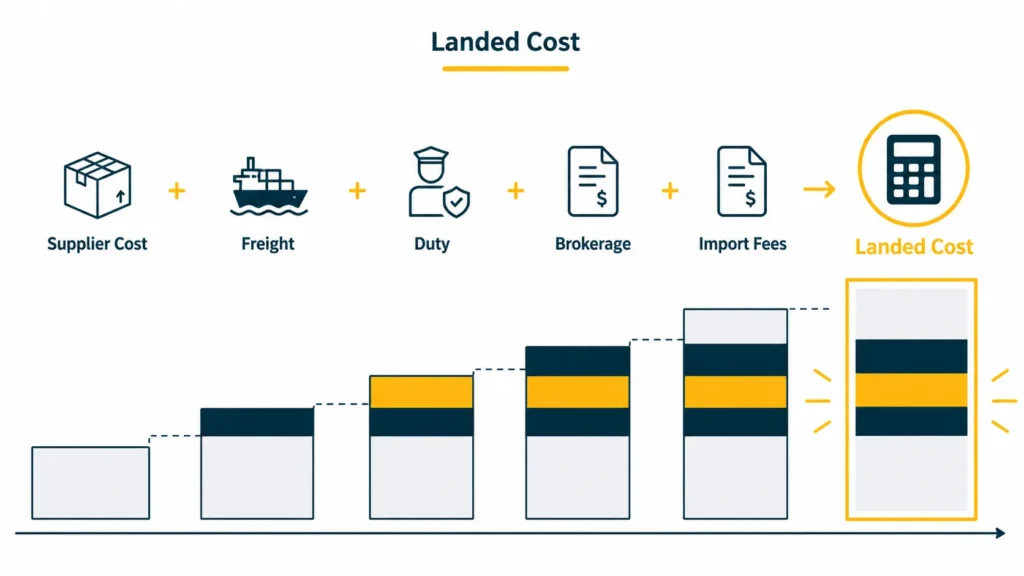
The point is, your supplier invoice is not your full cost. Until freight, duty, and brokerage are in there too, your margins aren’t real.
- Also read: “How to Calculate COGS for Ecommerce Stores“
E. Keep your categories useful
Your chart of accounts is just the category list in your accounting system. You don’t need hundreds of categories, just enough detail to understand what’s happening.
For cross-border ecommerce, that means separating things like:
- Canada vs. US sales, and Shopify vs. Amazon revenue
- refunds, platform fees, GST/HST, and US sales tax
- landed cost, FX gains and losses, and activity between your Canadian company and US company
The point isn’t to make your books look fancy. It’s to make your numbers useful.
- Also read: “US Sales Tax Requirements for Canadian Sellers“
How to Stay Compliant With Cross-Border Tax Rules
Tax is where a lot of Canadian ecommerce sellers start to feel unsure. That’s normal. Basically, cross-border tax comes down to knowing what applies in Canada, what applies in the US, and how to keep the records clean.
GST/HST in Canada
You probably already know GST/HST is part of running a Canadian ecommerce business. The hard part is keeping it clean in your ecommerce reports.
In Canada, once your taxable sales hit $30,000 in a single quarter (or across any four consecutive quarters) GST/HST rules kick in. So if your Canadian sales have been growing, it’s worth checking where you sit.
What you need to keep clear
Once GST/HST applies, your books should show:
- what GST/HST you collected
- what a platform may have collected
- what tax you paid on expenses
- what you may need to remit
The common mistake is simple: tax gets mixed into sales. Collected GST/HST is not really your revenue.
If you’re not sure what GST/HST you collected, paid, or still owe, SAL’s GST/HST Refund Calculator for Ecommerce Stores can help you get a clearer starting point.
US sales tax
US sales tax is one of the biggest surprises for Canadian sellers because there is no single US sales tax system. Each state has its own rules.
Since the 2018 South Dakota v. Wayfair ruling, states can require remote sellers to collect sales tax based on economic activity, not just physical presence.
Here’s the practical version
Amazon may collect tax for marketplace sales in many states.
Shopify is different. If you sell through your own Shopify store, you need to watch your own nexus. Nexus just means your business has enough connection to a state that sales tax rules may apply.This does not mean every Canadian seller needs to register everywhere tomorrow. But if your US sales are growing, you should start tracking sales by state before the numbers get big.
If you’re not sure what rules apply, working with a cross-border tax accountant can help you understand where you may have obligations and what to fix before filing season.
Transfer pricing in ecommerce
This one sounds technical, but the idea is simple.
If you have a Canadian company and a US LLC, say, your Canadian entity buys inventory and ships it to your US entity to fulfill American orders, there needs to be a documented reason for that transfer and a price that makes sense.
For example:
- your Canadian company may sell inventory to your US company
- your US company may pay your Canadian company for support
- one company may cover costs that belong to the other
Basically, related companies still need to act like real companies. The pricing should make sense, and the records should explain what happened.
If you’re thinking about setting up a US company, getting the LLC setup right from the start can help you avoid confusion around ownership, and tax filing.
- Also read: “Canada-US Transfer Pricing Guide“
Global Ecommerce Accounting Best Practices and Mistakes to Avoid
Most ecommerce accounting problems don’t happen because sellers are careless. They happen because the business grows, but the setup stays too basic.
Here’s what helps:
- Reconcile platform payouts monthly. Amazon and Shopify deduct fees, refunds, tax, and adjustments before paying you. Don’t wait until quarter-end.
- Don’t record payouts as revenue. If Shopify sends you $4,200 after $300 in fees, your revenue is not $4,200. Sales, fees, refunds, and tax should be separate.
- Know which company owns which sales. If you have a Canadian company and a US company, each platform account should be tied to the right company.
- Review FX every quarter. FX gains and losses can build quietly. A quick quarterly review helps catch issues while they’re still fresh.
- Keep the right records. Save Shopify reports, Amazon settlements, payment reports, bank statements, customs documents, freight bills, inventory records, and tax filings. CRA generally requires records to be kept for six years.
How SAL Accounting Can Help
Not sure if your current setup is handling the cross-border side correctly? You’re not the only one. This is one of the most common things we see with Canadian sellers who start selling into the US.
The real problem is not just “doing the books.” It’s knowing whether your numbers make sense.
You should be able to see what you sold, what fees and tax were taken out, where currency changed the numbers, and which market is making money. Most importantly, you should know what needs to be cleaned up first.
At SAL Accounting, we help Canadian ecommerce sellers get those answers from their books. You focus on growing the store. We help make the numbers behind it easier to understand and to trust.
Global ecommerce accounting is not just about staying compliant. It’s about having numbers you can use when you’re making decisions.
Book a free consultation with our ecommerce accountants and let’s take a look at what your setup actually needs.