
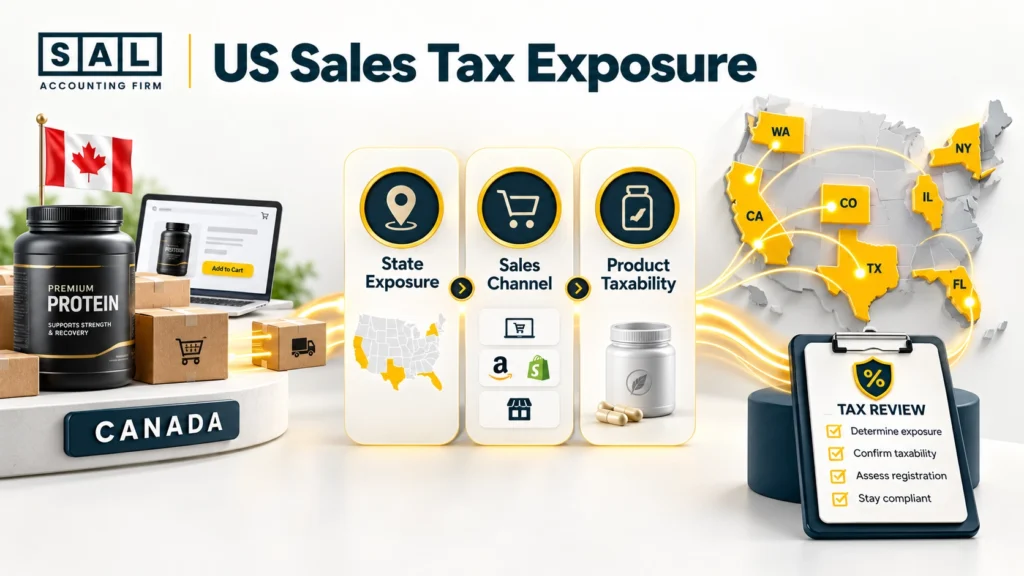
Being based in Canada doesn’t keep US sales tax away from your supplement sales. Once orders flow to American customers, three questions decide your exposure: which states you’re selling into, whether sales run through your own store or a marketplace, and whether each product is taxable where it lands.
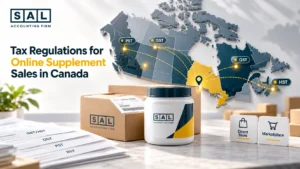
Sorting those out for supplement brands is part of the cross-border work at SAL Accounting. This map shows which states deserve a closer look first:
Wondering which states you may have already crossed into? Check with the US Economic Nexus Threshold Checker.
Quick Takeaways
- A Canadian address doesn’t exempt you from US sales tax.
- US sales tax is set state by state, not nationally.
- Sales into a state, or inventory stored there, can create a sales tax connection called nexus.
- Marketplaces collect tax on their own sales in many states, but not on your direct store sales.
- Supplements aren’t taxed the same way everywhere. Some states tax them, others treat many like food.
- Review your exposure by state, channel, and product, and repeat it as you grow.
Does a Canadian Online Supplement Seller Have to Worry About US Sales Tax?
Yes, once your US sales grow. Being located in Canada isn’t the only factor that matters.
A US state can expect an out-of-state seller to collect its sales tax. That includes a Canadian business. What counts is:
- How much you sell into each state
- Whether you have nexus there
- Where your inventory or operations sit
- How the sale is made: your own store or a marketplace
- Whether the product itself is taxable in that state
Put simply, it comes down to state exposure, sales channel, and product taxability.
Keep in mind, US sales tax is separate from US income tax. This article covers sales tax only. For the broader picture beyond supplements, see the US sales tax requirements for Canadian sellers. The rules at home are different again, and the Canadian sales tax rules for online supplement sellers work on their own track.
What Three Questions Should a Canadian Supplement Seller Check for US Sales Tax?
Three questions shape almost every answer. They only make sense when you look at them together.
| Question | What You’re Checking | Why It Matters | Example |
|---|---|---|---|
| Where are you selling? | Which states receive your orders | Nexus is decided state by state | Strong sales into Washington and Texas |
| How are you selling? | Your own store, a marketplace, or both | Changes who collects the tax | Shopify direct plus Amazon |
| What are you selling? | Vitamins, protein, meal replacements, other products | Taxability differs by state and product | Capsules taxed, a food product exempt |
Where Are You Selling?
Which states are your customers in, and has your activity there reached the point where a sales tax obligation could start?
How Are You Selling?
Are orders coming through your own ecommerce store, a marketplace like Amazon, or both?
What Are You Selling?
Are your products vitamins, protein powders, meal replacements, other nutrition products, or accessories? Each can be treated differently.
A “yes” to one question doesn’t answer the others. A state where you have nexus might not tax your main product. A marketplace might collect tax on some sales but not others. You need all three answers, state by state.
When Can Economic Nexus Create a US Sales Tax Obligation for a Canadian Seller?
When your sales into a state pass that state’s threshold. Since the US Supreme Court’s Wayfair decision in 2018, states can require out-of-state sellers to collect sales tax even without a physical presence.
At a high level:
- States use your sales activity to decide whether you have enough connection to owe sales tax
- Thresholds and measurement rules aren’t the same in every state
- Some states count only dollar sales, while others have also used order counts
- Some states include marketplace sales in your total, and others don’t
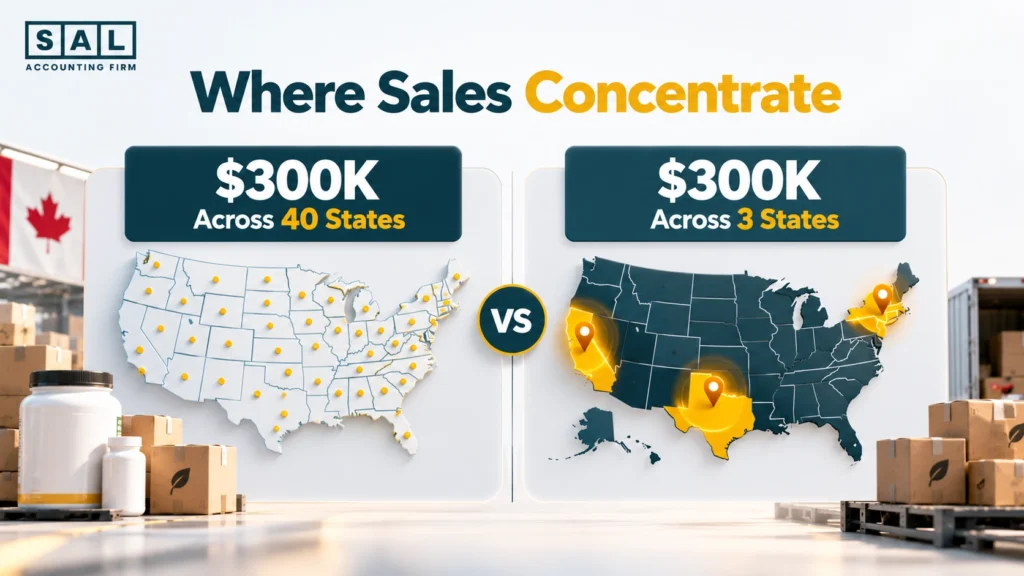
That’s why you need to track US sales by state, not just your total US revenue. $300,000 of US sales spread across 40 states can look very different from $300,000 concentrated in three.
The mechanics of thresholds and timing go deeper than this map needs. Knowing how sales tax nexus works for online sellers is the next step once you see which states are getting close.
Can Storing Supplement Inventory in the US Change Your Sales Tax Picture?
Yes. Nexus isn’t only about sales volume. Where your stock sits can matter too.
Many Canadian supplement brands store inventory in the US for faster delivery. Common examples:
- A US 3PL warehouse
- Amazon FBA inventory spread across fulfillment centres
- Another US storage or fulfillment partner
Having inventory in a state can give you a physical presence there, which may create nexus even if your sales in that state are small. Amazon also moves FBA stock between warehouses, so your inventory can end up in states you never chose.
That’s why warehouse locations belong in your nexus review, not only your sales reports. Keeping track of where your stock is starts with solid Amazon FBA accounting practices, since FBA inventory reports show which states your units sit in.
Case Study: How Sophie’s Collagen Brand in Lorne Park, Mississauga Reviews a US Warehouse Move1
Sophie sells collagen and joint supplements online from a small warehouse in Lorne Park, Mississauga. About half her sales go to US customers, all shipped from Canada. To speed up delivery, she plans to move her US stock to a 3PL warehouse in Pennsylvania. She thinks of it as a shipping decision, nothing more.
The Problem
Sophie hasn’t considered that storing inventory in Pennsylvania could create a sales tax connection there, even though her Pennsylvania sales are modest. She also hasn’t looked at whether her products are taxable in the states where most of her US customers live.
What We Do
Before the move, we map her US sales by state and channel. We flag Pennsylvania as a likely new nexus point once the inventory arrives. We also check which of her top states tax her collagen powders and capsules, and we connect her with a US sales tax specialist to confirm the state rules.
The Result
Sophie goes ahead with the warehouse, but with a plan. She registers where needed before the inventory lands, not after. She also knows which states to watch as her direct sales grow.
How Are Marketplace Sales Different From Direct Online Supplement Sales?
The channel changes who collects the tax.
| Factor | Marketplace Sale | Direct Store Sale |
|---|---|---|
| Example | Order on Amazon | Order on your Shopify store |
| Who usually collects | The marketplace, in states with marketplace facilitator rules | You, if you have nexus and the product is taxable |
| Your role | Monitor exposure and records | Register, collect, and file where required |
| Common mistake | Assuming it covers everything | Forgetting direct sales need their own review |
Nearly every state with a sales tax now requires large marketplaces to collect tax on the sales they facilitate. So Amazon may collect on your Amazon orders where those rules apply.
But your direct store sales are a separate channel. Say you sell $250,000 on Amazon and $200,000 through your own Shopify store into the US. Amazon’s collection covers the Amazon orders only. The Shopify sales still need their own state-by-state review.
Marketplace collection also doesn’t mean you can stop watching your overall state exposure. Amazon’s wider tax picture is laid out in this Amazon seller tax guide.
Pro Tip: Pull US sales by state for each channel separately. A state that looks quiet in total may be busy on your direct store alone.
Are Vitamins, Protein Powders, and Other Supplements Taxed the Same in Every State?
No. Having nexus in a state doesn’t tell you whether your products are taxable there. That’s a separate question.
Here’s why supplements are tricky. Many states that follow shared sales tax definitions treat “dietary supplements” differently from food. The label often decides it.
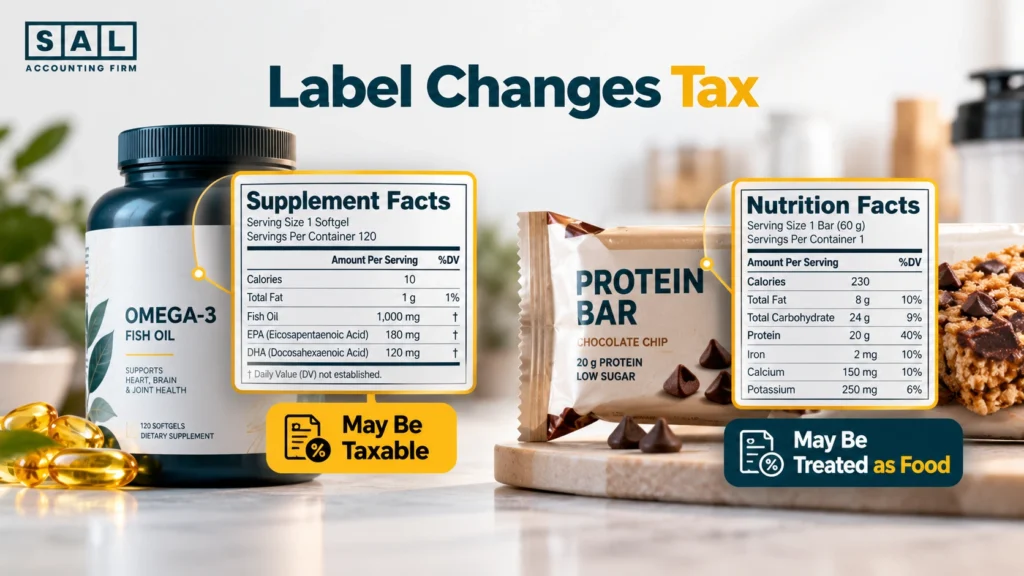
Washington is a clear example. Its Department of Revenue explains that products labelled with a “Supplement Facts” box are dietary supplements and are taxable. Products with a “Nutrition Facts” box are treated as food, which is generally exempt. Iowa uses a similar test. A taxable dietary supplement in Iowa must meet all three criteria, including having a “supplement facts” box on the label.
So in the same state:
- A vitamin capsule with a Supplement Facts label may be taxable
- A protein bar with a Nutrition Facts label may be treated as food
- A meal replacement shake may fall on either side, depending on its label and how it’s sold
Other states treat many supplements more like groceries, with lower rates or exemptions. There’s no single US answer.
Keep the two questions apart:
- Nexus answers: do we have enough connection with this state to review our obligations?
- Taxability answers: is this specific product taxable under this state’s rules?
One should never stand in for the other.
How Should a Canadian Supplement Seller Review US Sales Tax Exposure?
Map your business across three lenses at once:
State × Channel × Product
For each state you sell into, note:
- State: sales activity, nexus status, and any inventory there
- Channel: direct sales, marketplace sales, and who collected the tax
- Product: product type and the tax treatment that needs confirming
Here’s what part of that map might look like.
| State | Channel | Product | Who Collects | What to Review |
|---|---|---|---|---|
| Washington | Shopify | Vitamin capsules | Seller, if nexus | Nexus and registration |
| Washington | Amazon | Vitamin capsules | Marketplace | Confirm Amazon collects |
| Texas | Shopify | Protein bar | Depends on taxability | Food vs supplement treatment |
| Pennsylvania | Amazon FBA | Collagen powder | Marketplace, with inventory in state | Physical presence review |
Once the map is built, it shows which states need a closer look for registration, collection, reporting, or filing. When you get to that stage, it helps to know how to file sales tax for a US ecommerce business, ideally with a US sales tax specialist alongside your accountant.
Case Study: How Ethan’s Vitamin Brand in the Annex, Toronto Finds Its US Gaps2
Ethan runs an online vitamin and protein brand from a small office in the Annex, Toronto. He sells to US customers through his own Shopify store and through Amazon.com, with FBA inventory in several US states. He assumes Amazon takes care of US sales tax, so he’s never charged tax on his Shopify orders.
The Problem
Amazon collects tax on Ethan’s Amazon orders in states with marketplace rules, but his Shopify store collects nothing. His direct sales to Washington customers have grown fast this year. His vitamin capsules carry a Supplement Facts label, while one of his protein bars uses a Nutrition Facts label, so the two may be treated differently there. His FBA stock also sits in states he’s never reviewed.
What We Do
We build his State × Channel × Product map. We flag Washington for a nexus review on his direct sales, and we note that his capsules and his protein bar likely need different treatment there. We also list every state where Amazon has placed his FBA inventory. Then we bring in a US sales tax specialist to confirm registrations.
The Result
Ethan registers in the states that need it and sets up his Shopify store to collect where required. He keeps relying on Amazon for its marketplace sales, but now he knows exactly which sales Amazon covers and which ones are his.
What Changes Should Trigger Another US Sales Tax Review?
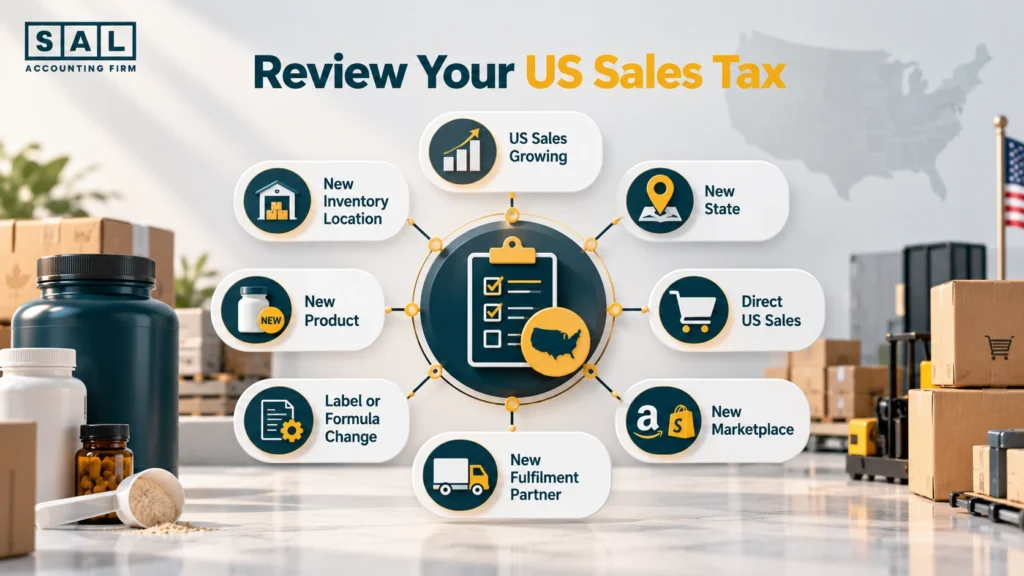
Your US sales tax position isn’t a one-time answer. Revisit it when something meaningful changes, such as:
- US sales growing quickly
- Strong sales into a state you haven’t reviewed
- Starting direct ecommerce sales to the US
- Adding a new marketplace
- Storing inventory in a new US location
- Launching a new product category
- Changing a product’s label or formula
- Changing fulfillment partners
Label changes deserve special attention for supplements. Switching from a Nutrition Facts panel to a Supplement Facts panel can change a product’s tax treatment in some states overnight.
Bigger moves, like opening a US warehouse or forming a US entity, are part of setting up a Canadian ecommerce business for US expansion, so it’s worth reviewing sales tax as part of that plan.
- Read more: “The Cost of Ignoring Cross-Border Tax Planning”
Final Thought: Which US States Need a Closer Look for Your Online Supplement Brand?
US sales tax isn’t one question for a Canadian supplement seller. It’s three: where you’re selling, how you’re selling, and what you’re selling. Nexus, channel, and product taxability each need their own answer, state by state.
Map your US sales once, then revisit it as your business grows. That’s how you catch a new obligation before it catches you.
Getting cross-border tax right is one step toward stronger numbers. Map out what comes next with our financial roadmap for online brands.