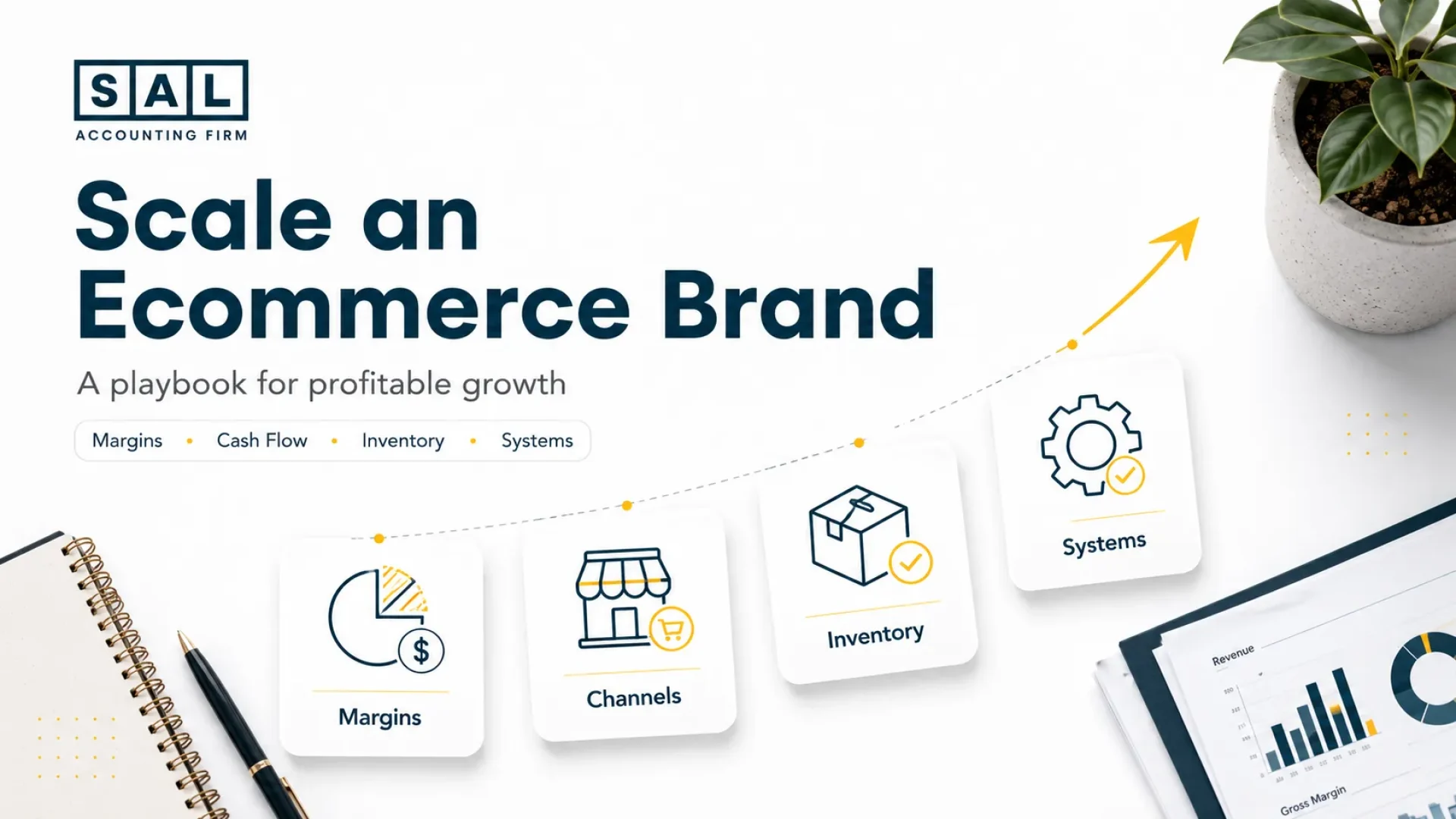
To scale an ecommerce brand, you need to grow sales only after your margins, cash flow, inventory, and systems can support the extra demand. In Q1 2026, U.S. retail eCommerce sales reached $326.7 billion, up 9.8% from Q1 2025, according to the U.S. Census Bureau quarterly eCommerce report.
In this guide SAL Accounting shows you what to check first, so growth feels planned instead of messy.
Talk to our e-commerce accounting expert before you scale on guesswork
Quick Takeaways
- Scaling is not just selling more. It means growing without letting costs, cash pressure, and operational mistakes grow at the same speed.
- Unit economics come before growth channels.
- The most important KPIs are contribution margin, LTV/CAC, MER, CVR, AOV, retention, inventory, and cash runway.
- Paid ads, Amazon, wholesale, and international expansion should be layered in when your numbers can support them.
- Clean accounting, tax tracking, and inventory forecasting become more important as the brand grows.
Pressure-test your margins with the Shopify Fee Calculator before bigger sales turn into smaller profits
How to Scale an Ecommerce Brand: The Simple Answer
To scale an ecommerce brand, first prove that each sale makes sense financially. Then build the channels, inventory, fulfillment, team, and accounting systems that let you grow without losing control. Don’t start with “How do we get more orders?” Start with:
- Which products are actually profitable?
- Which channels bring customers you can afford?
- Can inventory keep up?
- Will cash flow survive bigger orders and bigger ad spend?
- Are tax, bookkeeping, and reporting clean enough to support growth?
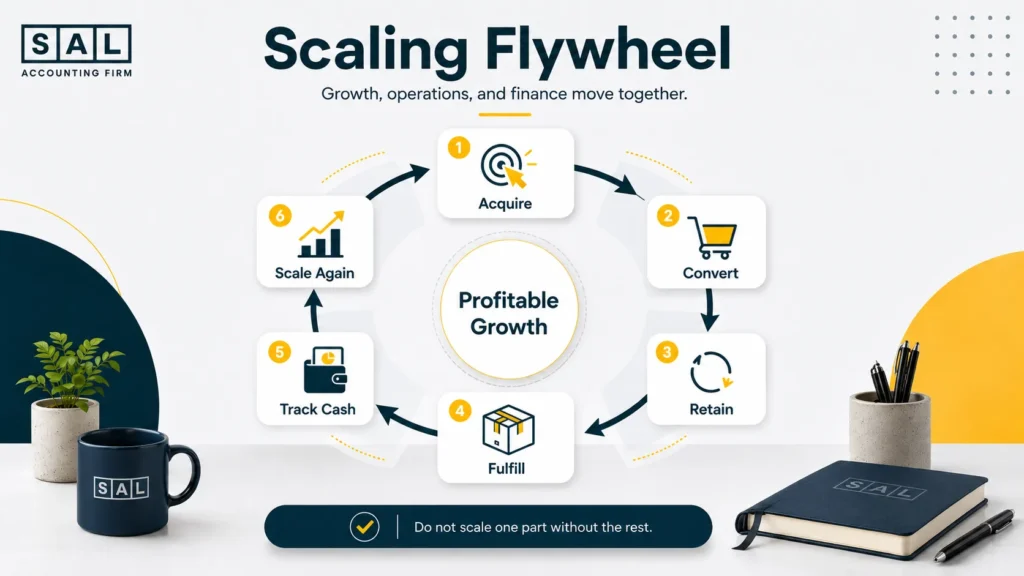
That is the difference between growth and scale. Growth can mean more revenue. Scale means the business can handle more revenue without becoming messier, less profitable, or harder to manage.
If the numbers are already starting to feel messy, get cleaner ecommerce books before bigger sales make them harder to untangle. That same foundation matters in ecommerce accounting for small businesses. A messy setup at $300K usually gets more painful at $1M.
Pro Tip: Before you add another sales channel, pull one month of orders and ask: “Which products actually made money after product cost, shipping, fees, refunds, and ads?” If you cannot answer that, you are not scaling yet. You are guessing louder.
Are You Ready to Scale Your Ecommerce Brand?
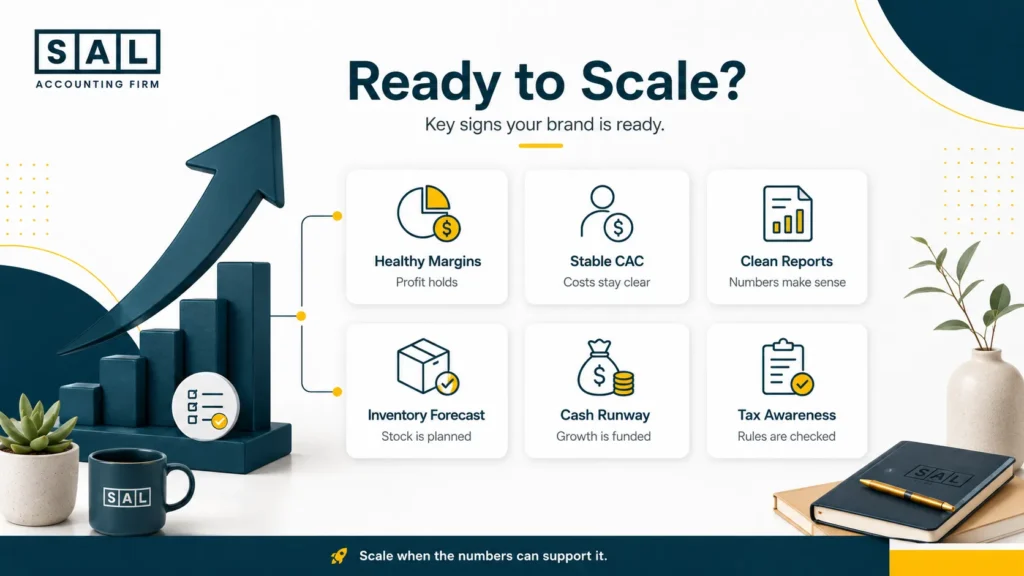
You are probably ready to scale when the business has a repeatable product, a clear customer, enough margin, and enough cash to support growth. You may not be ready if sales are growing but the bank account still feels confusing. Before scaling, check these signs:
- Your bestsellers have healthy margins.
- You know your real cost per order.
- Your customer acquisition cost is stable.
- You can forecast inventory before promotions.
- Your monthly reports are current.
- You know whether Shopify, Amazon, or wholesale is actually making money.
- You understand your sales tax and GST/HST position.
For Canadian ecommerce brands, tax needs to be part of the scaling check. The CRA explains when businesses may stop being small suppliers under its GST/HST small supplier rules. When tax starts showing up in more than one channel, your GST/HST return filing needs to match what actually happened across the store, not just what landed in the bank.
- Read more: “GST/HST Refund Calculator for Ecommerce Stores”
Unit Economics: The Numbers That Decide If Scaling Makes Sense
Unit economics simply means the money behind one order or one customer.
Example: Let’s say you sell a product for $100. After product cost, packaging, shipping, payment fees, discounts, and returns, you keep $35 before ads. If it costs $45 to acquire that customer, more ad spend will not fix the problem. It will make the problem bigger.
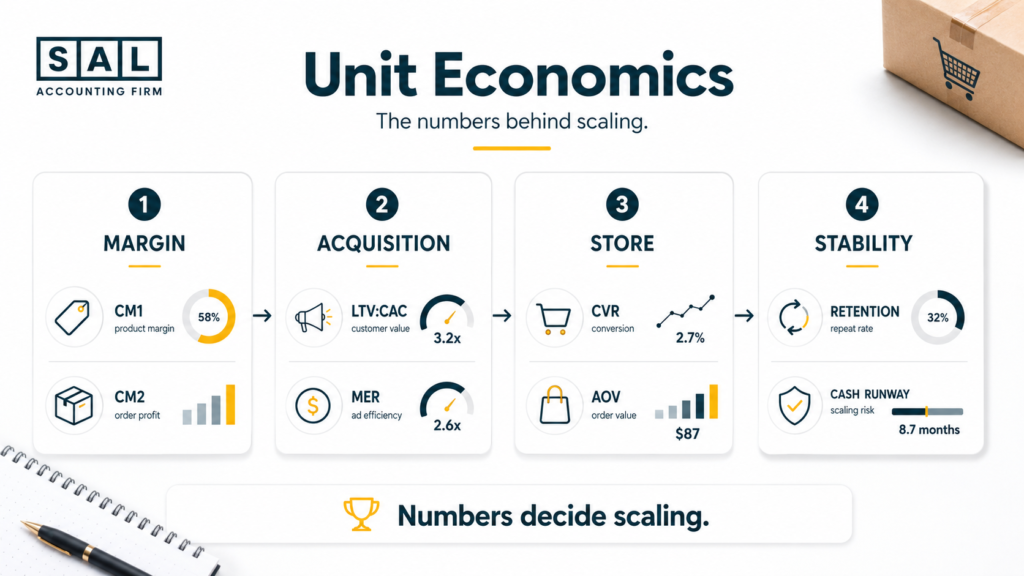
That is why contribution margin matters. Here’s a simple view of the main scaling KPIs.
| KPI | What It Shows | Simple Formula | Why It Matters |
| CM1 | Profit after product cost | Revenue minus COGS | Shows product margin |
| CM2 | Profit after variable costs | CM1 minus fees, shipping, returns | Shows order-level profit |
| LTV/CAC | Customer value vs cost | LTV divided by CAC | Shows if acquisition works |
| MER | Total ad efficiency | Revenue divided by ad spend | Shows full marketing return |
| CVR | Store conversion | Orders divided by sessions | Shows traffic quality |
| AOV | Average order size | Revenue divided by orders | Helps lift margin |
| Retention | Repeat purchase strength | Repeat buyers divided by customers | Reduces ad pressure |
| Cash runway | Time before cash runs tight | Cash divided by monthly burn | Shows scaling risk |
Stripe also puts unit economics, cash flow, and supply chain strength at the centre of ecommerce scaling. Demand is not enough. You need to fulfill orders without shrinking margins.
A clean margin check starts with calculating COGS for ecommerce stores. Then check e-commerce payment reconciliation, because the payout is not the full sale.
Pro Tip: Don’t judge profit from platform dashboards alone. Check margin after product costs, fees, refunds, shipping, and ads.
Ecommerce Growth Strategy: Which Channels to Scale First
A strong ecommerce growth strategy does not mean adding every channel at once. It means adding the next channel when the business is ready for it.
Start with the lowest-risk improvements first:
- Improve your product pages and conversion rate.
- Build email and SMS retention.
- Scale paid ads slowly around proven products.
- Add SEO and content for long-term demand.
- Test affiliates or influencers.
- Add Amazon, wholesale, or retail when margins support it.
- Expand internationally only when operations and tax are ready.
Salesforce defines ecommerce scaling as growing revenue and customers without drastically increasing costs, which is a helpful way to think about it. Scale is not just more traffic. It is better capacity. Salesforce’s ecommerce scaling guide also points to operations, technology, and retention as part of the scaling system. Here’s how different growth channels can affect the numbers.
| Channel | Best For | Main Risk | Check Before Scaling |
| Shopify/DTC | Brand control | High CAC | CM2, CVR, LTV/CAC |
| Amazon | Demand capture | Fees and less control | Net margin after Amazon fees |
| Wholesale | Larger orders | Lower margins | Payment terms and cash flow |
| Retail | Visibility | Inventory pressure | Sell-through and production capacity |
| International | New markets | Tax, duties, returns | Landed cost and sales tax exposure |
Shopify and Amazon both change what you actually keep. Shopify lists plan and transaction costs on its pricing page, while Amazon notes 2026 U.S. FBA fees will rise by an average of $0.08 per unit in its seller fee update.
That is why Shopify vs Amazon FBA is not just a channel choice. It is a cash flow, fee, and profit decision.
Pro Tip: Before adding a new channel, compare one SKU across each option. Check fees, shipping, returns, discounts, payout timing, and what you actually keep.
Case Study: How a Liberty Village Shopify Brand Scales Without Guessing1
A Shopify apparel founder in Liberty Village, Toronto, has strong monthly sales and a growing repeat customer base. The brand looks healthy from the outside. Orders are coming in, Meta ads are active, and the founder is thinking about increasing spend before the next seasonal launch. But the bank account does not seem to match Shopify sales, and some products feel busy without clearly being profitable.
The Problem
The brand is treating payouts like revenue. Fees, refunds, discounts, shipping, and ad spend are not being reviewed clearly by product or campaign. So the founder can see sales, but not what the business actually keeps.
What We Do
We would rebuild the reporting around actual sales, product costs, platform fees, refunds, ad spend, and contribution margin. Then the founder can see which products can handle more ad spend and which ones need pricing, shipping, or cost fixes before scaling.
The same thing often shows up when brands tighten their Shopify accounting best practices. The goal is not just cleaner books. It is knowing which decisions are safe to make next.
Inventory, Fulfillment, and 3PL: How to Grow Without Breaking Operations
A lot of ecommerce brands scale marketing before they scale operations. That creates problems like:
- stockouts during strong campaigns
- too much cash tied up in slow inventory
- wrong product costs
- late supplier orders
- rising 3PL fees
- messy returns
- overselling across Shopify, Amazon, and wholesale
Inventory forecasting does not need to be fancy at first. But it does need to be consistent. A simple forecast should include:
- recent sales by SKU
- seasonal demand
- planned promotions
- supplier lead times
- safety stock
- cash needed for purchase orders
- storage and fulfillment costs
For Shopify sellers, Shopify inventory accounting keeps product cost tied to what was actually sold, not just what was purchased.
For Amazon sellers, Amazon FBA bookkeeping matters because settlement reports can include storage, fulfillment, referral fees, reimbursements, refunds, and adjustments in one place.
International shipping adds another layer. Shopify tells merchants to verify HS codes and country of origin before collecting duties and import taxes at checkout in its duties and import taxes guide. If that setup is rushed, customers can end up with surprise charges or delayed shipments.
Pro Tip: Forecast inventory in dollars, not only units. A purchase order for 5,000 units may look fine from a stock perspective, but if it drains cash before ad spend, payroll, tax, and supplier bills are covered, growth can get uncomfortable fast.
Case Study: How a Meadowvale Amazon Seller Prepares for US Growth2
An Amazon home goods seller near Meadowvale, Mississauga, has steady Canadian sales and wants to push harder into the U.S. The product sells well, suppliers are in place, and the founder sees a clear opportunity. But the bigger the brand gets, the harder it becomes to answer basic questions: how much inventory to order, how much cash to keep aside, and whether Amazon fees are eating too much margin.
The Problem
The seller is planning U.S. growth before getting a clean view of landed cost, Amazon fees, storage costs, inventory timing, and sales tax exposure. The opportunity is real, but the numbers are not clear enough yet.
What We Do
We would map the full cost of selling each product, including product cost, freight, duties, Amazon fees, storage, refunds, and tax considerations. Then the founder can decide which SKUs are ready for U.S. growth and which ones need pricing or cost changes first.
For sellers moving beyond Canada, international selling through Amazon FBA gets more complex than simply turning on a new marketplace. Demand is only one part of the decision. The numbers have to work after marketplace fees, freight, duties, storage, and tax.
Finance, Tax, and Accounting Systems You Need Before Scaling
The bigger your ecommerce brand gets, the less you can rely on rough numbers. You need a clear rhythm for:
- weekly cash review
- monthly close
- inventory and COGS checks
- platform payout reconciliation
- ad spend review
- channel profitability
- sales tax and GST/HST review
- accounts payable and supplier timing
- cash flow forecasting
This is not about making accounting more complicated. It is about making decisions easier.
If Shopify shows $80,000 in sales but only $68,000 hits the bank, your e-commerce financial statements should show where the difference went. U.S. sales tax can also apply without a physical U.S. location. The Sales Tax Institute’s economic nexus chart explains state-by-state thresholds.
Pro Tip: Run a monthly scaling close: margin by channel, inventory, sales tax exposure, cash runway, ad spend, and next purchase orders.
90-Day Growth Plan to Scale an Ecommerce Brand
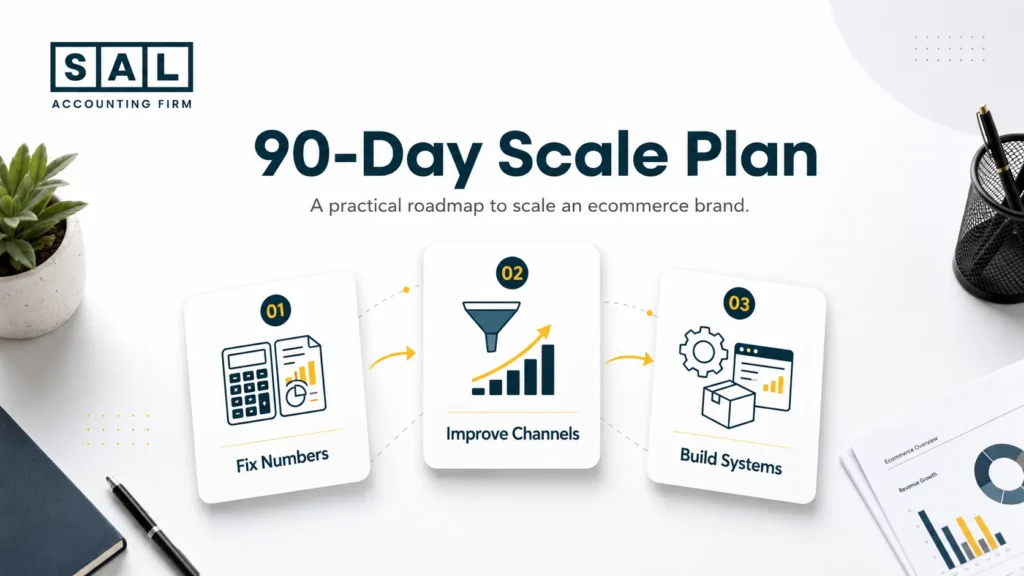
Here’s a simple 90-day growth plan.
| Timeline | Focus | Main Actions | Output |
| Days 1–30 | Numbers | Review CM2, CAC, MER, cash, inventory | Scaling readiness view |
| Days 31–60 | Channels | Improve offer, CVR, email, best ads | Clear growth priorities |
| Days 61–90 | Systems | Forecast inventory, review 3PL, close books | Repeatable scaling rhythm |
In the first 30 days, don’t start by adding new channels. Start by cleaning up what you already have. Look at:
- your top 10 products by profit, not just sales
- your worst-margin SKUs
- your highest-return products
- your best customer segments
- your ad campaigns by contribution margin
- your cash needs for inventory
In days 31–60, improve what already works: product pages, email flows, retargeting, and offers. Tools can help, but only after the setup is clear. QuickBooks and Xero both list plan options, but software will not fix messy numbers. Use ecommerce automation tools only once the process is clean.
In days 61–90, assign clear owners for reporting, inventory, tax checks, and cash planning. If finance is pulling the founder away from growth, compare in-house vs outsourced ecommerce accounting.
Common Mistakes That Stop Ecommerce Brands From Scaling Profitably
Most scaling mistakes are not dramatic. They are small issues that get bigger with volume. Common ones include:
- scaling ads before knowing contribution margin
- trusting ROAS but ignoring MER
- recording payouts as revenue
- expanding to Amazon without checking net margin
- entering wholesale without reviewing payment terms
- ordering too much inventory too early
- ignoring sales tax exposure
- waiting too long to close the books
- using too many tools with no clear owner
- hiring before the process is clear
One of the biggest mistakes is thinking more revenue will automatically create more profit. It might. But only if the numbers work. That is why e-commerce accounting mistakes are worth fixing before the brand gets bigger. Small reporting gaps become expensive when order volume grows.
If the issue is not one mistake but the whole setup feeling unclear, the process of choosing the right ecommerce bookkeeper should start with whether they understand platforms, payouts, inventory, sales tax, and channel-level margin. Not just whether they can categorize transactions.
Final Thoughts: How to Scale an Ecommerce Brand With Confidence
Learning how to scale an ecommerce brand is not just about getting more traffic, spending more on ads, or adding new sales channels. The real work is knowing what is profitable, what is draining cash, which channels are worth scaling, and what systems need to be fixed before growth creates more pressure.
If your store is growing but the numbers are getting harder to trust, book a consultation at SAL Accounting and get a clearer sense of what needs to be tracked, cleaned up, or fixed before the next stage.