
Your accountant filed last year’s return without much trouble. Your books are technically “done” every month. But every time you ask “what’s my margin on this SKU?” or “how much US sales tax do I actually owe?” the answer comes back as a long pause and a “let me check.”
That gap is what this post is about.
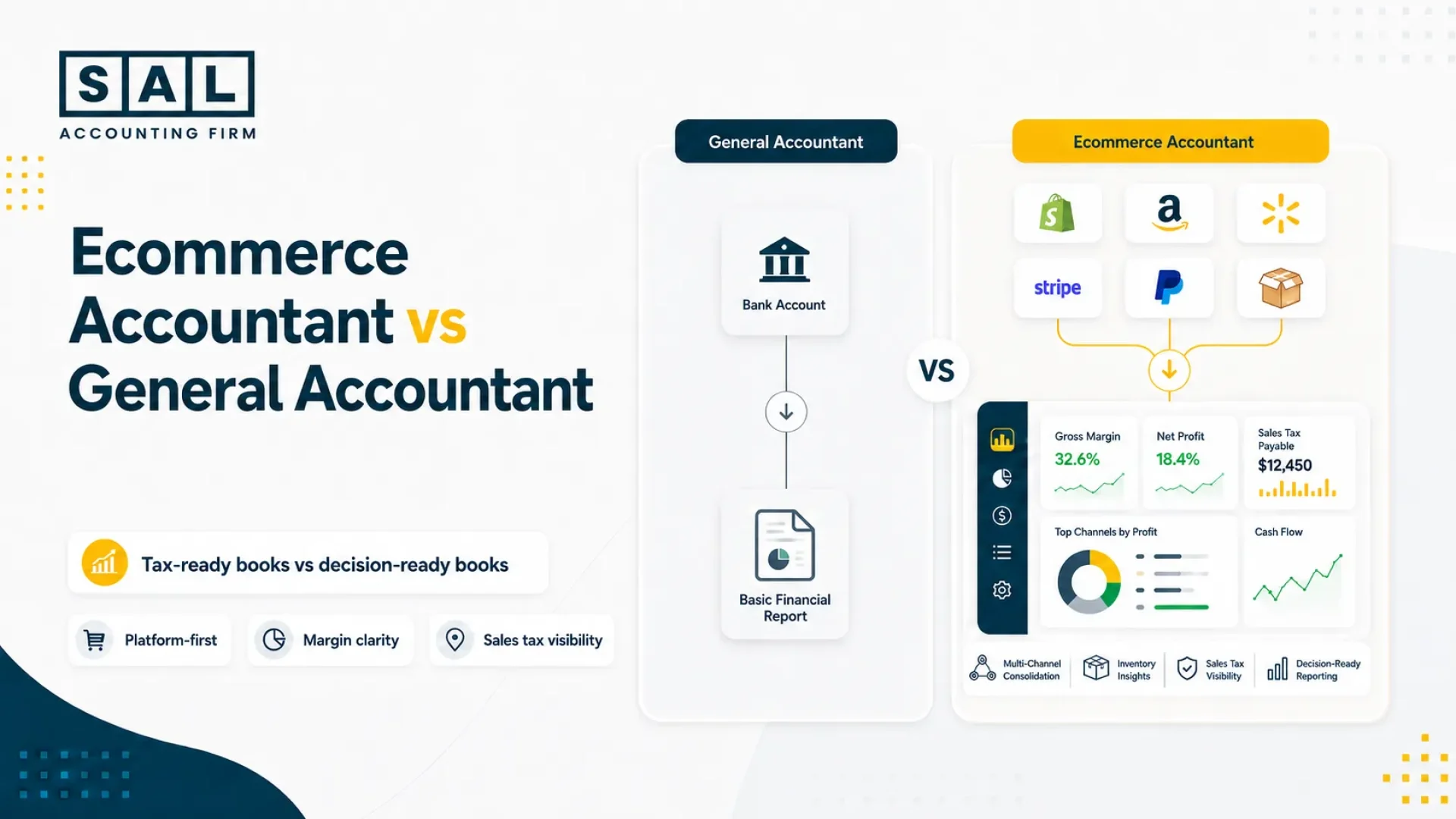
A general accountant is built around the year-end return. An ecommerce accountant is built around the operating decisions you make every week. Both are useful. But they’re not the same job.
We see this a lot with Canadian eCommerce founders at SAL Accounting. The store grows across Shopify, Amazon, Stripe, PayPal, FBA, and US customers, but the books are still being treated like a regular business. Six months later, nobody can explain why the numbers don’t match the store.
Quick Takeaways
- A general accountant usually starts with your bank deposits. An ecommerce accountant starts with your platform reports, then ties them back to the bank.
- The difference shows up when the numbers get messy: Shopify deposits, Amazon payouts, refunds, fees, landed costs, sales tax, and which products are actually making money.
- A generalist can look cheaper on the monthly invoice. The real cost often shows up somewhere else: missed tax issues, invisible margins, cash flow surprises, and decisions made on numbers that don’t match the business.
- You don’t need to wait for the year-end to switch. Most clean handovers can happen mid-year.
- Later in this post, there’s a five-question check you can run on your current books.
What Does an Ecommerce Accountant Do?
An ecommerce accountant manages the full financial picture of an online store: settlement reconciliation, gross-to-net revenue, COGS and landed cost, inventory accounting, Canadian and US sales tax, and SKU-level reporting that shows which products actually make money.
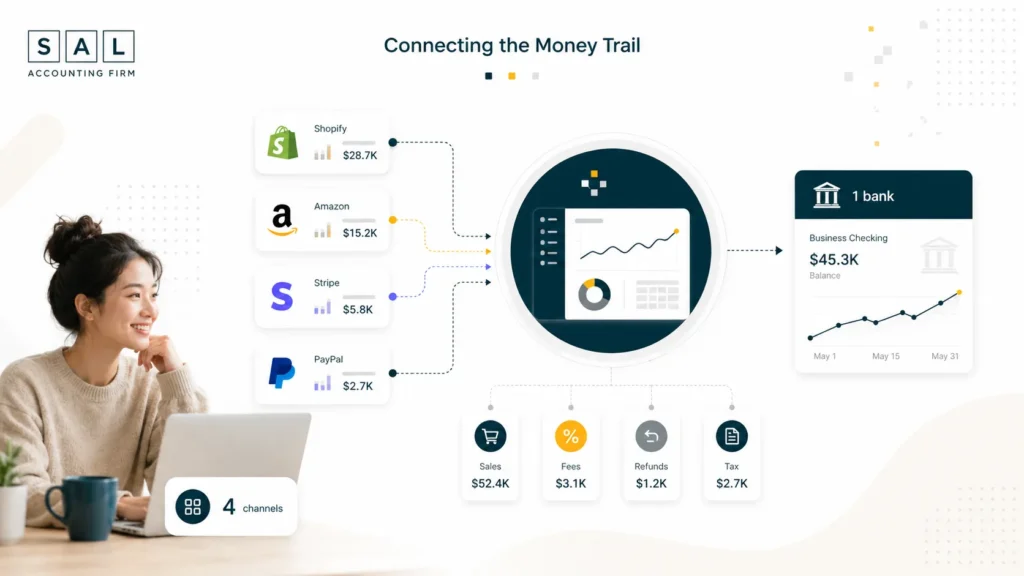
That’s the simple version. In practice, the work is about closing the gap between what your store says, what your processor pays out, and what your bank shows. Because those numbers are rarely the same.
Shopify may show one sales number. Amazon may show another. Stripe, PayPal, refunds, chargebacks, sales tax, duties, shipping, platform fees, and inventory costs all move through the business before money lands in the bank.
If your accounting only starts at the bank deposit, you’re already missing part of the story.
eCommerce Accountant vs General Accountant: The Side-by-Side
In plain terms.
| Area | General Accountant | Ecommerce Accountant |
| Primary data source | Bank statements, year-end review | Platform settlements first, then tied to the bank |
| Revenue recognition | Records what hits the bank as revenue | Gross sales recorded; fees, refunds, and tax broken out separately |
| COGS | Often a single year-end adjustment | Monthly, by SKU, with landed cost (shipping, duties, FBA fees) |
| Sales tax | GST/HST for Canada | GST/HST/QST + US state nexus + marketplace facilitator rules |
| Tools | QuickBooks or Xero alone | QuickBooks or Xero + A2X or Synder for settlement mapping |
| Monthly close | Quarterly at best | Monthly, with clearing accounts reconciled to zero |
| Reporting | P&L for the tax return | P&L by channel, margin by SKU, CM2 view, cash-flow snapshot |
| Cross-border | Domestic focus | Built around US-Canada FX, nexus, and customs |
The generalist is built around the filing. The specialist is built around the decisions you’re making every week.
5 Checks to See If Your Current Setup Is Working
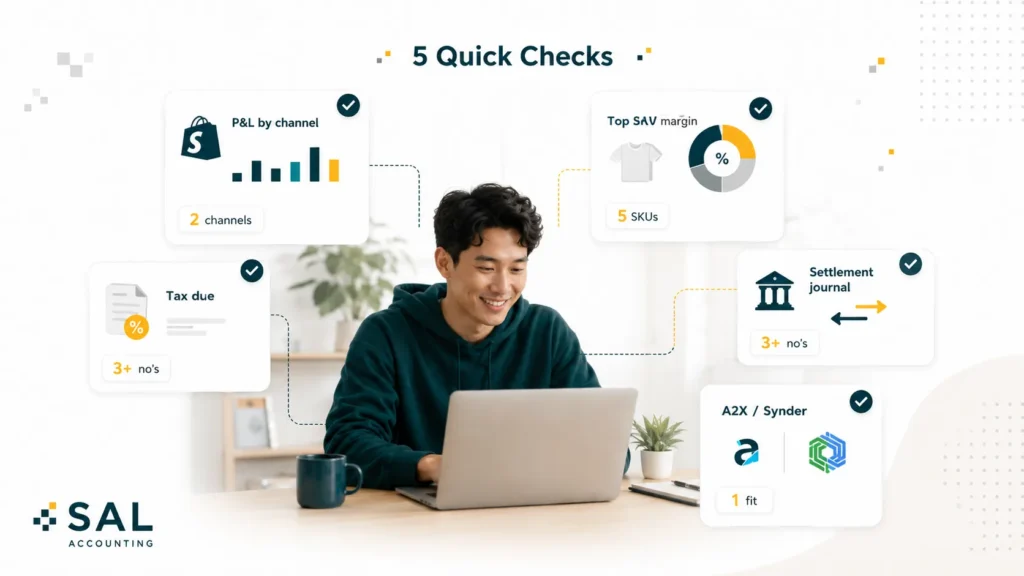
Before we get into the details, a lot of people reading this already have a sense their books aren’t quite keeping up. Here are five quick checks to find out. You don’t need to be an accountant to answer them.
- Can you pull a P&L by channel for last month, including Shopify, Amazon, and wholesale?
- Can you see your gross margin on your top SKU with landed cost included?
- Does your sales tax liability match what you actually filed or owe?
- Are Shopify and Amazon settlements posted as summary journals instead of bank deposits?
- Does your accountant know what A2X or Synder is, and which one fits your setup?
If you said no to one or two, you’re probably fine for now. If you said no to three or more, your books may have outgrown your accountant.
That’s the most common reason new clients come to us, and it’s not a reflection on the generalist. They just may not be set up for ecommerce work.
- Also read: “In-house Vs. Outsourced Ecommerce Accounting“
Where the Difference Actually Shows Up
Theory is easy. Here’s what changes when an ecommerce accountant takes over your books.
1. The Shopify Deposit Isn’t Revenue
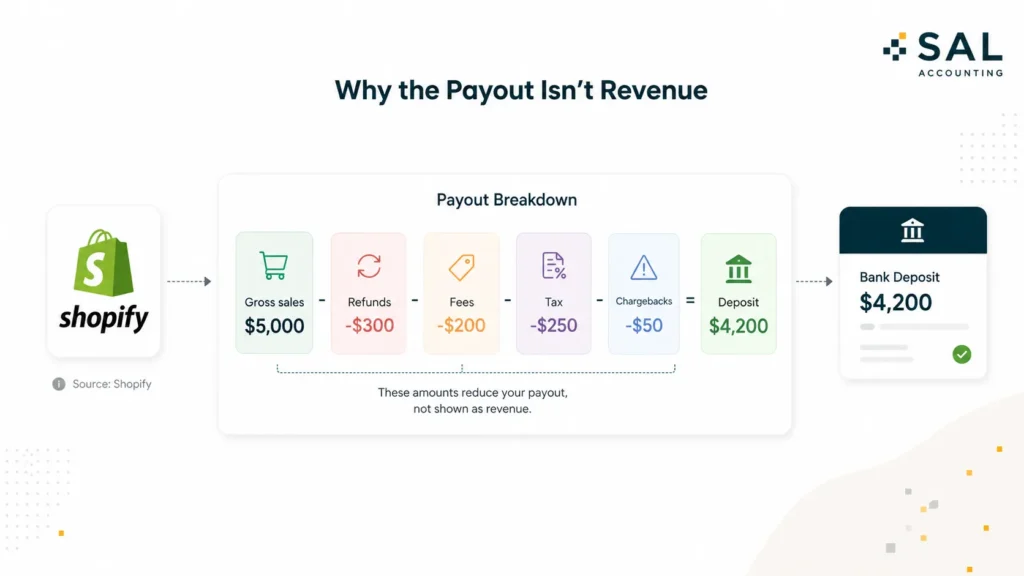
Your Shopify dashboard shows $5,000 in sales, but the bank shows a $4,200 deposit.
A general accountant may record the $4,200 as revenue because that’s what landed in the bank. An ecommerce accountant looks inside the payout. Now, here’s what’s actually inside that deposit:
$5,000 gross sales − $300 refunds − $200 processing fees − $250 sales tax collected − $50 chargebacks = $4,200 bank deposit
Revenue started at $5,000, not $4,200. The other amounts need to be separated so you can see what went to refunds, what went to fees, what was collected for tax, and what actually became cash. That’s settlement-based accounting, and it’s the foundation for ecommerce books that make sense.
You can always ask the help and consultation of our expert Shopify accountants and bookkeepers. Just book a free call with us.
2. COGS Is Monthly, Not Annual
A general accountant may update COGS once a year. A Shopify accountant or Amazon accountant updates it monthly, by SKU, with landed cost: supplier cost, inbound shipping, duties, prep, packaging, and FBA-related charges.
That matters because a product can look profitable at first and still lose money once everything is counted. Say a product sells for $35. Supplier cost is $12. Add inbound shipping at $2.50, duties at $1.80, FBA fees at $7.20, and you’re at $23.50 in costs before a single ad runs. The margin conversation looks completely different from the $35 price tag. Our COGS guide for e-commerce stores covers the full breakdown.

3. US Sales Tax Doesn’t Stop at Marketplace Facilitator
Amazon, Etsy, and Walmart collect and remit US state sales tax in many states. That helps, but it doesn’t always remove your filing obligations.
If your FBA inventory sits in multiple US states, you may have a nexus there. Some states may still expect registration or returns, even when a marketplace collects tax on your behalf.
For Canadian ecommerce sellers, the risk is that no one checks inventory location, state thresholds, and filing requirements. An ecommerce accountant knows to look before it becomes a year-end problem. And if you’re collecting in USD and reporting in CAD, every payout involves an FX conversion. If your books don’t account for the timing of that, your revenue figures can drift from what you actually received.
The US economic nexus threshold checker tells you fast where you actually stand, and the CRA’s GST/HST registration rules cover the Canadian side.
4. You Get a P&L by Channel, Not Just a Single Line
A general accountant gives you total revenue and expenses. An ecommerce accountant gives you reporting by channel and SKU, such as:
- Shopify, Amazon, and wholesale revenue
- gross margin by channel
- margin by SKU
- platform fees, shipping, and fulfilment costs
- contribution margin after selling costs
That’s where CM2 helps. Basically, it shows whether a product is still profitable after the main selling costs are included. This helps you decide whether to scale Amazon, protect Shopify, adjust pricing, pause ads, or drop a product that looks busy but isn’t making money.
- Also Read: “Top E-commerce Pricing Strategies“
The Hidden Cost of Staying with a Generalist
A generalist can look cheaper on the monthly invoice. The problem is that the real cost usually shows up somewhere else.
- Sales tax problems that grow quietly. FBA inventory crosses a state threshold. Nobody flags it. Months later, you may be dealing with back tax, penalties, and interest. In most cases, the first review surfaces things that have been quietly building for a while: sales tax thresholds crossed, states where inventory created a filing obligation. None of it is unusual, but it’s easier to sort out early.
- Margins you can’t see. If COGS is updated once a year, you spend most of the year pricing, promoting, and discounting based on numbers that may not reflect reality.
- Cash flow surprises. Amazon pays out every 14 days. If nobody’s modelling that timing, you run out of cash for the next inventory order even while sales are growing.
- Decisions made on hunches. When the books don’t match the platforms, every operating call becomes harder: ad spend, inventory, hiring, pricing, and channel decisions.
- Lender and investor questions you can’t answer. If you ever want a line of credit, an SBA loan, or outside investment, the first question is monthly financials by channel and SKU. A generalist book doesn’t have those.
The point is, none of these costs show up directly on your accountant’s bill. That’s why the gap can stay invisible until something breaks.
What Switching Actually Looks Like
The most common reason founders stay with an accountant who no longer fits isn’t loyalty. It’s the fear that switching will be messy.
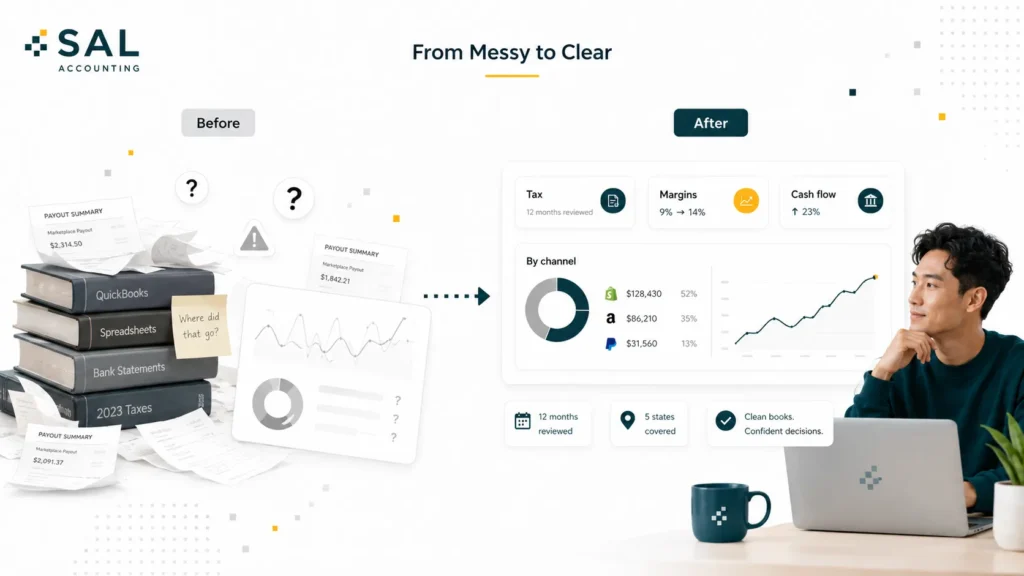
Usually, it’s more manageable than expected. Here’s what the first few weeks typically look like: we start by reviewing the last 12 months of books, not to judge them, just to understand what’s there, what’s missing, and what matters most. From there, we fix the highest-priority issues first, usually how settlements are recorded and whether COGS is close to accurate. Then we rebuild reporting so you can actually see margins by channel.
You can switch mid-year. You don’t need to wait until year-end.
The first step is visibility: what’s missing, what’s wrong, what’s fine, and what needs to be rebuilt first. The goal isn’t perfection overnight. It’s moving from “I think the books are done” to “I can trust what they’re telling me.”
Case Study: Toronto Wellness Brand Catches a $9,400 Sales Tax Gap in the First Week1
Maya runs a wellness brand on Shopify and Amazon. The business makes about $60,000 a month, and around 40% of sales come from the US. She had worked with a local general accountant for three years. Her tax returns were always filed on time, so nothing seemed wrong.
What surfaced in the handover: When SAL Accounting reviewed the books, they found that Maya’s Amazon inventory had been stored in five US states for 18 months. This may have created US sales tax responsibilities that hadn’t been checked. The estimated back-tax gap was $9,400.
What changed in the first 30 days: Maya got a clearer picture of where she stood with sales tax, cleaner Amazon reporting, and her first monthly profit report by sales channel. She also found out that two products were losing money after costs, so she changed their prices in week three.
Outcome: The tax issue was handled cleanly. Over the next two quarters, net margin increased from 9% to 14% because Maya could finally see where money was leaking from the business.
How SAL Accounting Can Help
The difference between a general accountant and an ecommerce accountant isn’t just the software they use. It’s what they’re actually looking at. Shopify sales. Amazon settlements. Stripe payouts. Refunds. Fees. Inventory. Sales tax. FX. The bank. The filings.
All of those pieces need to connect before your numbers become useful.
That’s our work at SAL Accounting. We help Canadian ecommerce sellers understand what’s happening inside their books, especially when they’re selling through Shopify, Amazon, and into the US.
Not sure whether your books are keeping up with your store? Book a free call with SAL Accounting. We’ll walk through the five checks above using your actual setup, show you where the gaps are, and explain what a cleaner handover could look like if you decide it’s time to switch.
Or if you’d rather check a few things first, start with the ecommerce EBITDA calculator or the US economic nexus threshold checker.
- Hypothetical scenario. Numbers are illustrative. ↩︎