We pulled together this guide to make cross-border ecommerce shipping easy to understand. Our goal is to show you how to ship products between Canada and the US, so you skip surprise fees, delays, and lost customers. But the big change you need to know is that the U.S. de minimis exemption stays fully suspended in March 2026. Even small packages (under $800) that used to enter duty-free now face full customs, duties, and extra fees.
If your goods qualify under USMCA rules and you handle the paperwork right, you can still ship them duty-free and avoid new surcharges. We at SAL Accounting cover this change in detail throughout the guide, plus the latest 2026 shipping costs, carrier comparisons, delivery times, and practical tips to help your business grow.
Quick Takeaways
- US de minimis exemption is suspended in 2026 — no duty-free entry under $800 for any commercial parcel.
- Claim USMCA preference with Certificate of Origin to ship duty-free and avoid most surcharges.
- Use DDP Incoterms and couriers like UPS/FedEx to prepay duties and eliminate customer surprises.
- Switch to domestic fulfillment (US warehouse for Canadian sellers) to skip customs and cut delivery to 1–4 days.
- Set 5–12 day expectations and send “cleared customs” updates to boost satisfaction and reduce support.
What Is Cross-Border E-commerce Shipping?
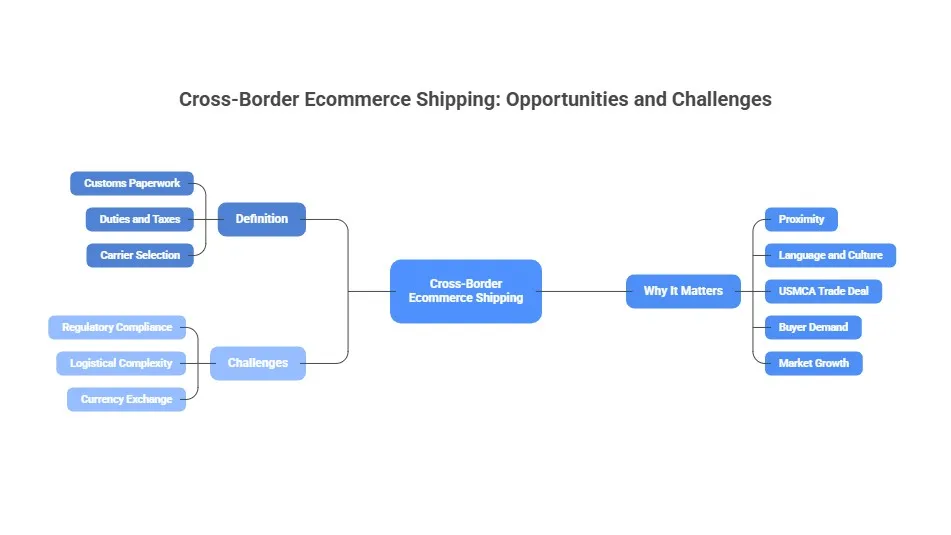
Cross-border ecommerce shipping means you sell stuff online from Canada to the U.S., or from the U.S. to Canada. You handle the extra steps like customs paperwork, duties, taxes, and getting the package across the border. It’s not the same as shipping inside one country. You deal with two sets of rules and often use different carriers. Expert eCommerce bookkeeping and accounting services help you get it right.
Why It Matters for Canadians and U.S. Sellers in 2026
This kind of shipping gives you real chances to grow right now. Here’s why:
- The countries share a border, so shipping stays fast and costs less than sending things to Europe or Asia. E.g., you can sell internationally on Shopify.
- People speak similar languages and shop in similar ways, so marketing and customer support feel natural.
- The USMCA trade deal lets many products cross duty-free; you just need the right paperwork. Check the IRS Form 8833 guide for the tax treaty.
- Buyers want it: 55.5% of Canadian online shoppers already buy from foreign stores (mostly U.S. ones).
- The market keeps getting bigger. North America’s cross-border ecommerce logistics sector is growing fast, heading toward over $111 billion by 2030 (Grand View Research projection).
How to Ship Products Between Canada and the US: Step-by-Step Guide
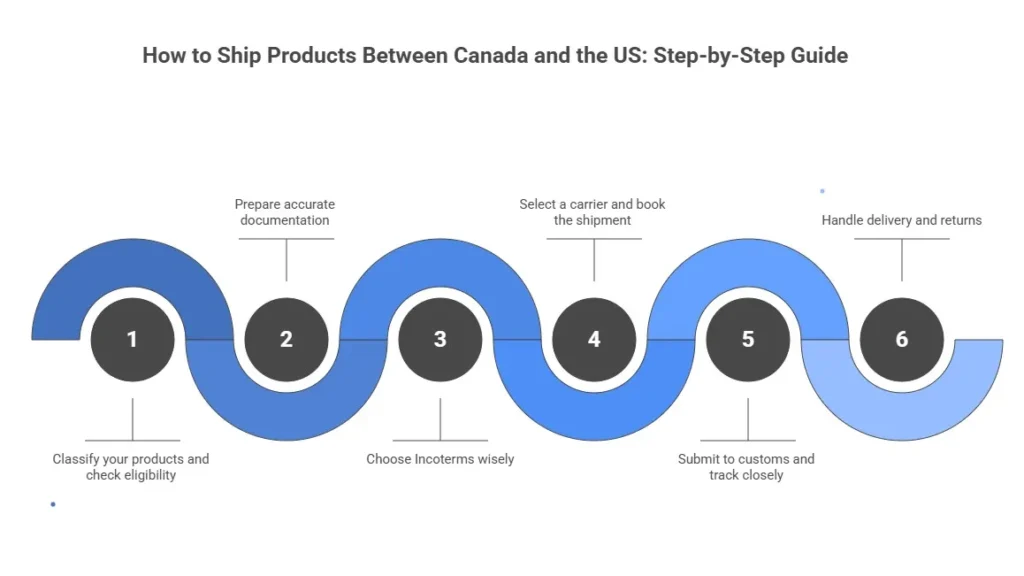
Cross-border ecommerce shipping will become more complex in 2026, but you can still handle it well. Follow these steps. It makes cross border accounting and bookkeeping easier. Most e-commerce sellers and small businesses use this exact process:
1. Classify your products and check eligibility
Find the correct HS code for each item. Use the free lookup tools on cbp.gov (US) or cbsa-asfc.gc.ca (Canada). Next, check if the product qualifies under USMCA rules of origin. Qualifying goods cross duty-free and usually avoid the 10% Section 122 surcharge that started in February 2026.
Pro Tip: Download the free USMCA Certificate of Origin template from trade.gov now. Fill it digitally and attach it to every qualifying shipment.
2. Prepare accurate documentation
Create a clear commercial invoice. You can use e-commerce accounting tools and software for such a purpose. Include these items:
- Full product description
- HS codes
- Accurate value (use retail price for shipments to Canada under the new “Last Sale” rule)
- Country of origin
- Incoterms
Attach the USMCA Certificate when you claim preference. Add a packing list. Include extra certificates if needed (for food, cosmetics, or restricted items). For shipments to Canada, note GST/HST and provincial taxes. See what happens if an e-commerce seller is not registered with GST/HST.
3. Choose Incoterms wisely
Decide who pays duties and taxes. Select DDP (Delivered Duty Paid) when you want to prepay everything. Customers stay happy, and cart abandonment drops. Select DDU (Delivered Duty Unpaid) when the buyer handles customs fees. This option costs you less but risks unhappy customers because of surprises.
4. Select a carrier and book the shipment
Compare carriers:
- Canada Post or USPS works well for very low-value or low-cost orders (duties often apply anyway).
- UPS, FedEx, or DHL give better customs support, faster USMCA claims, and reliable tracking.
Book directly or through Shopify apps such as ShipStation or Easyship. Check out the best e-commerce integrations for Shopify and other sellers. Add tracking and insurance when the item value exceeds $100.
5. Submit to customs and track closely
Most carriers file the customs entry electronically (ACE system for the US, CARM for Canada). Watch the tracking status. Holds occur from paperwork errors or random checks. Send customers updates: “Your order is in customs” or “It cleared customs!”
6. Handle delivery and returns
After customs clearance happens, the package arrives by ground or express. Typical total time for ground delivery is 4–10 days. Here are the key actions you should take at this stage:
- Set a clear cross-border return policy so customers know exactly what to expect.
- Offer prepaid return labels within North America whenever possible. This reduces friction and increases satisfaction.
- Consider using a fulfillment center in the US if you sell from Canada, or in Canada if you sell from the US. Pay attention to the GST/HST return in Canada for cross-border taxation.
- Many orders become domestic shipments this way and skip customs completely. You save time, money, and avoid delays.
Pro Tip: For your first 5–10 shipments, use a customs broker through your carrier. They catch errors fast and save time. The small fee pays for itself.
2026 Regulations & Customs Duties for Canada- US E-commerce Logistics
2026 changed cross-border e-commerce rules between Canada and the US a lot. These updates affect duties, paperwork, and costs for sellers, but not the US-Canada tax treaty to avoid double taxation. Know the main ones to stay compliant and control expenses.
US Import Rules: De Minimis Fully Suspended
The US ended the de minimis exemption completely. This happened in 2025 via Executive Order 14324 (effective August 29, 2025). Learn the Shopify tax exemptions to get the most out of them. A February 20, 2026, executive order continued the suspension (effective February 24, 2026).
- No duty-free entry for parcels under $800 anymore. No matter the origin, value, or shipping method (postal or courier).
- All commercial shipments need a full customs entry.
- Sellers face duties, brokerage fees, taxes, and paperwork on every package.
US Import Surcharge: Temporary 10% Section 122 Duty
A temporary import surcharge started on February 24, 2026, under Section 122 of the Trade Act of 1974. It lasts 150 days (until July 24, 2026) to address balance-of-payments issues. Have a month-end close process checklist for e-commerce sellers.
- Rate: 10% ad valorem on most imports.
- Applies broadly to fix trade deficits.
- USMCA-qualifying goods from Canada usually skip this surcharge (Check the list). They enter at 0% with a proper Certificate of Origin and certification.
Canada Import Rules: Last Sale Valuation + GST/HST
Canada’s “Last Sale” rule (phased in early 2026 via CBSA updates) bases duties on the final retail price to the buyer, not wholesale costs. This raises duties for dropshipping and non-resident sellers. The guide on dropshipping taxes in Canada helps you stay compliant.
- GST/HST (5–15% by province) applies to nearly all imports.
- No low-value exemptions remain.
Who Pays Duties & Taxes?
- DDP (Delivered Duty Paid): Seller prepays, best for happy customers, less abandonment.
- DDU (Delivered Duty Unpaid): Buyer pays on arrival, cheaper for the seller but risks complaints.
Pro Tip: Use couriers (UPS/FedEx/DHL) to claim USMCA preferences easily. Postal (Canada Post/USPS) often collects duties even when eligible.
This table summarizes duty rates, surcharges, and key notes for Canada–US ecommerce shipments in 2026:
| Direction | Compliance Type | Duty Rate | Additional Fees/Surcharge | Notes |
| Canada → US (USMCA-compliant) | With Certificate of Origin | 0% | Usually 0% Section 122 surcharge | Key to avoiding extras; postal may not process well. |
| Canada → US (non-USMCA) | Standard | MFN rate (varies by HS) | +10% Section 122 surcharge (temp.) | Full entry required; no de minimis. |
| US → Canada | Last Sale valuation | Duties on retail price | + GST/HST (5–15%) | No low-value free pass; platform collection common. |
| Any direction (low-value < $800) | General | Full applicable duties | Brokerage + possible fees | De minimis suspended in US; formal entry needed. |
How Much Does Cross-Border Shipping Cost Between Canada and the US
Shipping costs between Canada and the US are higher than domestic rates. The de minimis exemption is suspended, so no duty-free entry exists for parcels under $800. Every commercial shipment requires a formal customs entry and brokerage fees. Carrier base rates have risen due to fuel costs and inflation. Here are realistic base rates for a typical 1–2 kg parcel (ground or economy service, non-peak):
- Canada Post or USPS (postal) charges $18–$55. This is the cheapest option for light items, but duties and brokerage fees often add on at delivery. You can also cut withholding taxes for your e-commerce store.
- UPS, FedEx, or DHL (couriers) charge $45–$140 or more. The price is higher, but couriers give faster clearance, better tracking, and easier USMCA exemptions. Brokerage fees usually run $10–$30.
Common extra charges include:
- Brokerage/customs entry fee: $15–$50 per shipment (required for commercial parcels)
- Fuel, dimensional, or peak surcharges: 10–20% extra
- Duties and taxes: 0% with proper USMCA preference; otherwise, standard rates apply
- Optional insurance: $2–$10 (recommended for items over $100)
How to Save on Cross-Border Shipping Costs Between Canada and the US
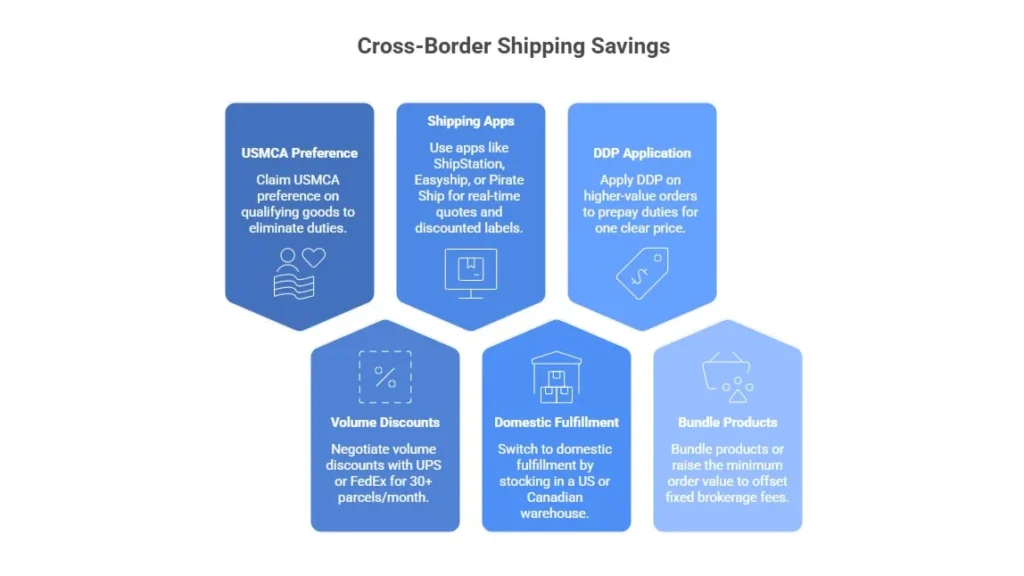
You can cut shipping expenses noticeably with a few smart, practical steps. Here are the most effective ones that many Shopify sellers and small businesses use successfully:
- Claim USMCA preference on qualifying goods. This eliminates duties (the biggest saving, especially in Canada → US).
- Negotiate volume discounts with UPS or FedEx (30–50% off base rates for 30+ parcels/month).
- Use apps like ShipStation, Easyship, or Pirate Ship for real-time quotes and discounted labels. Shopify integration with apps like Xero can be helpful, too.
- Switch to domestic fulfillment: stock in a US warehouse (if selling from Canada) or Canadian warehouse (if selling from the US) so most orders ship locally and skip customs.
- Apply DDP on higher-value orders. Prepay duties for one clear price and reduce cart abandonment.
- Bundle products or raise the minimum order value. This offsets fixed brokerage fees.
Pro Tip: For orders $100–$150+, choose couriers (UPS/FedEx/DHL) over postal. The extra base cost usually saves money overall. Customers avoid surprise duties and get faster delivery.
- Read More: “Best Business Bank Accounts for E-commerce Stores”
Case Study: Toronto Apparel Brand Cuts Costs 45% with US Fulfillment1
A Toronto-based Shopify apparel seller (women’s activewear) in the Liberty Village neighborhood sees US orders make up 60% of sales in 2026. But they face 7–10 day transit times and surprise duties that hurt conversions.
Problem
Long delivery times, surprise duties at the door, high cart abandonment, and rising brokerage fees eat into their margins and slow down US growth.
What We Do
We recommend they shift bulk inventory to a US fulfillment center near Buffalo. The brand claims USMCA preference on qualifying goods and switches to DDP via UPS. SAL Accounting supports them with cross-border bookkeeping to track GST/HST remittances and duty savings accurately while staying compliant.
The Result
Landed costs drop 45%. Cart abandonment falls 30%. US revenue rises 55% in the first six months. Customer reviews improve because of faster, predictable shipping. The brand maintains full compliance and maximizes margins without unexpected tax issues.
How Long Does US-Canada Ecommerce Shipping Take? (Realistic Timelines & Factors)
Shipping takes 4–12 business days on average due to customs clearance. Times vary by carrier, service, and the factors below. Realistic timelines (typical 1–5 kg parcel, non-peak):
- Ground or economy services: (Canada Post Ground, USPS Ground Advantage, UPS Ground, FedEx Ground): 4–10 business days. This is the most common and affordable choice. Customs processing often extends beyond the higher end. Watch the e-commerce taxes in Canada and the US.
- Express or priority services: (Canada Post Xpresspost – USA, USPS Priority Mail International, UPS Worldwide Express, FedEx International Priority): 1–4 business days (sometimes 2–5 for ground express to Canada). These provide faster clearance and better tracking when speed is important.
Main Factors That Affect Delivery Times
- Customs clearance: paperwork issues or inspections add 1–5+ days
- Carrier: couriers (UPS/FedEx/DHL) clear faster than postal (Canada Post/USPS)
- Direction: Canada → US often quicker with USMCA; US → Canada slower due to taxes/valuation
- Peak seasons/holidays: +2–7 days from high volume
- Weather/border delays: winter storms or busy crossings slow ground routes
- Compliance: DDP + USMCA paperwork reduces holds
Pro Tip: Display “5–12 business days (customs included)” on product pages. Send updates like “Cleared customs!” to keep customers happy and cut support questions.
- Read More: “In-House vs Outsourced E-commerce Accounting”
Cross-Border Shipping Best Practices: Which Carrier Is Best for Canada-US E-commerce?
The right carrier makes cross-border ecommerce smoother, cheaper, and faster. Compare the main options for Canada–US shipments: Canada Post, USPS, UPS, FedEx, DHL, and Purolator. This table compares the most popular carriers:
| Carrier | Base Cost Range | Transit Time (Business Days) | Best For | Pros | Cons | Customs/USMCA Support |
| Canada Post / USPS (postal) | $18–$55 | 4–10 (ground) | Low-value, lightweight orders | Lowest cost, widespread coverage | Slower customs, hard USMCA claims, duties often added | Weak |
| UPS | $45–$140+ | 3–8 (ground) | Reliable mid-value orders | Strong customs handling, volume discounts, good tracking | Higher base rates | Excellent |
| FedEx | $45–$140+ | 3–8 (ground), 1–4 express | Speed + reliability | Fast clearance, express options, reliable | Peak surcharges, higher for express | Excellent |
| DHL | $50–$150+ | 2–6 | International focus, express | Global network, good for high-value | Less domestic coverage in NA | Strong |
| Purolator | $40–$120 | 2–7 | Canada-based sellers to US | Fast cross-border, good for Canada origin | Limited US coverage outside major areas | Good |
Case Study: Mississauga Beauty Brand Boosts US Conversions 35% with Courier Switch & DDP2
A Mississauga-based Shopify beauty brand (skincare products) in the Square One area currently ships to the US with Canada Post. They face frequent customs holds, surprise duties for buyers, and 25% return rates from unhappy customers.
Problem
Customs delays, surprise fees, high returns, and low conversions hold back their US growth even though product demand is strong.
What We Do
We suggest they switch to FedEx and use DDP terms to prepay duties and taxes. They also claim USMCA preferences on qualifying products. SAL Accounting helps them optimize duty prepayments and track provincial sales tax so everything scales smoothly.
The Result
Conversions rise 35%. Returns fall below 10%. Average order value increases 20%. US sales double in four months. Customers love the surprise-free delivery, and the brand grows with clean, accurate financial tracking.
How to Boost Delivery Speed & Customer Satisfaction in Cross-Border Ecommerce Shipment
Timely delivery and happy customers drive repeat sales. Use these four key tips to deliver faster, reduce complaints, lower support needs, and control costs.
Communicate Realistic Shipping Timelines Clearly
Show “5–12 business days (includes customs)” on product pages, checkout, and emails. Clear expectations cut “where is my order?” questions dramatically, especially if you choose the best business structure for your online store.
Send Proactive Tracking & Customs Updates
Notify customers automatically when the package clears customs or hits a delay. Messages like “Your order cleared customs and is on its way!” build trust and reduce support tickets.
Use DDP for Higher-Value Orders
Prepay duties and taxes yourself so customers see one final price at checkout. DDP eliminates surprise fees, increases conversions, and greatly improves satisfaction.
Switch to Domestic Fulfillment When Possible
Stock inventory in a US warehouse (Canadian sellers) or Canadian warehouse (US sellers). Most orders become local 1–4 day deliveries that skip customs, cut costs, and boost reliability.
Pro Tip: Pair upfront timelines with automated tracking emails. This combo can raise satisfaction scores by 20–30% and slash support workload. Consult our cross-border accounting and bookkeeping expert for the best results.
Final Thoughts
Cross-border ecommerce shipping between Canada and the US offers huge growth potential in 2026, despite de minimis suspension and new rules. Claim USMCA preferences, choose reliable couriers, use DDP for higher-value orders, and shift to domestic fulfillment to avoid surprises, speed up delivery, and keep customers happy. These steps protect margins and build loyalty.
SAL Accounting helps with cross-border bookkeeping, GST/HST compliance, and duty optimization. Contact us for a consultation and scale confidently.
Cross-Border Ecommerce Shipping FAQ: Canada & US
Classify your products with HS codes. Prepare a commercial invoice and USMCA Certificate if you claim duty-free. Choose DDP Incoterms. Pick UPS or FedEx as your carrier. Track the shipment closely. Update customers along the way. Use ShipStation to make booking easy.
]Ground or economy services take 4 to 10 business days. Express or priority services take 1 to 4 business days. Customs can add 1 to 5 extra days. Plan for 5 to 12 business days total.
UPS works better for most ecommerce businesses. It gives faster customs clearance, easy USMCA claims, good tracking, and volume discounts. Canada Post fits only very low-value items but often causes delays and extra duties.
Use carrier websites or apps like ShipStation, Easyship, or Pirate Ship. Enter your package details, destination, and value. Get real-time quotes that include duties and taxes. Choose DDP to see the full landed cost before checkout.
Small-volume sellers usually do not need to register. In Canada, register for GST/HST if sales go over $30,000 CAD per year. US registration stays rare for most sellers. Carriers handle brokerage for your first shipments.
Check the tracking right away. Contact the carrier immediately. Send any missing documents fast. Update the customer with a new ETA. Get broker help if needed. Fix it quickly to avoid complaints.