

U.S. sales tax exposure can lower your offer, delay closing, or leave part of the purchase price in escrow—even if your Canadian ecommerce business has never been audited. At SAL Accounting, we see this risk surface when a buyer rebuilds years of Shopify, Amazon, FBA, and filing history during due diligence.
Before you list the business, you need to know where the gaps are, what they could cost, and which ones can still be fixed before the buyer finds them.
See which states may need attention before the buyer does with SAL’s US Economic Nexus Threshold Checker.
Quick Takeaways
- Sales tax issues can reduce your offer, delay closing, or trigger a holdback.
- Buyers compare your sales, inventory locations, registrations, filings, and payments.
- FBA inventory and US warehouses may create obligations your sales reports do not show.
- Marketplace-collected tax does not automatically cover your direct-store sales.
- Finding the gaps early gives you more control over the deal.
Buyer-ready tax work starts with buyer-ready books. Our ecommerce accounting and bookkeeping service connects your sales, payouts, inventory, and tax balances so the story in your data room still holds together when the buyer starts testing it.
Why Sales Tax Risk Becomes a Real Problem When You’re Selling
Sales tax risk becomes a deal problem because the buyer is not only purchasing your revenue. They are also assessing liabilities that may remain inside the company or follow the assets being acquired.
While you are running the store, a missed registration can feel like something to handle later. During a sale, it can affect the price, closing terms, and buyer confidence.
No audit notice means a state has not examined you.
No known issue means no one has identified a problem yet.
A buyer-ready position means the sales, nexus history, registrations, filings, and payments have been reviewed and documented.
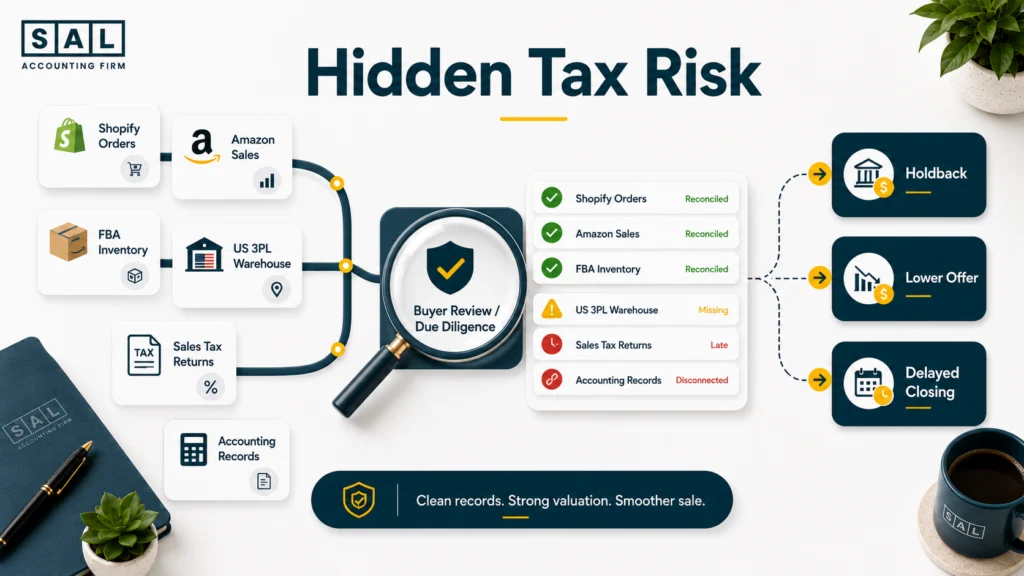
Those are not the same thing. Your Shopify reports may show the orders. Amazon may show marketplace-collected tax. Your 3PL may hold the inventory-location history. Your accounting records may show the payments.
The risk appears when those records do not tell the same story.
Pro tip: Start with every state where you had sales, inventory, FBA stock, a 3PL, employees, or contractors—not only the states where you currently file.
What Buyers and Their Advisors Check During Due Diligence
A buyer normally compares where the business operated with where it registered, filed, and paid.
They may not accept a tax-software dashboard or a statement that “Amazon handled it.” They will usually ask for the records behind that conclusion.
| Review area | What the buyer tests | Common gap | Why it matters |
|---|---|---|---|
| Nexus | Sales and physical presence | Registration began late | Older periods may be exposed |
| Filings | Returns against platform sales | Missing or incomplete periods | Liability may still be open |
| Payments | Tax collected against tax paid | Unpaid sales tax balance | Collected tax needs urgent attention |
| Marketplaces | Amazon sales against direct sales | Transactions mixed together | Responsibility may be unclear |
Nexus History Across States
The buyer may rebuild your activity by state and month. That review can include direct Shopify sales, marketplace sales, FBA inventory, 3PL warehouses, employees, contractors, and the date each sales threshold was crossed.
Marketplace-facilitator rules often require marketplaces to collect and remit tax on facilitated orders. However, marketplace sellers may still have registration or filing responsibilities, and direct website sales can create a separate obligation when the relevant threshold is met.
Example: Amazon may collect tax on its orders while your Shopify store continues selling directly into the same state. The buyer still needs to know:
- When nexus started
- Which sales counted toward the threshold
- Who collected the tax
- Whether the seller still had a filing duty
For a Shopify business, specialized Shopify accounting support should make the trail from order to payout to sales tax return easy to follow before the data room opens.
Filing and Payment History
Registration is only the beginning.
The buyer may request filed returns, payment confirmations, state account transcripts, amended returns, zero returns, tax notices, and sales tax payable balances.
They will then compare those records with your source data.
A return marked as filed can still raise questions when the sales do not match Shopify or Amazon, marketplace orders were classified incorrectly, or collected tax does not agree with the amount remitted.
Registration Gaps
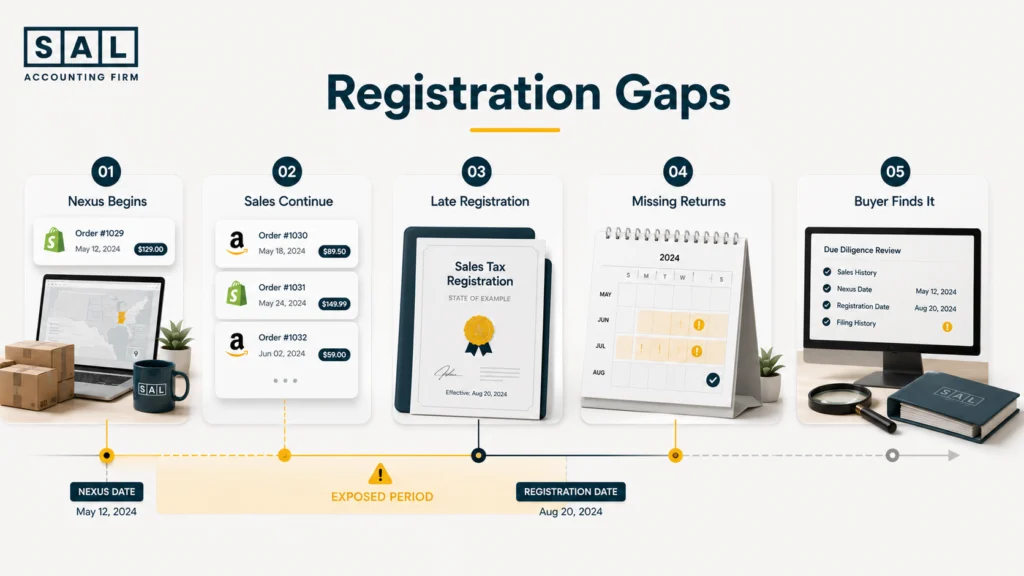
A registration gap may appear when:
- Sales crossed a threshold before the permit date.
- FBA inventory entered a new state.
- A 3PL added another warehouse.
- Direct sales were overlooked because a marketplace collected tax.
- Several stores were reviewed separately instead of together.
For Amazon brands, Amazon seller bookkeeping should connect settlement reports, FBA inventory, fees, and tax records before the buyer begins rebuilding them independently.
- Read more: “U.S. Sales Tax Requirements for Canadian Sellers”
What Happens If Tax Issues Surface Mid-Deal
When a sales tax issue appears during due diligence, the buyer normally asks one question first:
How large could the exposure be?
More diligence. The buyer may request several years of sales, inventory, registration, and filing records.
A holdback or escrow. Part of your purchase price may be withheld until the issue is resolved.
A price adjustment. The buyer may reduce the offer when the exposure affects the value they believe they are receiving.
A delayed closing. Registrations, catch-up filings, or tax-clearance requests may need to be completed before the deal can move forward.
The tax amount is only one part of the problem.
An unsupported estimate creates uncertainty. And when the buyer cannot verify the number, they may protect themselves using a much larger one.
Case Study: Aisha’s Buyer Uncovers Sales Tax Gaps in Three States1
Aisha runs a growing Shopify skincare brand from Leslieville, Toronto. She files sales tax returns in five states and has never received an audit notice, so she assumes her US sales tax position is under control.
The Problem
During due diligence, the buyer’s advisor compares Aisha’s Shopify sales with historical 3PL inventory records. They find that her products were stored—and direct orders were shipped, into three additional states before she registered there.
With no clear nexus timeline or exposure estimate, the buyer requests a large holdback from the sale price.
What We Do
We rebuild Aisha’s monthly sales by state, map her 3PL inventory history, and separate marketplace transactions from direct Shopify orders. We then identify the likely nexus date in each state and calculate the potential tax, interest, and filing exposure by period.
The Result
Instead of facing one broad, worst-case estimate, Aisha gives the buyer a clear state-by-state summary showing what happened, what has been resolved, and what remains open.
The buyer reduces the proposed holdback, and the deal moves forward with far less uncertainty.
Successor Liability: What a Buyer Could Inherit
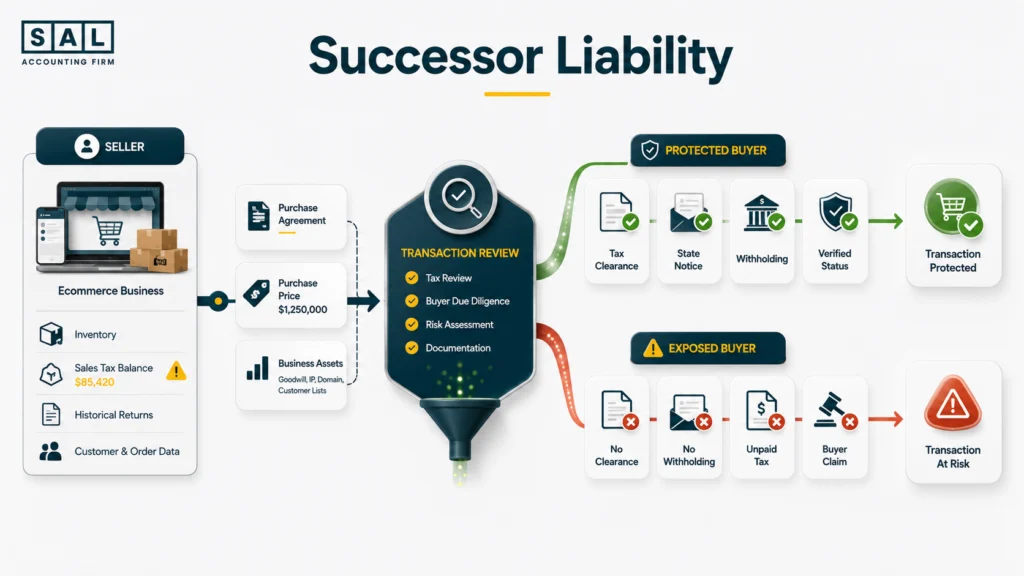
Successor liability can leave the buyer responsible for unpaid taxes from before the sale. Depending on the state, they may need advance notice, a tax clearance, or part of the purchase price withheld.
The table below shows how four states may protect buyers from inherited sales tax liabilities:
| State example | Buyer protection | Timing or condition | Deal concern |
|---|---|---|---|
| New York | Bulk-sale notice and release | Notice generally required before payment or possession | Buyer may inherit unpaid sales tax |
| Texas | Certificate of No Tax Due | Must be requested before closing | Buyer may be liable up to the purchase price |
| Washington | Successorship Notice and Tax Status letter | Assessment process follows the notice | Buyer may need to withhold unpaid tax |
| California | Withholding and tax clearance | Clearance request must follow the required process | Purchaser can become personally liable |
The key point is simple: a promise in the purchase agreement may not be enough.
The buyer may also want protection from the tax authority through a clearance, notice, escrow, or withholding process.
Asset Sale vs Share Sale
In an asset sale, the buyer may focus on bulk-sale notices, clearances, and successor-liability rules.
In a share sale, the buyer purchases the company that already contains its historical liabilities.
Neither structure automatically removes sales tax risk. The material states and deal documents need to be reviewed before closing.
Pro tip: Start clearance and tax-status requests early. Waiting until the closing date is already set can put the entire timeline under pressure.
How to Prepare Before You Go to Market
The strongest time to review sales tax exposure is before the buyer receives your data room.
Reviewing Your Nexus and Filing History
Build one state-by-state record showing:
- Direct and marketplace sales
- Inventory or physical presence
- Likely nexus date
- Registration date
- First return filed
- Payments made
- Open notices
- Current status
Then compare the same periods across Shopify, Amazon, your 3PL, your accounting records, tax software, and filed returns.
The goal is not to create another large spreadsheet.
It is to create a timeline the buyer can follow without guessing what happened.
Also read: “Sales Tax Nexus for Sellers”
Fixing Registration Gaps
Use this order:
- Confirm the likely nexus date.
- Separate direct and marketplace sales.
- Calculate taxable sales by period.
- Estimate tax, interest, and penalties.
- Review the available resolution routes.
- Complete the filings and save every confirmation.
Do not automatically register first and investigate later.
A voluntary disclosure agreement may reduce the historical lookback or waive some penalties when the business qualifies. Eligibility and terms vary, and prior contact with the state can affect access to the program. Collected but unremitted tax can also receive different treatment and may need to be paid in full.
Cleaning Up Records Before Due Diligence Starts
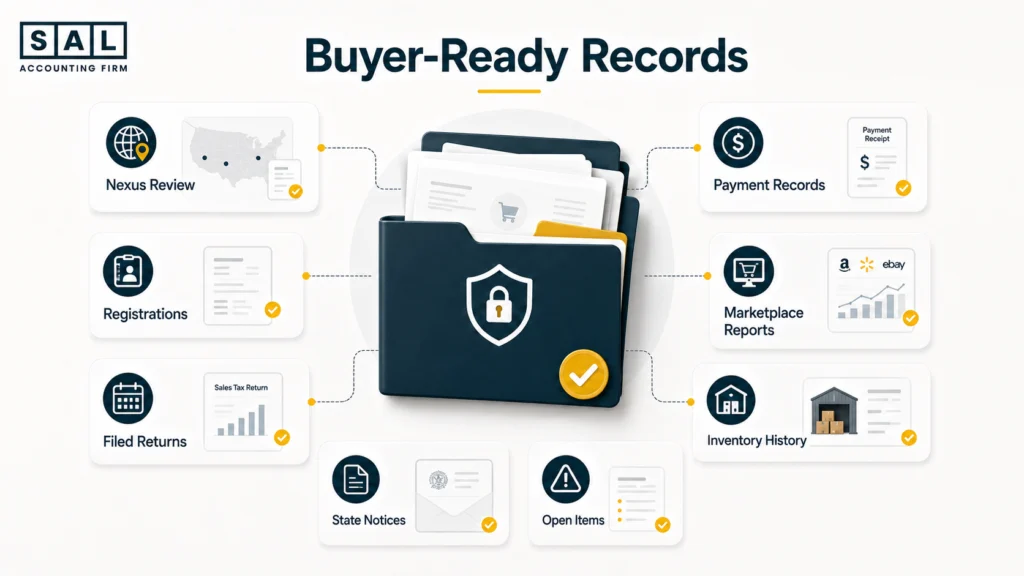
Create one sales tax folder for the buyer. Include your nexus analysis, registrations, filed returns, payment receipts, marketplace reports, inventory-location records, state notices, clearance documents, and current filing calendar. Use filenames that explain what each document contains.
Good:
2025-Texas-Sales-Tax-Return-Q4.pdf
Weak:
final-return-new-3.pdf
For Shopify records, it is also worth checking whether the tax collected in the store agrees with the filings and payments outside it.
- Also read: “Shopify Sales Tax Reporting”
Case Study: Daniel Cleans Up the Gaps Before Going to Market2
Daniel runs a Shopify and Amazon home-organization brand near Square One in Mississauga. The business brings in about $3.2 million a year, with more than half of its sales coming from US customers. He plans to sell within nine months.
The Problem
The company is registered in four states, but the records do not explain why those states were chosen or when each obligation began.
FBA inventory has also moved through other states, while direct Shopify sales have continued to grow. To make matters worse, marketplace-collected tax is mixed with tax collected directly from customers.
A buyer would have to untangle the history themselves—and may assume the worst.
What We Do
We rebuild Daniel’s monthly sales by state, trace his FBA and 3PL inventory locations, and separate Amazon marketplace orders from direct Shopify sales.
We then compare the likely nexus dates with his registrations, returns, and payments. The largest gaps are addressed first, while the remaining items are clearly documented.
The Result
Daniel enters the sale process with a clear state-by-state tax summary instead of a pile of disconnected reports.
The buyer can see what was reviewed, what was fixed, and what still needs attention. That reduces uncertainty, keeps due diligence moving, and protects Daniel from an oversized holdback based on worst-case assumptions.
What This Risk Actually Costs You in a Deal
Sales tax exposure rarely stops at the tax bill. It can also affect the price, delay closing, or hold back part of your payout. Here’s where those costs usually show up—and how to get ahead of them:
| Cost area | What it may include | Possible deal effect | Best response |
|---|---|---|---|
| Direct exposure | Tax, interest, and penalties | Lower purchase price | Quantify it early |
| Cleanup work | Historical analysis and back filings | Longer diligence | Start before listing |
| Buyer protection | Escrow, holdback, or indemnity | Less cash at closing | Resolve major states first |
| Missing records | Data reconstruction | Larger buyer estimate | Support every conclusion |
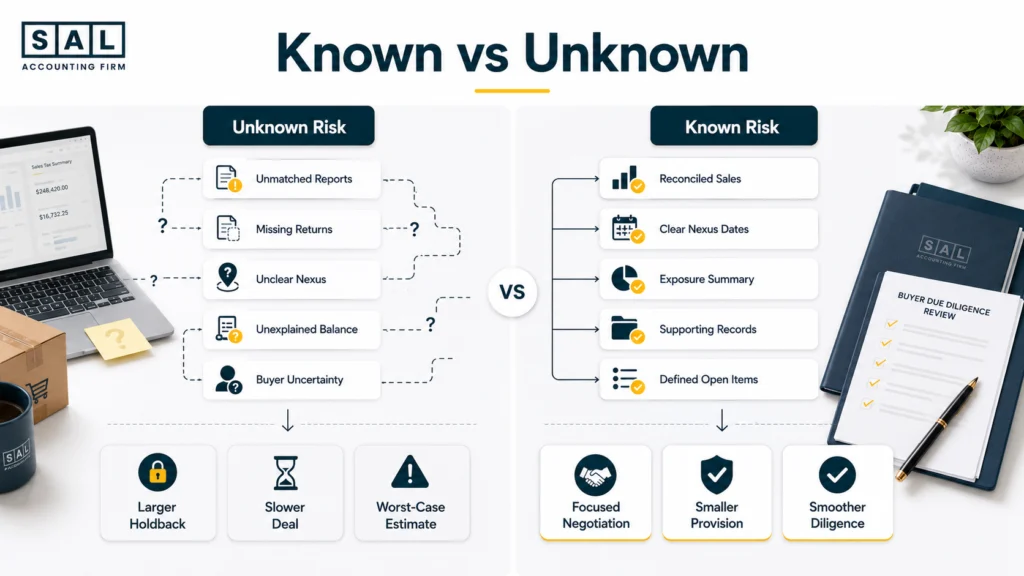
The biggest cost may be uncertainty.
A known $25,000 exposure with clear support can be easier to negotiate than an unknown issue the buyer estimates at $100,000.
The later the problem appears, the less control you usually have over the solution.
Pro tip: Do not give the buyer one unexplained total. Show the states, periods, sales, assumptions, payments, and remaining actions behind it.
Ready to Get Your Tax Position Clean Before You Sell?
You do not need a perfect compliance history. You need to know where the material gaps are, what they could cost, and how they will be resolved or explained.
Starting before due diligence gives you more time, more options, and a stronger position at the negotiating table.
Planning to sell your ecommerce business? Talk to SAL Accounting before the buyer starts rebuilding your tax history.