
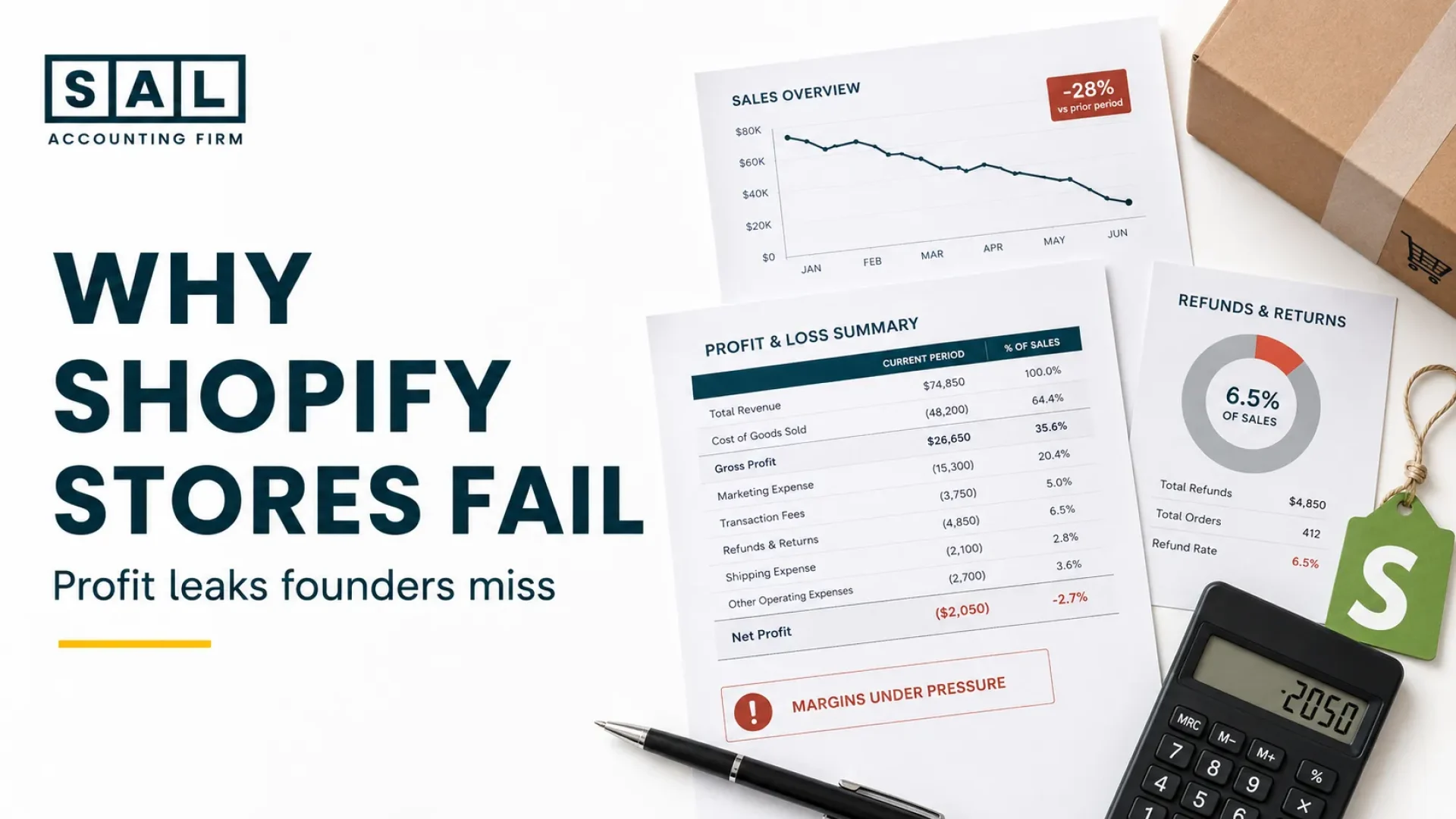
Most Shopify stores do not fail because the platform is broken. They fail because the store looks active while the numbers underneath are unclear. A Shopify dashboard may show orders, payouts, and traffic, but those numbers do not always show what each sale leaves behind after costs, fees, refunds, ads, inventory, and tax.
That is the gap SAL Accounting focuses on in this guide: the failure points to watch, the numbers that matter, and the fixes that stop small leaks from turning into cash problems.
See what your store actually keeps with our ecommerce accounting expert
Quick Takeaways
- Shopify stores usually fail because the business model behind the store is weak, not because Shopify itself is bad.
- Sales do not automatically mean profit. A store can grow revenue and still lose money on each order.
- The biggest Shopify store failure reasons usually come down to product-market fit, weak margins, poor traffic, low conversion, messy cash flow, inventory problems, and tax confusion.
- Paid ads can help a strong store grow, but they can also make bad unit economics show up faster.
- A simple weekly dashboard can help founders catch problems before they turn into a cash crunch.
Why Do So Many Shopify Stores Fail? The Short Answer
Shopify stores fail when sales grow faster than the business behind them. A store may look active on the surface, but still struggle because the founder does not clearly understand:
- whether people truly want the product
- how much profit each order keeps
- how much ads cost to bring in a customer
- why visitors are not converting
- how refunds, shipping, fees, and apps affect margins
- whether cash flow can support inventory and growth
- what taxes need to be tracked as sales expand
Basically, Shopify failure usually happens when the dashboard looks good, but each order does not make enough money after costs.
See what your Shopify sale actually keeps after fees with the Shopify Fee Calculator.
Why Shopify Stores Fail Even When Sales Look Good
Shopify makes it easy to launch an online store. It does not automatically make the business profitable. That difference matters. A lot of new founders spend most of their energy on the visible parts:
- the theme
- the product photos
- the logo
- the ads
- the influencer post
- the first few orders
Those things matter, but they are not the whole business. Product cost, contribution margin, ad costs, refunds, inventory timing, tax, and cash flow matter just as much. You may see claims that 80% to 95% of Shopify stores fail, but Shopify does not publish one simple official success rate. A better way to think about it is this: ecommerce is easy to start, but hard to keep healthy when the numbers are unclear.
That is where ecommerce accounting for small businesses becomes more than admin work. It helps you see whether the store is actually working.
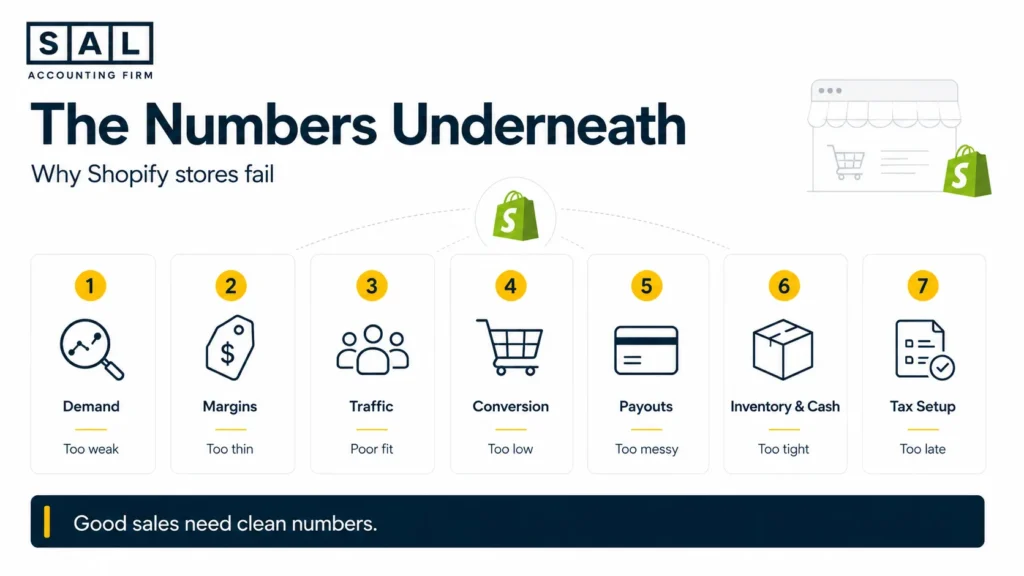
10 Shopify Store Failure Reasons and How to Fix Them
Before you fix a Shopify store, you need to know what is actually breaking it. Most failure points are not random. They usually come back to the same few issues: weak demand, unclear margins, poor traffic, low conversion, messy cash flow, inventory problems, and tax confusion.
1. The Product Was Never Properly Validated
One of the most common answers to “why ecommerce stores fail” is simple: the product did not have enough real demand. This happens when a founder chooses a product because it looks trendy, has a high markup on paper, or went viral for a week. But likes are not the same as buying intent. Before going deep into inventory or ads, check:
- Are people already searching for this product?
- Do competitor reviews show repeated complaints or unmet needs?
- Can you explain why someone would buy from you instead of Amazon?
- Is there repeat purchase potential?
- Are people willing to pay the real price after shipping and tax?
A store selling a $28 accessory with $12 shipping and no clear brand trust may struggle, even if the product looks good. The customer is not just judging the item. They are judging the full buying experience. This is where many Shopify dropshipping stores run into trouble. The product can be easy to list, but much harder to prove, price, ship, and support in a way that creates repeat buyers.
2. The Store Has Sales, but the Margins Do Not Work
This is where a lot of Shopify stores get stuck.
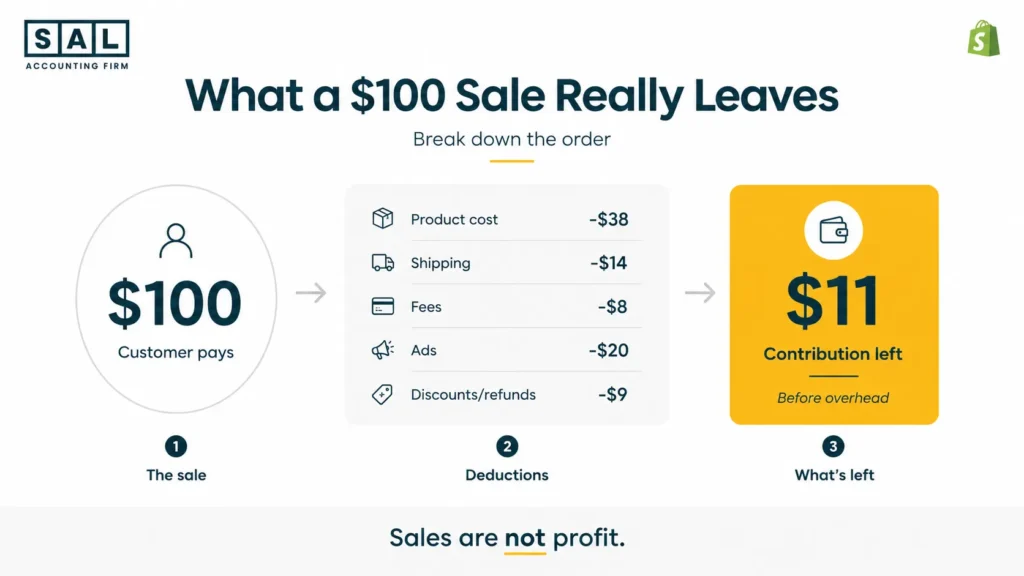
Example: Let’s say you sell a product for $100. Sounds good, right? Now subtract the product cost, shipping, Shopify fees, payment fees, ad spend, discounts, and expected refunds. Suddenly, the order does not look as strong.
Here’s a simple Shopify profit breakdown that shows why sales alone do not tell you whether the store is actually working.
| Shopify Order Example | Cost Type | Amount | What It Shows |
| Customer pays | Revenue | $100 | Top-line sale |
| Product cost | COGS | -$38 | Cost to buy/make item |
| Shipping + packaging | Fulfillment | -$14 | Delivery cost |
| Shopify/payment fees | Platform fees | -$8 | Selling cost |
| Ad spend | Marketing | -$20 | Customer acquisition |
| Discount | Promotion | -$5 | Margin reduction |
| Refund allowance | Returns | -$4 | Expected reversals |
| Contribution left | Profit check | $11 | Before overhead/tax |
That does not mean the store failed. It means the real number was never $100. The number that matters is what you keep after the direct costs.
This is why COGS for Shopify matters so much. Product cost has to match what was actually sold, not just what was purchased. The same issue shows up when founders start calculating ecommerce COGS across bundles, returns, shipping changes, and supplier price increases.
3. Shopify Ads Are Not Working Because the Economics Are Broken
When founders say “Shopify ads are not working,” the issue is not always the ads. Sometimes the ad account is doing its job. The store just cannot afford the customer.
If you spend $35 to acquire a customer and the first order only leaves $18 after direct costs, you are losing money before the customer even gets the product. That can work only if:
- repeat purchase rate is strong
- customer lifetime value is clear
- cash flow can handle the payback period
- the product has enough margin to scale
Keep in mind, paid ads make weak economics visible faster. They do not fix them.
IRP Commerce reported that cost per acquisition increased year over year in April 2026, which is exactly why margin tracking matters before scaling ad spend. For Shopify founders, Shopify accounting best practices help connect ad spend to what actually happened after the sale, not just what the ad dashboard reported.
4. The Store Gets Traffic, but Conversion Rate Is Too Low
Traffic is not the win. Buyers are the win. If your Shopify store gets visitors but few people buy, the issue may be conversion rate optimization. Shopify conversion rate optimization is not just about button colours or popups. It is about making the buying decision feel clear, safe, and easy. Common problems include:
- unclear product benefits
- weak product photos
- slow mobile pages
- hidden shipping costs
- no delivery estimate
- no reviews
- confusing return policy
- too many checkout steps
Baymard’s cart abandonment research puts average cart abandonment at 70.22%, so even small checkout issues can cost sales. Shopify also points to mobile and checkout friction in its CRO content.
If people do not trust the page, they do not finish the purchase. Strong Shopify store examples usually make the product, price, shipping, returns, and trust signals easy to understand.
5. The Store Looks Nice, but Customers Do Not Trust It
A store can look clean and still feel risky. Trust problems are often small on their own, but together they create friction. For example:
- no real contact page
- no clear refund policy
- generic product descriptions
- no shipping timeline
- fake-looking reviews
- no brand story
- poor product sizing or specs
- too many aggressive discounts
This is common with new private label and dropshipping stores. The product might be fine, but if customers do not trust the page, refunds, chargebacks, and support issues can follow. For Shopify sellers, a clear Shopify refund policy helps set expectations before the order happens, not after the customer is already frustrated.
6. The Founder Tracks Payouts Instead of Real Revenue
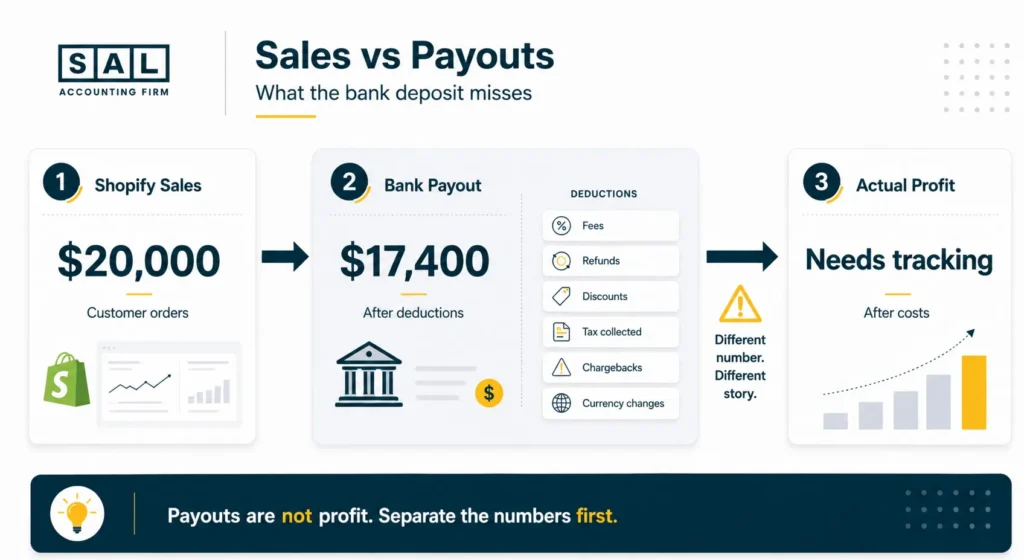
This is one of the biggest Shopify store failure reasons we see. Your Shopify payout is not the same as your revenue. The payout is what hits the bank after certain deductions or timing differences. It may already be affected by:
- payment processing fees
- refunds
- chargebacks
- discounts
- sales tax collected
- currency conversion
- payout holds
- app or platform adjustments
Example: If Shopify shows $20,000 in sales and $17,400 hits your bank, that does not mean your revenue is $17,400. It means something happened between the customer payment and the bank deposit.
This is where ecommerce payment reconciliation becomes a real decision-making issue. If the sale, payout, fee, refund, and tax amounts are not separated properly, the founder ends up making choices from a bank balance instead of the real store numbers.
For stores selling through more than one channel, ecommerce reconciliation best practices matter even more because Shopify, Amazon, PayPal, Stripe, and the bank may all tell slightly different versions of the same story.
Case Study: How Aisha in Liberty Village, Toronto Found the Profit Leak in Her Shopify Payouts1
Aisha runs a small skincare Shopify store from Liberty Village in Toronto. Her store looks healthy from the outside. Sales are growing, her Meta ads are bringing in orders, and Shopify shows steady activity. But every month, cash still feels tight. She can see money coming in, but she cannot clearly explain where it goes after fees, refunds, influencer discounts, shipping, packaging, and inventory purchases.
The Problem
Aisha is using Shopify payouts as her sales number. That makes the store look simpler than it really is. Fees, refunds, taxes, and discounts are getting blended together, so her reports do not show which products are actually profitable.
What We Do
We separate the full sales picture from the payout picture. That means tracking gross sales, discounts, refunds, Shopify fees, payment fees, shipping, tax collected, and product costs clearly. Once the numbers are cleaned up, Aisha can see which products are worth scaling and which promotions are quietly eating the margin.
The Result
Aisha gets a clearer view of which products actually make money and which offers only look good in Shopify. Instead of judging the store from payouts alone, she can see how fees, refunds, discounts, shipping, and product costs affect each sale before deciding what to scale.
7. Inventory and Cash Flow Are Not Planned Together
A Shopify store can fail even when people want the product. That sounds strange, but it happens all the time. The issue is cash timing. You may need to pay suppliers before customers buy. You may need to reorder inventory before the first batch has fully paid for itself. You may have money tied up in slow-moving products while bestsellers run out.
These Shopify inventory and cash flow metrics help you spot problems before a growing store turns into a cash crunch.
| Shopify Inventory Metric | What It Measures | Warning Sign | What to Check |
| Cash runway | Time before cash gets tight | Less than 3 months | Fixed costs + reorders |
| Inventory turnover | How fast stock sells | Slow-moving products | Sales by SKU |
| Sell-through rate | Stock sold vs stocked | Too much dead stock | Product demand |
| Stockout rate | Missed sales from no stock | Bestsellers unavailable | Reorder timing |
| Refund rate | Orders reversed | High returns | Product quality/fit |
| Reorder cash need | Money needed for stock | No cash for restock | Supplier terms |
Shopify inventory accounting connects product cost to what was actually sold, so you are not guessing whether inventory is helping the store grow or quietly trapping cash.
The same issue shows up in a Shopify cash flow statement, because profit and cash are not always the same thing. A store can look profitable and still struggle to reorder inventory on time.
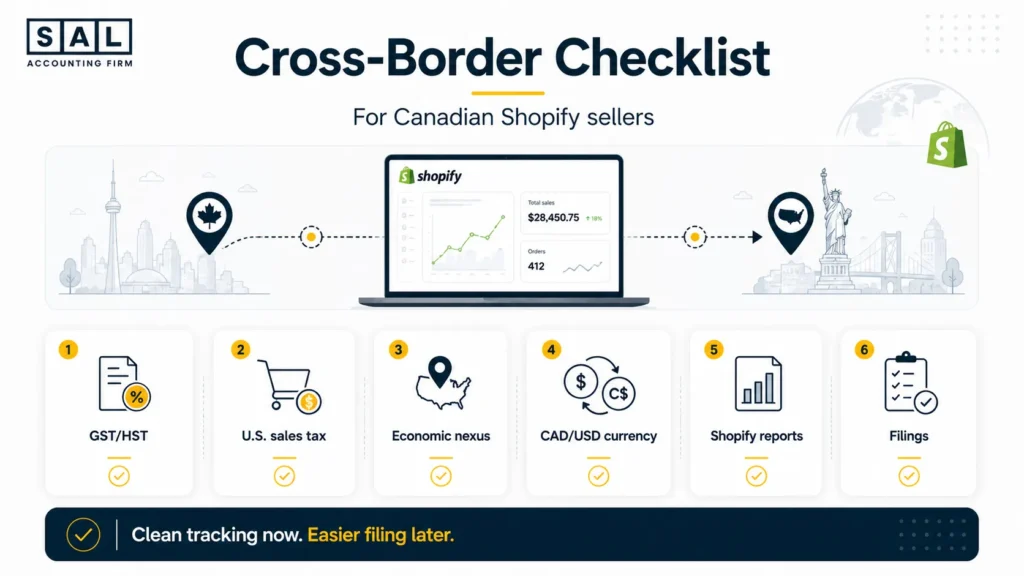
8. The Store Expands Across Borders Before the Tax Setup Is Clear
For Canadian Shopify stores, U.S. growth can be exciting. It can also make the numbers messier fast. Once you start selling across the Canada-U.S. border, you may need to think about:
- GST/HST
- U.S. sales tax
- economic nexus
- CAD/USD currency conversion
- payment fees
- state-by-state thresholds
- marketplace rules
- whether your current business structure still makes sense
For Canadian Shopify sellers, tax can get messy as sales grow. The CRA explains when GST/HST registration may be required, and Shopify explains how U.S. tax liability and economic nexus can apply when selling into the United States.
That is why U.S. sales tax requirements for Canadian sellers matter before growth turns into cleanup.
Case Study: How Daniel in Port Credit, Mississauga Got Control Before Expanding Into the U.S.2
Daniel runs a home goods Shopify store from Port Credit in Mississauga. His Canadian sales are steady, and he wants to sell more aggressively into the U.S. The problem is that his setup has grown in pieces. Shopify shows one version of sales, the bank shows another, and his bookkeeping does not clearly separate Canadian sales, U.S. sales, taxes collected, refunds, payment fees, and currency exchange.
The Problem
Daniel is planning U.S. growth before his accounting system is ready for cross-border sales. He does not have a clean view of margin by market, and he is not sure how U.S. sales tax, CAD/USD exchange, and payment fees will affect profit.
What We Do
We review the numbers before expansion adds more complexity. That means separating Canadian and U.S. sales, checking Shopify reports against payouts, reviewing GST/HST and U.S. sales tax questions, and building a simple monthly reporting rhythm. The goal is not to slow growth down. It is to help Daniel expand with numbers he can actually trust.
Result
Daniel gets a cleaner view of what his Canadian sales are doing now, what U.S. growth could change, and which numbers need to be tracked before he expands further. Instead of guessing from Shopify payouts or waiting for cleanup later, he has a clearer monthly rhythm for sales, tax, currency, fees, and profit by market.
As Canadian and U.S. sales start mixing together, cross-border ecommerce tax guidance gives you a clearer path for tracking sales tax, currency, payouts, and filings before they turn into cleanup work.
9. The Store Has No Weekly Operating Cadence
A lot of Shopify founders check sales daily but do not check business health weekly. That is a problem. Sales tell you activity. They do not tell you whether the store is getting stronger.
A simple Shopify KPI dashboard helps founders stop guessing and start seeing whether the store is getting healthier or just busier.
| Shopify KPI | What It Tells You | Good Question to Ask | Review Cadence |
| Contribution margin | Profit after direct costs | Do orders make money? | Weekly |
| LTV/CAC | Value vs acquisition cost | Can ads scale safely? | Monthly |
| MER | Revenue vs ad spend | Is marketing efficient? | Weekly |
| CVR | Visitors who buy | Is traffic converting? | Weekly |
| AOV | Average order size | Can bundles help? | Weekly |
| Refund rate | Product/order issues | Are expectations clear? | Weekly |
| Cash runway | Time before cash pressure | Can we cover reorders? | Monthly |
| Inventory turnover | Speed of stock movement | Is cash stuck in stock? | Monthly |
Now, you do not need a huge reporting system on day one. But you do need a rhythm. A Shopify month-end close checklist can turn messy platform activity into a repeatable routine.
10. The Founder Waits Too Long to Fix the Numbers
This is common, and it is not something to feel embarrassed about. A lot of Shopify stores start simple. Then sales grow, apps get added, products change, refunds happen, ads scale, and tax gets more complicated. Before long, the store has outgrown the basic setup. The warning signs usually look like this:
- you are not sure which products are profitable
- your bank balance does not match your sales
- your ad reports look good but cash feels tight
- you are unsure what tax has been collected
- inventory purchases keep surprising you
- month-end reports arrive too late to help
At that point, the issue is not just bookkeeping. It is decision-making.
That is when many founders realize they may have outgrown basic support. The question is no longer “Are the books done?” It becomes “Can I actually trust these numbers?” That is often the point where an ecommerce business needs a CPA, especially when cross-border sales, inventory, and tax all start showing up at once.
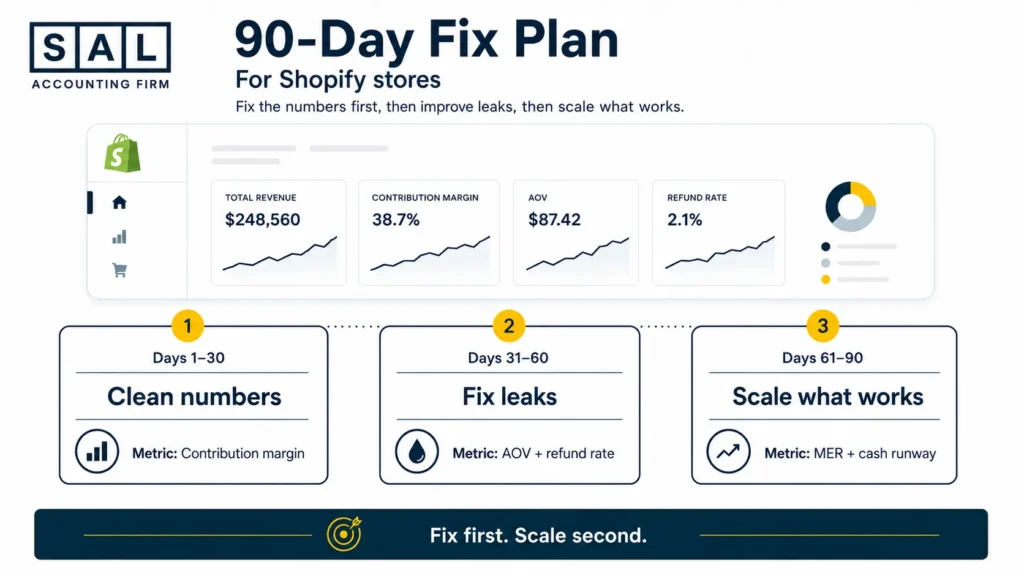
How to Avoid Shopify Failure: A 90-Day Turnaround Plan
Knowing why Shopify stores fail is useful. But the real value is knowing what to fix first. Here’s a simple 90-day Shopify turnaround plan for founders who need to fix margins, traffic, and cash flow without trying to solve everything at once.
| 90-Day Shopify Fix Phase | Main Goal | Priority Actions | Best Metric to Watch |
| Days 1–30 | Clean up numbers | Sales, fees, refunds, COGS | Contribution margin |
| Days 31–60 | Fix profit leaks | Pricing, bundles, refunds | AOV + refund rate |
| Days 61–90 | Scale what works | Ads, SEO, retention | MER + cash runway |
Days 1–30: Clean Up the Numbers
Start with the money. Before changing your ads, theme, or product line, make sure you know what is actually happening. Focus on:
- separating sales from payouts
- calculating contribution margin by product
- reviewing Shopify fees and payment fees
- checking product costs and shipping costs
- identifying refund and chargeback patterns
- reviewing cash runway
- listing tax questions by market
This is also a good time to review ecommerce business expenses, because many stores lose margin through small costs that do not feel important on their own. Apps, packaging, payment fees, influencer samples, returns, and software can all add up.
If the store is still early, starting costs for an ecommerce business can help explain why some cash problems are not caused by poor sales. Sometimes the store was simply underfunded from the beginning.
Days 31–60: Fix the Leaks
Once the numbers are clearer, start fixing the biggest leaks. That could mean:
- raising prices
- reducing discount dependency
- improving product page clarity
- adding better reviews and FAQs
- tightening the refund policy
- testing bundles
- improving abandoned cart emails
- removing apps that do not pay for themselves
- changing shipping thresholds
Do not try to fix everything at once. Pick the leaks that affect cash and margin first.
Example: If AOV is too low, bundles may matter more than a new ad campaign. If refunds are too high, product expectations may matter more than traffic.
This is also where tools should be reviewed carefully. Shopify integrations for ecommerce can help when they solve a real problem, but adding more apps without checking cost, data quality, and reporting impact can make the setup harder to manage.
Days 61–90: Scale What Actually Works
Now you can scale more carefully. By this point, you should know:
- which products have healthy margin
- which channels bring better customers
- which offers increase AOV
- which products cause refunds
- which markets create tax questions
- how much cash the store needs to reorder inventory
If paid ads are part of the plan, watch MER and contribution margin together. If SEO is the next move, focus on products and problems customers already search for. If retention is weak, improve email, SMS, subscriptions, or repeat purchase offers before increasing ad spend.
For growing stores, accounting software for Shopify sellers should make sales, fees, refunds, taxes, inventory, and payouts easier to turn into reports you can actually use.
If Shopify is already your main channel and the numbers are getting harder to trust, Shopify accounting experts can help you see what came in, what got deducted, and what your store actually kept.
Conclusion: Why Shopify Stores Fail and What to Fix Next
The real answer to “why do Shopify stores fail?” is not one single mistake. It is usually a mix of weak margins, unclear numbers, poor traffic quality, low conversion, inventory pressure, tax confusion, and cash flow problems that were not caught early enough.
The good news is that most of these problems are fixable once you can see them clearly. If your Shopify sales are growing but your numbers still feel hard to trust, talk to our team and get a clearer sense of what needs to be fixed, tracked, or set up next.