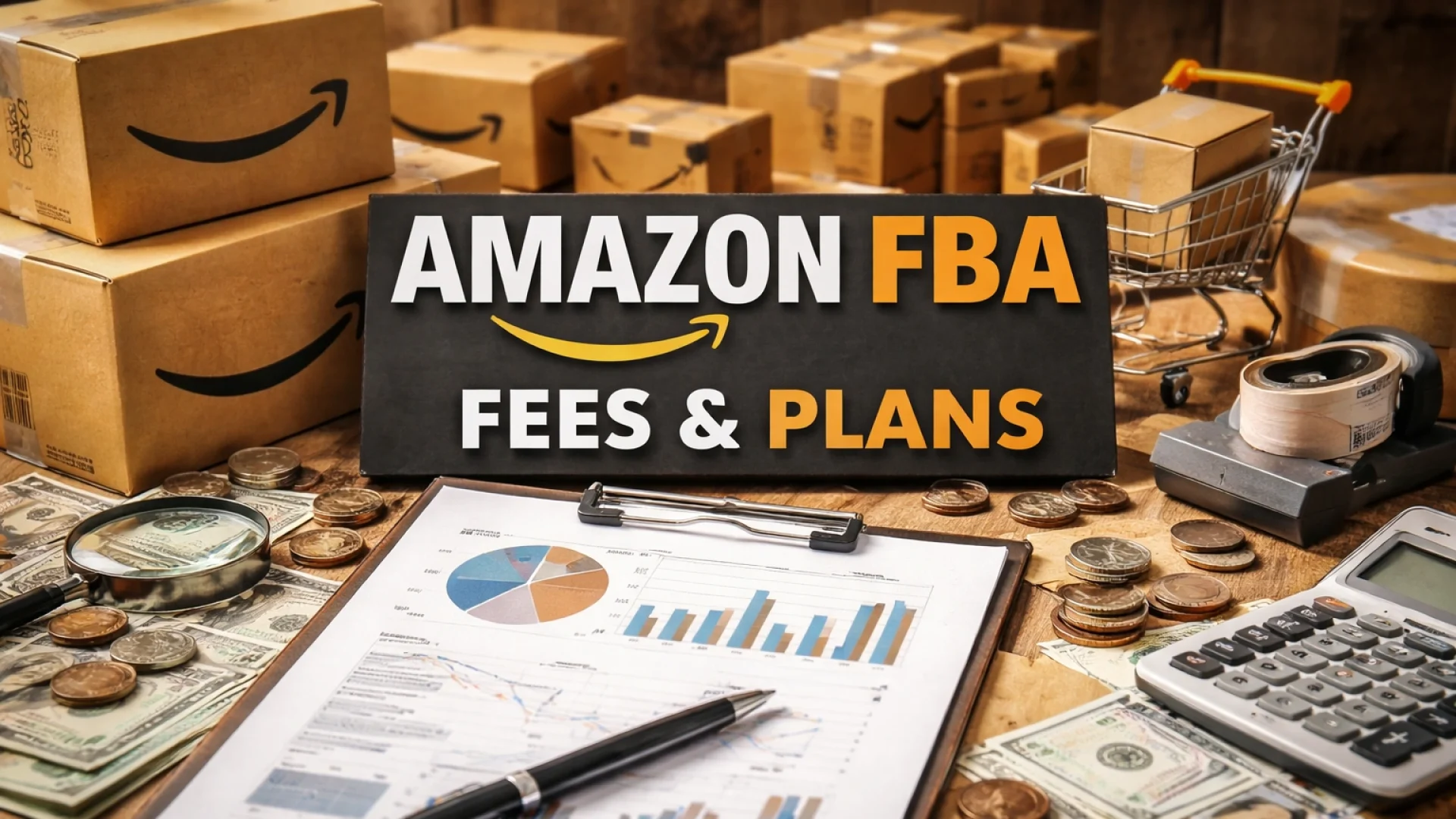
We want to make Amazon FBA fees easy to understand. We’ll break down the Amazon FBA monthly plans and the full amazon fba fee structure so you can pick the right option, whether you’re starting out or growing fast.Surprisingly, Amazon raised FBA fulfillment fees by just $0.08 per unit in 2026 (starting January 15), less than 0.5% of most selling prices.
Yet for many sellers, those pennies add up fast to thousands extra each year, especially when combined with storage and referral fees that can take 25 to 40% of revenue. We at SAL Accounting will explain every detail, show 2026 charts, give real examples, and share easy ways to cut costs.
Quick Takeaways
- Amazon FBA fees in 2026 total 25–40% of selling price: 8–15% referral, $3–$5 fulfillment per unit, storage $0.78/cu ft Jan–Sep or $2.40 Oct–Dec.
- 2026 fulfillment fees rose only $0.08 per unit on average (Jan 15); items under $10 get ~$0.86 bigger discount.
- Use Individual plan ($0.99/item) under 40 sales/month; switch to Professional ($39.99/month) at 40+ for ads and lower cost.
- Minimize fees: turn inventory 3–6 months, use Ships in Product Packaging, remove slow stock before 12 months (avoid $0.30+ aged surcharges).
- Run every product through Amazon’s Revenue Calculator—it shows exact 2026 fees and profit instantly before you list or reorder.
What Is Amazon FBA and Why Do Sellers Pick It Over Shipping Everything?
Amazon FBA stands for Fulfillment by Amazon. You send your products to Amazon’s warehouses. They store them, pack orders, ship them, handle customer questions, and manage returns. This saves you a lot of time and effort. Your listings get the Prime badge. Prime members get fast, free shipping. Many buyers only buy Prime items, so this often increases your sales. Here are the main benefits:
- Prime badge draws in Prime shoppers who expect 1–2 day delivery.
- Amazon takes care of packing, shipping labels, and tracking, no more post office runs.
- They handle customer service, returns, and refunds for you.
- Sell 10 items or 10,000, Amazon handles the volume without extra work on your end.
- Expand to other countries more easily with Amazon managing local shipping.
For most sellers, especially beginners and small businesses, FBA works better. You focus on sourcing products and marketing instead of boxes and tape. Our Amazon accounting and bookkeeping services help you a lot in this way.
Example: Say you sell 150 T-shirts a month. Packing and shipping yourself takes hours weekly and costs $6–$8 per package via USPS or UPS. FBA might cost $3–$4 per shirt in fulfillment fees, but you save all that time and get Prime eligibility. Many sellers see sales rise 30–50% thanks to Prime.
How Do Amazon FBA Fees Work? (Amazon FBA Monthly Plans Explained)
Amazon gives you two main selling account types that work perfectly with FBA. These Amazon FBA monthly plans decide your base subscription cost and the tools you get access to. Picking the right one early helps you control costs and grow without wasting money on features you don’t need yet. Check the guide on Amazon FBA bookkeeping for more. Here are the plans:
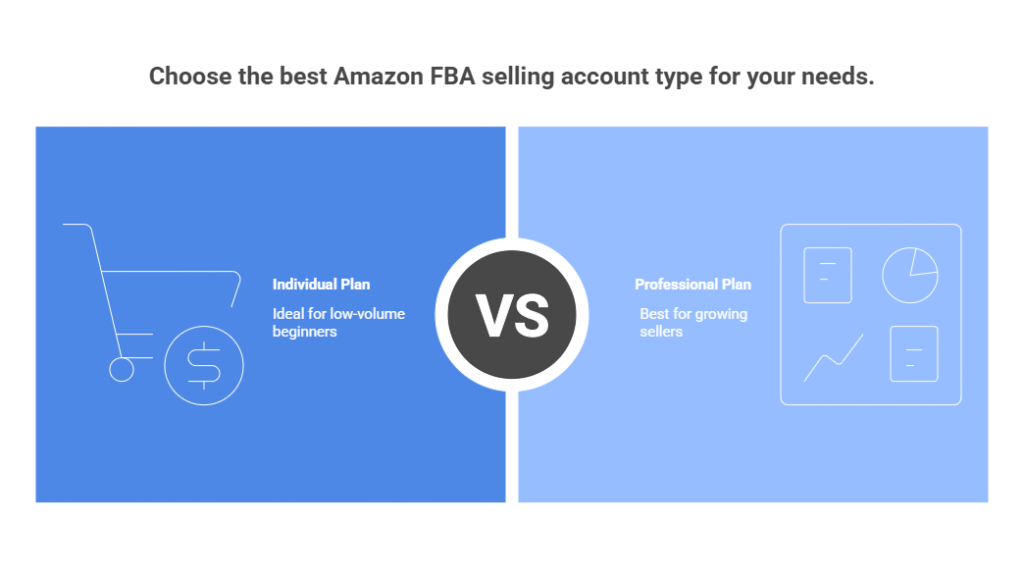
Individual Plan – Best for Low-Volume Beginners
This plan keeps things super simple and cheap when you’re just starting or testing products. You only pay when something actually sells, no monthly bill hanging over your head.
- $0.99 per item sold (that’s the only fee from the account itself)
- No monthly subscription fee at all
- Basic listing and selling features (you can create listings, manage orders, but no advanced options)
- Ideal if you expect to sell fewer than 40 items per month
Many new sellers choose Individual because there’s almost no risk. You can try a few products, learn how FBA works, and see real sales before committing to a monthly fee. The downside is that each sale costs that extra $0.99, and you miss out on powerful tools like running ads or uploading products in bulk.
Professional Plan – Built for Growing Sellers
The professional plan is designed for people who treat Amazon selling as a real business and want to scale. You pay one flat fee every month no matter how many (or how few) items you sell.
- $39.99 per month (fixed cost, same every billing cycle)
- Unlimited listings and unlimited sales (no per-item charge)
- Full access to professional tools: Amazon Advertising, bulk listing uploads, advanced analytics reports, Brand Registry eligibility, coupons, and more
- Perfect if you sell 40 or more items per month or plan to grow quickly
The Professional plan usually becomes cheaper once you pass about 40 sales in a month. For example, if you sell 50 items, the Individual plan would cost $49.50 in per-item fees, more than the $39.99 Professional fee. Plus you get way better ecommerce automation tools to list faster, run promotions, and track performance. Most serious sellers switch here within their first few months.
This table compares the two Amazon seller plans side by side so you can quickly see which fits your business.
| Feature | Individual Plan | Professional Plan | Best For |
| Monthly Cost | $0 (no subscription) | $39.99 fixed | Low volume vs scaling |
| Per-Item Fee | $0.99 per sale | $0 | Under 40 sales vs 40+ sales |
| Listings Limit | Basic (one at a time) | Unlimited + bulk uploads | Testing vs many products |
| Advertising Access | No | Yes (Amazon Ads) | Growth & visibility |
| Advanced Tools | No (no analytics, Brand Registry) | Yes (reports, coupons, Brand Registry) | Serious sellers |
| Break-even Point | — | ~40 sales/month | Switch at 40+ monthly sales |
What Are Amazon FBA Fees? (The Complete Structure)
Amazon FBA fees stack up from multiple layers on top of your monthly selling plan. You pay referral fees on sales, fulfillment fees per shipped unit, monthly storage for inventory, and extras like long-term surcharges or inbound placement. Have a look at the fees as follows:
Referral Fees – The Percentage Amazon Takes on Every Sale
Amazon charges this cut on the item price (not shipping) for every sale, whether you use FBA or self-fulfill. This is a very important part of e-commerce business expenses you must consider. Have a look at the list below:
- Rates run 8–15% based on category (e.g., electronics around 8%, books 15%, clothing up to 17% for items over $15)
- Minimum fees apply in many cases ($0.30–$1.00 if the percentage is too low)
- No changes to referral rates in 2026, same as previous years
Fulfillment Fees – The Core Cost for Pick, Pack, Ship, and Returns
This per-unit fee covers Amazon picking your product, packing it, shipping it, and basic returns. It varies by size tier (small/large standard, bulky), weight, and selling price.
- Overall 2026 increase averages $0.08 per unit
- For standard-size items $10–$50: small ones up ~$0.25 per unit, large ones up ~$0.05 on average
- Items under $10 get boosted Low-Price FBA discounts, now $0.86 less per unit vs higher-priced items (up from $0.77)
- Peak season (Oct 15–Jan 14) adds temporary surcharges; fees revert to non-peak after Jan 15
- No new fee categories introduced in 2026
- Read More: “Amazon Tax Exemption Program (ATEP): A Guide to Saving on Purchases for Your Business”
What are the hidden Amazon FBA fees? (Storage Fees and Other Charges)
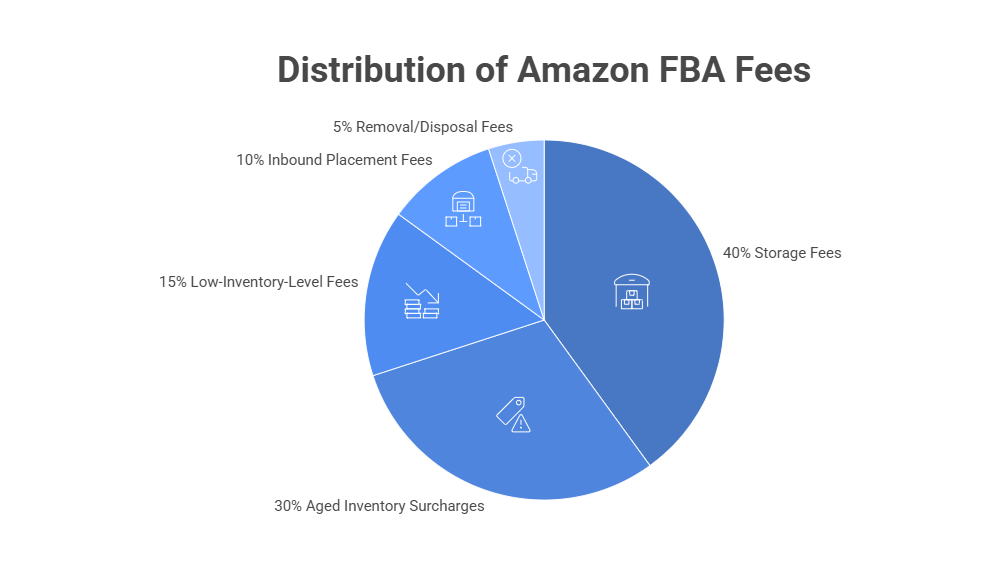
Storage fees apply when products sit in Amazon warehouses. Amazon charges monthly based on cubic feet used. Rates spike in peak season. Aged inventory gets extra penalties to encourage fast sales. Other charges include inbound placement, removals, and unplanned services.
In 2026, standard monthly storage rates stay the same, but aged surcharges rose starting January 15–16.
Monthly Inventory Storage Fees
Amazon charges these fees every month for the space your inventory takes up in their warehouses. They calculate based on the volume in cubic feet. Rates stay the same in 2026 (no major hikes outside seasonal changes), but the Q4 spike is steep to encourage moving stock before holidays. These are the fees according to your business size.
- Standard-size items (Jan–Sep): $0.78 per cubic foot per month
- Standard-size items (Oct–Dec): $2.40 per cubic foot per month (a +208% jump for peak season)
- Oversize items: Higher separate rates (typically start lower off-peak but rise in Q4. check Seller Central for your exact tier)
Example: A product taking 0.1 cubic feet (like a small phone case) costs $0.078 per unit per month Jan–Sep. For 1,000 units, that’s $78/month. In Oct–Dec, it jumps to $0.24 per unit—$240/month for the same inventory. Plan restocks to avoid holding extra during Q4. Check the Amazon sellers tax guide in the US and Canada as well.
Aged Inventory Surcharges
These extra penalties hit if items sit unsold too long. Amazon assesses them monthly (on the 15th) for units over 181 days old to free up warehouse space. In 2026, rates increased starting January 15–16 to push faster turnover.
- 12–15 months old: Minimum $0.30 per unit per month (or $6.90 per cubic foot, whichever is higher), up $0.15 from previous years
- Over 15 months: New tier at $0.35 per unit or $7.90 per cubic foot (whichever higher)
Example: On 500 units aged 13 months (each 0.1 cu ft), you pay at least $150/month in aged fees alone ($0.30 × 500), plus regular storage. Over 15 months, it could rise to $175/month. Sellers often remove or liquidate slow-movers before these kick in to avoid the compounding hit.
Other Common Charges
These smaller fees pop up for specific actions or situations. They add up if you’re not careful with logistics.
- Low-inventory-level fees: Charged on shipped units if stock falls below ~28 days of supply (based on demand). In 2026, calculated per FNSKU (not parent ASIN), expanded to bulky items, but grocery exempt, encouraging steady stock without stockouts.
- Inbound placement fees: Apply when Amazon splits shipments across multiple centers (average +$0.05/unit in 2026; avoid by using Amazon-optimized shipments).
- Removal/disposal fees: For pulling or discarding inventory (some lowered slightly in 2026, e.g., standard-size under 0.5 lb dropped to $0.84/unit).
- Returns processing: Basic handling included in fulfillment, but extras may apply for certain cases.
Pro tip: Monitor inventory health in Seller Central reports. Keep velocity high, avoid overstocking, and use removal orders early for aged items, these steps cut storage surprises and keep costs low.
- Read More: “Amazon and Shopify Integration Guide for eCommerce”
Amazon FBA Fee Chart 2026: Quick Visual Breakdown of Key Costs
Here’s a straightforward summary of the most important 2026 Amazon FBA fees (non-peak rates after January 15). These apply to standard-size items unless noted, good for the e-commrece beginners and SMBs to know. Exact numbers vary by your product’s exact dimensions, weight, category, and price, use Amazon’s Revenue Calculator for precision.
Fulfillment Fees (Pick, Pack, Ship & Basic Returns – Non-Peak)
These fees pay for Amazon picking your item, packing it, shipping it, and handling basic returns. In 2026 Amazon raised them by an average of only $0.08 per unit. That’s less than half a percent of most selling prices.
- Items priced $10–$50: small standard-size units went up about $0.25 per unit on average; large standard-size units rose about $0.05 per unit on average
- Items under $10: now get a bigger Low-Price discount, roughly $0.86 less per unit than similar items priced $10 or more (better than the old $0.77 discount)
- Items over $50: bigger increases apply (small standard +$0.51 per unit, large standard +$0.31 per unit)
- Peak season (October 15–January 14): extra surcharges add on top (they go away after January 15)
Use the e-commerce tax and accounting tools that help you track the expenses better.
Monthly Storage Fees (Per Cubic Foot)
Amazon charges these every month based on how much space your inventory takes. Rates stay the same as before except for the normal holiday jump to clear space.
- Standard-size items January–September: $0.78 per cubic foot per month
- Standard-size items October–December: $2.40 per cubic foot per month (big +208% increase for holidays)
- Oversize items: have their own higher rates (check your size tier in Seller Central)
Aged Inventory Surcharges (Extra for Slow-Moving Stock)
These extra fees hit if items sit unsold more than 181 days. Amazon adds them monthly to free up warehouse space. The 2026 changes raised these fees starting mid-January.
- Items 12–15 months old: minimum $0.30 per unit per month (or $6.90 per cubic foot, whichever is higher) – up $0.15 from before
- Items over 15 months: new tier at $0.35 per unit or $7.90 per cubic foot (whichever is higher)
Referral Fees (Category Percentage of Item Price)
Amazon takes this percentage from the item price (not shipping) on every sale – FBA or not. Rates did not change in 2026.
- Typical range: 8–15% depending on category
- Common examples: electronics around 8%, books 15%, clothing up to 17% for items over $15
- Minimum fees: usually $0.30–$1.00 when the percentage comes out very small
Product Examples (Non-Peak Estimates)
- Small phone case ($18, ~6 oz, 0.1 cu ft): fulfillment around $3.45 (after the $0.25 increase), referral 8% = $1.44 → total about $5 per sale before storage
- T-shirt ($25): fulfillment usually $3.50–$4.00, referral 17% = $4.25 → total fees often 25–35% of selling price
- Low-price gadget ($9): fulfillment drops a lot with the discount – usually around $2.50 or less
Most sellers see total Amazon FBA fees take 25 to 40% of the selling price when everything adds up. The small $0.08 average fulfillment increase means about $80 extra cost on every 1,000 units sold. Sell fast and price carefully to keep more profit.
Pro Tip: Save Amazon’s 2026 fee pages in Seller Central as bookmarks. Run your products through the Revenue Calculator every week.
- Read More: “Shopify Inventory Accounting and Bookkeeping guide”
This table shows the main Amazon FBA fees in 2026 (non-peak rates after January 15) so you can see them at a glance.
| Fee Type | Rate/Details (2026) | When It Applies | How to Minimize |
| Referral Fee | 8–15% of item price (category-based) | Every sale (FBA or FBM) | Choose low-referral categories |
| Fulfillment Fee | Avg +$0.08/unit; ~$3–$5/unit standard | Per shipped unit | Price under $10 for ~$0.86 discount |
| Monthly Storage | $0.78/cu ft Jan–Sep; $2.40/cu ft Oct–Dec | Monthly per cubic foot | Keep turnover 3–6 months |
| Aged Surcharges | Min $0.30/unit/mo after 12 mo; $0.35 after 15 mo | Slow stock over 181 days | Remove before 12 months |
| Low-Price Discount | ~$0.86 less per unit vs $10+ items | Items priced under $10 | List more products under $10 |
| Inbound Placement | ~$0.05–$0.30/unit average | Split shipments | Use Amazon optimized plans |
How to Calculate Amazon FBA Fees for Any Product
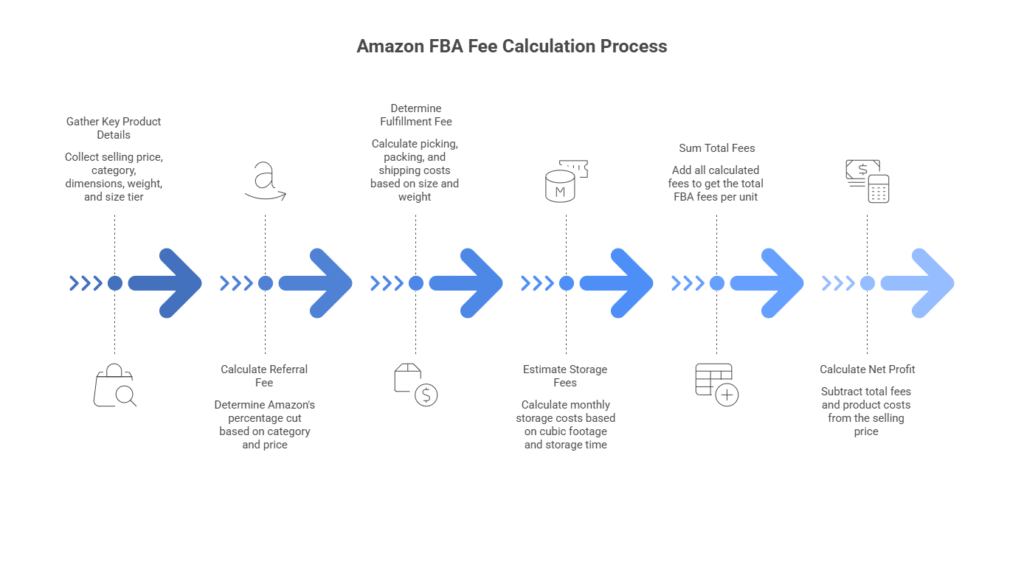
Amazon FBA fees vary by size, weight, price, category, and storage time. Use the Revenue Calculator for accurate 2026 rates. You should take the following steps:
Gather Key Product Details First
Collect everything Amazon needs before you start, including:
- Your selling price
- Product category (sets the referral percentage)
- Packaged dimensions (length × width × height in inches)
- Packaged weight (in ounces or pounds)
- Size tier (Small Standard, Large Standard, Bulky—confirm with Amazon’s tool or calculator)
Calculate the Referral Fee
This is Amazon’s percentage cut on the item price (excluding shipping). To calculate it:
- Find your category rate (usually 8–15%; examples: electronics ~8%, books 15%, clothing up to 17% over $15).
- Formula: Referral Fee = Selling Price × Category Rate
- Minimums often apply ($0.30–$1.00 in many categories).
Example: A $25 T-shirt falls in the clothing category, where Amazon charges 17% referral fee for items priced over $15. Referral fee = $25 × 17% = $4.25. You may also need to calculate COGS for your e-commerce store.
Determine the Fulfillment Fee
This covers picking, packing, shipping, and basic returns.
- Based on size tier, shipping weight (unit or dimensional, whichever higher), and price band (<$10, $10–$50, >$50).
- 2026 non-peak updates: average +$0.08 per unit; small standard $10–$50 items up ~$0.25/unit; items under $10 get ~$0.86 more discount than similar higher-priced items.
- Peak season (Oct 15–Jan 14) adds extra surcharges. Use the Revenue Calculator or Seller Central tables for your exact amount.
Estimate Storage and Other Fees
Storage is charged monthly per cubic foot used.
- Rates: $0.78/cu ft Jan–Sep, $2.40/cu ft Oct–Dec (standard-size).
- Per-unit storage = total monthly storage ÷ expected monthly sales.
- Add aged surcharges if slow-moving: min $0.30/unit/month after 12 months; $0.35/unit after 15 months.
- Include extras like inbound placement (~$0.05–$0.30/unit average), low-inventory fees, or removal charges if needed.
Sum Total Fees and Calculate Profit
Add it all up for the complete picture.
- Total FBA Fees per Unit = Referral + Fulfillment + Storage (per unit) + Other Fees
- Net Profit per Unit = Selling Price − Total Fees − Product Cost − Other Expenses (ads, prep, shipping to Amazon, etc.)
Case Study: Toronto Tech Seller Masters FBA Fee Calculations for a $34.99 Wireless Charger
A tech seller in Toronto’s Liberty Village area sells wireless chargers at $34.99 (electronics category, small standard size, 7 oz, 0.12 cu ft). They are unsure if the product stays profitable after all 2026 FBA fees and worry about miscalculating costs before ordering inventory.
Problem
Unclear fee breakdown leads to hesitation on reordering and potential losses from underpricing or overstocking.
What We Do
We walk them through the full calculation using Amazon’s Revenue Calculator with current 2026 non-peak rates: referral fee (8%) $2.80, fulfillment fee $3.52 (includes $0.08 average increase), storage (2-month average hold) $0.19, other fees estimate $0.30.
The Result
Total FBA fees per unit reach $6.81. Product cost stays $9.75. Profit per unit lands at $18.43 (53% margin before ads). They confidently order 200 units and achieve strong sales thanks to accurate upfront numbers. “Seeing the exact fees in the calculator gives us peace of mind—we know we make money,” they say.
Which Amazon FBA Monthly Plan and Strategy Fits Your Business Best?
You’ve seen the fees and examples. Now let’s match the right Amazon FBA monthly plan to your situation. The two plans (Individual and Professional) work with FBA the same way, but they affect your base costs and tools. Pick based on sales volume, growth goals, and product type. This helps you stay cost-efficient and scale without surprises.
Individual Plan Fits Best If…
You sell low volume or want to test the waters. This plan has no monthly fee, but you pay $0.99 per item sold. It works great for beginners under 40 sales per month. You get basic tools to list items one by one and manage orders.
Example: A small business tests 20–30 phone cases per month. They avoid the $39.99 hit and only pay $0.99 × sales.
Downside: No ads, no bulk uploads, no advanced reports.
Switch when you consistently hit 40+ sales, the $0.99 fees exceed the Professional monthly cost.
Professional Plan Fits Best If…
You sell steadily or plan to grow fast. You pay $39.99 flat per month, no per-item fee. You unlock unlimited listings, Amazon Advertising, bulk tools, detailed analytics, Brand Registry, coupons, and more. This can specially be good for those Amazon FBA businesses that sell internationally.
Example: A seller moves 100 T-shirts per month. Professionals save money ($39.99 vs $99 in Individual fees) and lets them run ads to boost visibility.
It’s ideal for private labels, multiple products, or serious e-commerce entrepreneurs. Most scaling sellers use this for efficiency and growth features.
Quick Decision Guide
To understand which plan fits exactly your Amazon business, ask yourself:
- Do I sell fewer than 40 items per month right now? → Start with Individuals.
- Do I plan ads, bulk listings, or 50+ sales soon? → Go Professional.
- Do I sell high-volume/low-margin items? → Professional saves on fees and gives tools to optimize.
- Do I sell large/heavy products? → FBA fees rise anyway, so Professional’s tools help manage better.
Use FBA on either plan. Start Individual to learn, then upgrade in Seller Central (takes minutes). Many beginners switch within 3–6 months once sales pick up.
Pro Tip: Calculate your break-even: Divide $39.99 by $0.99 ≈ 40 sales/month. At 41 sales, Professional saves money plus gives better tools.
If you need expert help with the Amazon FBA fees, consult our e-commerce accountant today.
How to Cut or Avoid Amazon FBA Fees?
Amazon FBA fees usually take 25–40% of your selling price when everything adds up. The small 2026 fulfillment bump of about $0.08 per unit makes smart pricing and fee cutting even more important. Good pricing covers your costs, keeps you in the game, and leaves real profit. These simple tips help you lower fees and keep more money.
Calculate Your True Break-Even Price First
Figure out your lowest safe price before you list anything. Add up product cost, referral fee, fulfillment fee, estimated storage, a little buffer for returns and ads, and your target profit (shoot for 20–30% at least).
Example: $5 product cost + $1.44 referral (8%) + $3.45 fulfillment + $0.20 storage = $10.09 total cost. Price the item $18 to $22 to get solid margins. Use Amazon’s Revenue Calculator to test prices fast. It uses the latest 2026 rates and shows your exact profit right away.
Price to Win the Buy Box Without Killing Margins
Try to sit in the top 15–20% of prices in your niche instead of always being the cheapest. Dropping too low kills profit quick. Set a hard rule: never sell below total cost + fees + at least 15% profit. Repricer tools adjust your price automatically. They help you win the Buy Box while keeping your margin safe.
Optimize Inventory to Slash Storage Fees
Move stock fast so storage doesn’t eat your profit.
- Target 3–6 months of turnover so you don’t hold too much.
- Send smaller shipments more often to avoid the October–December spike ($2.40 per cubic foot).
- Remove slow sellers before 12 months to skip aged surcharges ($0.30+ per unit per month).
- Keep your IPI score above 450. Amazon gives fewer limits and lower extra fees when inventory looks healthy.
Cut Inbound and Placement Fees
Use Amazon’s shipment optimization suggestions when you create inbound plans. They split shipments less and lower placement fees. Use Ships in Product Packaging for items that qualify to skip extra prep charges. If you sell high volume, check out Amazon Warehousing & Distribution (AWD) for cheaper long-term storage.
Other Quick Wins to Lower Fees
These small changes add up fast.
- Pick products under $10 when you can—they get a bigger fulfillment discount (~$0.86 less per unit in 2026).
- Watch low-inventory fees and restock before stock gets too low during busy times.
- Switch to Professional plan once you hit 40+ sales per month to drop the $0.99 per-item fee and unlock ads plus bulk tools.
- Check Seller Central reports every week to catch storage creep or slow movers early.
Pro Tip: Before you list or reorder, run quick tests in the Revenue Calculator. Change the price and see fees and profit update in seconds. Contact our bookkeeping and accounting experts who guide you perfectly for you Amazon FBA business.
Case Study: Mississauga Beauty Brand Slashes FBA Fees by $3,180 Monthly
A beauty brand in Mississauga’s Erin Mills area sells face masks at $19.99 (beauty category, 400 units/month). Initial fees consume 39.2% of sales ($7.83 per unit).
Problem
High storage costs from slow turnover, $0.99 per-item fees on the Individual plan, and extra placement charges from unoptimized shipments eat into margins.
What We Do
We help them switch to the Professional plan, improve turnover from 5 to 3 months, use Amazon’s shipment optimization and Ships in Product Packaging, remove slow SKUs before aged surcharges hit, and adjust select listings under $10 for bigger fulfillment discounts.
The Result
Fees fall to 26.3% ($5.25 per unit), saving $3,180 monthly on the same volume. They now reinvest savings into new product lines. “We finally stop paying Amazon more than we have to, real money back in our pocket,” the founder says.
Conclusion: Ready to Master Amazon FBA Fees in 2026?
You now understand Amazon FBA fees, plans, and costs, from referral percentages to storage surcharges and the small 2026 updates. Use the Revenue Calculator, price smart, keep inventory moving, and pick the right plan for your volume. Start calculating today, optimize weekly, and watch profits grow. FBA still powers most sellers to Prime success.
Take action now. Contact us or email at tax@salaccounting.ca for personalized help and watch your profits grow.