We’re here to give you a clear and honest look at the cost to start an e-commerce business. We’ll help you launch with confidence and avoid those nasty surprises later. You may completely overlook the GST/HST threshold. Once your sales start rolling in, you suddenly face mandatory registration, piles of extra paperwork, and painful cash flow headaches way faster than you ever expected.
SAL Accounting explains exactly how that hidden trigger works. We’ll share realistic 2026 numbers and help you build a smart e-commerce startup budget that actually fuels your growth.
Quick Takeaways
- You can start an e-commerce business in 2026 for as little as $500 – $2,000 using dropshipping.
- Most beginners spend between $3,000 and $8,000 to launch a realistic online store.
- Always plan for both one-time costs and monthly ongoing expenses from day one.
- Platform fees, apps, and marketing are your biggest monthly costs — track them carefully.
- Watch the $30,000 GST/HST threshold in Canada — crossing it suddenly creates extra paperwork and cash flow stress.
- Start small, test your products, and scale only when you have real sales.
How Much Does It Cost to Start an E-commerce Business in 2026?
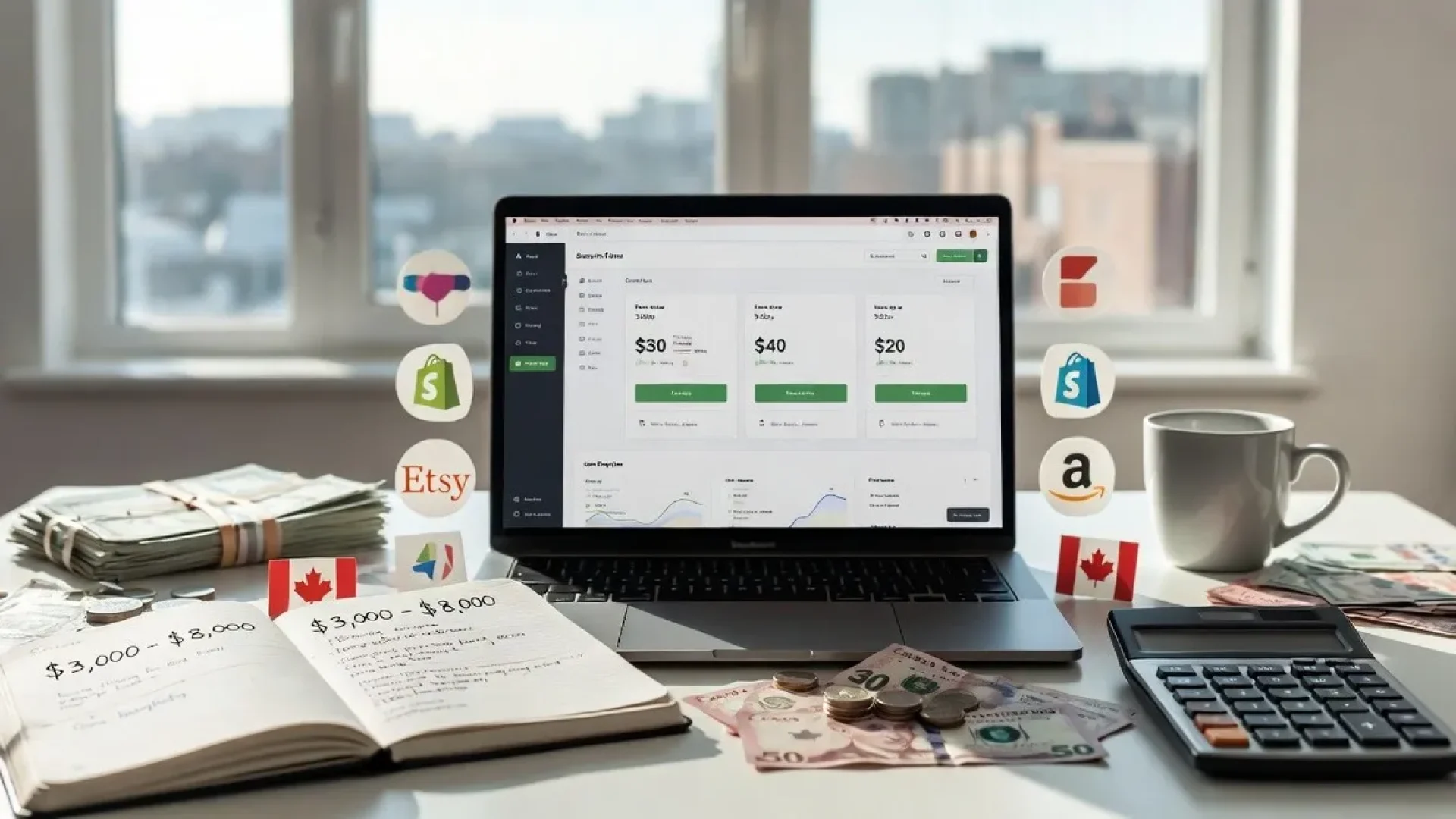
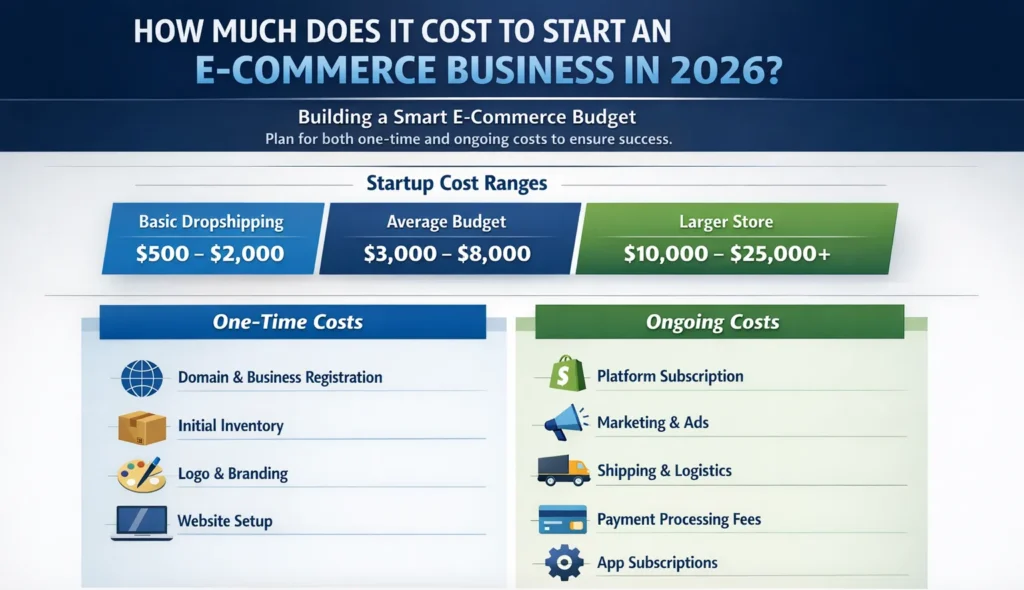
You can start an e-commerce business for as little as $500 – $2,000 if you use dropshipping and keep things basic. A realistic average budget for most beginners is $3,000 – $8,000. This covers a proper Shopify store, some inventory or ads, and essential tools. If you want a larger store with more products and marketing, expect $10,000 – $25,000+.
Our e-commerce accounting and bookkeeping experts helped many Canadian founders create budgets that truly support long-term success. Let’s explain everything in detail.
One-Time vs Ongoing Costs: How to Build a Smart E-commerce Startup Budget
When you start an online store, you have two main types of costs: one-time costs and ongoing costs. These expenses for e-commerce businesses are as follows:
- One-time costs are the expenses you pay only once when you begin. These include domain registration, business registration, initial inventory, logo and branding, and setting up your website.
- Ongoing costs are the expenses that keep coming every month or every year. These include platform subscription fees, marketing, shipping and logistics, payment processing fees, and app subscriptions.
Many new store owners focus only on the one-time costs. They forget about the monthly expenses. This mistake often creates cash flow problems once sales begin. You need to plan for both types from day one. In the sections below, we will show you realistic 2026 numbers for each category.
Here is a simple overview that shows the difference between costs you pay once and costs that continue every month.
| Cost Type | Examples | One-Time Cost (CAD) | Monthly / Ongoing Cost | Notes |
| Website & Domain | Shopify plan + domain | $0 – $500 | $39 – $399 | Most popular option |
| Business Setup | Registration + legal | $0 – $300 | $0 – $50 | Sole proprietor is cheapest |
| Inventory | Initial stock or samples | $500 – $8,000 | $0 – $2,000 | Very low with dropshipping |
| Marketing | Ads, social media, SEO | $0 – $1,000 | $300 – $1,500 | Biggest variable cost |
| Apps & Tools | Email, reviews, shipping | $0 | $100 – $300 | Easy to overspend |
| Legal & Insurance | Insurance + accounting software | $300 – $800 | $0 – $50 | Often forgotten |
How Much Does It Cost to Create Your E-commerce Website?
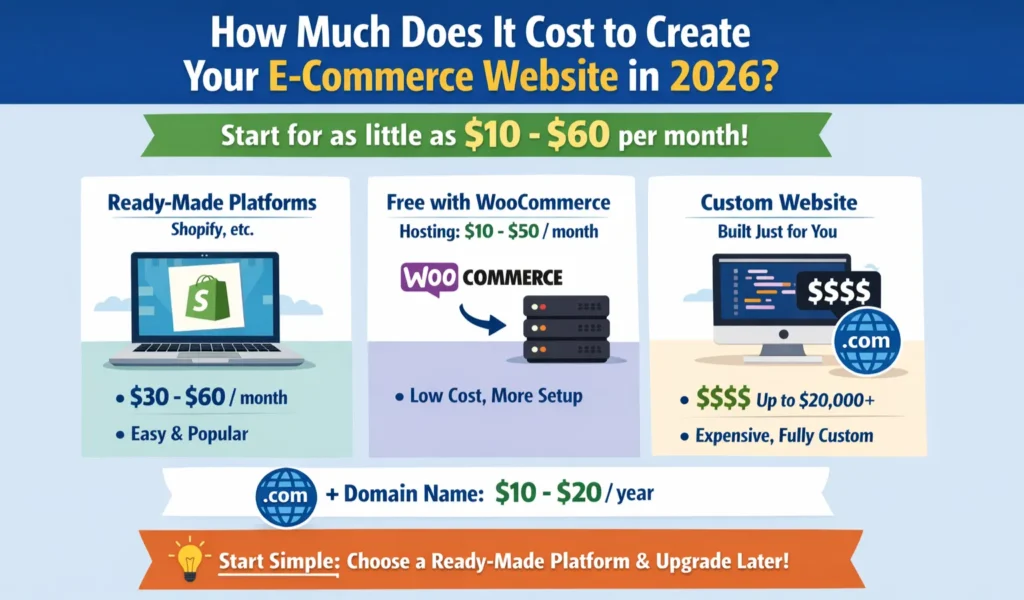
You can create your e-commerce website for as little as $10 to $60 per month in 2026. The good news is that you don’t need to spend a lot of money to get started. Every e-commerce seller has a few easy options:
- Ready-made platforms like Shopify or similar tools. These are the most popular choices for beginners. You can start with basic plans that cost between $30 to $60 per month.
- Free options like WooCommerce (WooCommerce pricing plan). It costs nothing for the software, but you still need to pay for hosting, which usually runs $10 to $50 per month.
- Custom-built websites. These are more expensive. Expect to pay anywhere from a few thousand dollars up to $20,000 or more if you want something completely unique.
Most new store owners start with a ready-made platform because it’s fast and includes everything you need: hosting, security, and a checkout system. You also need a domain name. A good domain usually costs $10 to $20 per year. Compare Shopify vs WooCommerce before making any decision.
Pro Tip: Start simple. Pick a ready-made platform with a low monthly fee. You can always upgrade later when your store grows.
Platform Fees and Subscription Costs: What You’ll Pay Monthly?
Platform fees are one of the highest ongoing costs for your online store. Here are the most popular platforms and what they actually cost per month in 2026:
Main Platform Options and Their Monthly Fees
- Shopify: Most beginners start with the Shopify Basic plan at around $39 per month (or less if you pay yearly). Higher plans go up to $105 or $399 per month when you need more features. Basic is the best Shopify plan for beginners.
- Wix or Squarespace: These usually start between $29 and $40 per month for plans with full ecommerce features.
- BigCommerce: Basic plans also start around $29 to $39 per month (BigCommerce pricing)
- WooCommerce: The software is free, but you pay for hosting, typically $10 to $50 per month.
Marketplace Options (Amazon & Etsy)
If you don’t want to build your own website right away, you can sell on big marketplaces instead:
- Amazon: Professional plan costs $39.99 per month. You also pay referral fees of 8–15% per sale plus fulfillment fees. Also, check the key cost differences between Amazon and Shopify.
- Etsy: No monthly subscription fee. You pay a $0.20 listing fee per item plus 6.5% transaction fee and payment processing fees.
Most new store owners who want their own branded store choose Shopify or Wix. Wix apps for e-commerce help you a lot. Many people start on Etsy (especially for handmade or unique items) or Amazon (for high volume) because they are faster to set up.
Pro Tip:If you want full control and your own brand, go with Shopify or similar. If you want to test products quickly with almost no upfront work, try Etsy or Amazon first.
Transaction and Payment Processing Fees
You also pay transaction fees every time a customer buys something. This is usually 2.4% to 2.9% per sale, plus a small fixed fee, like 30 cents. The percentage often gets lower when you upgrade your plan.
This table helps you quickly compare the monthly cost of different platforms and marketplaces.
| Platform | Monthly Fee (Basic) | Transaction Fees | Best For | Total Monthly Cost (with apps) |
| Shopify | $39 | 2.4% – 2.9% + 30¢ | Branded online store | $150 – $350 |
| Wix / Squarespace | $29 – $40 | 2.9% + 30¢ | Simple stores | $120 – $280 |
| BigCommerce | $29 – $39 | 2.9% + 30¢ | Growing stores | $140 – $320 |
| WooCommerce | $0 (software) | Depends on payment gateway | Custom stores | $80 – $250 |
| Amazon | $39.99 | 8% – 15% + FBA fees | High volume sales | $400+ |
| Etsy | $0 | 6.5% + listing fees | Handmade & unique items | $50 – $150 |
E-commerce App Costs: How Much You’ll Pay Monthly?
On top of your platform fees, you will likely add some apps to your store. Most new store owners use between 5 and 10 apps for e-commerce accounting and other purposes. These apps help with important tasks like email marketing, collecting product reviews, improving shipping, showing upsells, or managing inventory. Here are some common examples:
- Email marketing app (like Klaviyo or Omnisend) – $20 to $50 per month
- Product review app (like Judge.me or Loox) – $15 to $30 per month
- Shipping and tracking tool (like AfterShip or ShipStation) – $10 to $40 per month
- Upsell and cross-sell app – $10 to $25 per month
- Inventory management app – $20 to $60 per month
Each app usually costs between $10 and $50 per month. Some simple apps are cheaper, while more advanced ones can cost $80 or even $100+ per month. Because of this, many new store owners end up paying an extra $100 to $300 per month on apps alone.
Pro Tip: Start with only the 2 or 3 apps you really need right now. For example, begin with an email marketing tool and a review app. Then review your apps every month and cancel the ones you are not using.
Inventory & Fulfillment Costs: The Cost to Start an Online Store and Set Up a Retail Business
Inventory and shipping are two of the highest costs when you run an online store. You have two main ways to sell products:
1. Dropshipping
You don’t buy products in advance. When a customer orders, the supplier sends the item directly to them. This means your upfront cost is very low, often just $200 to $1,000 to start. However, your profit per sale is usually smaller. Read the Shopify dropshipping guide to learn more.
2. Buying Your Own Inventory
You buy the products first and store them. This costs more money upfront, usually $2,000 to $8,000 or more, depending on how many products you sell. But you can make a higher profit per sale.
3. Shipping Costs
Shipping is another important cost you need to plan for. Every time you send a package, you pay shipping fees. These usually range from $5 to $15 per order, depending on the size and where you send it. Cross-border ecommerce shipping costs more.
Pro Tip: If you are just starting and want to keep costs low, begin with Shopify dropshipping. Once you know which products sell well, you can start buying your own inventory later.
E-commerce Marketing Expenses: How Much Should You Spend?
Getting customers is one of the biggest challenges for a new online store. Marketing helps people find your store and make their first purchase. Here’s how much most beginners spend on marketing in 2026:
- Paid ads (Facebook, Instagram, Google, TikTok): $300 to $1,500 per month
- Social media marketing: $100 to $500 per month
- Email marketing: $20 to $100 per month
- SEO and content: $0 to $400 per month
Most new store owners start with $500 to $1,000 per month on marketing. Some smart beginners begin with almost $0 and only use free methods like posting on social media and learning SEO.
Pro Tip: Don’t go all-in on ads right away. Start small, test what works, and then increase your budget. A good rule to follow: Spend about 15% to 25% of your expected sales on marketing.
How GST/HST / Sales Tax Affects Your E-commerce Business Start-Up Costs
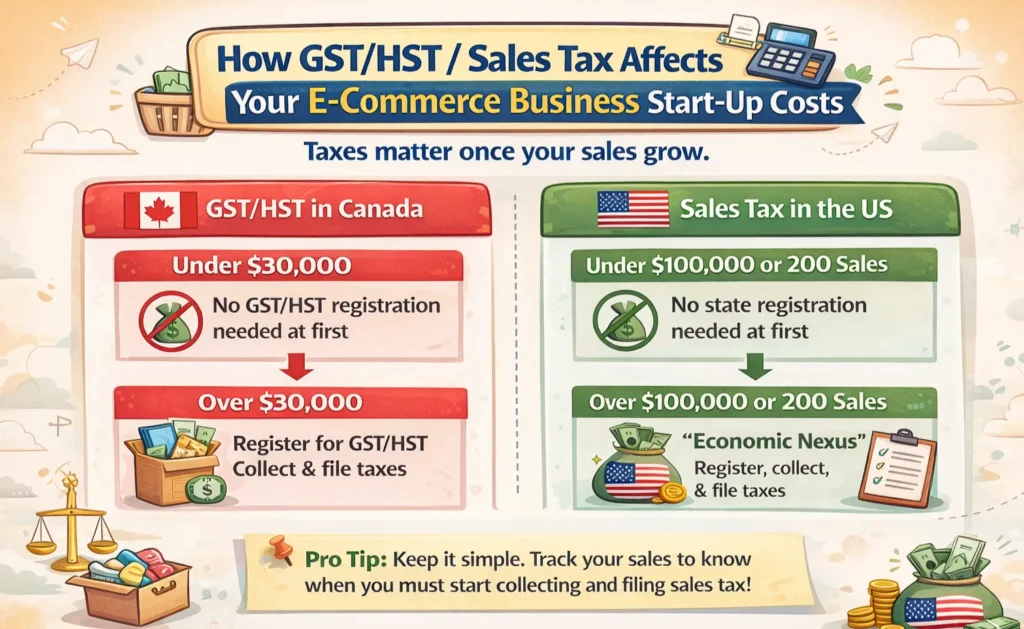
Taxes are not a high cost at the very beginning, but they become important once your sales grow.
GST/HST in Canada
You do not need to charge or collect GST/HST when your total sales are under $30,000. Once your worldwide sales go over $30,000 in any four consecutive quarters (or in one single quarter), you must register for GST/HST. After that, you collect tax from customers and send it to the government.
Registration itself costs nothing, but you will spend time on extra paperwork and monthly or quarterly filings. Not registering your e-commerce store with HST/GST costs you more.
Sales Tax in the US
In the United States, you must collect sales tax if you reach “economic nexus” in a state. This usually happens when you make more than $100,000 in sales or 200 transactions in that state in a year. Many states have this rule now. You collect the tax from customers and send it to the state.
Pro Tip: Stay under the $30,000 mark at first if possible. This gives you time to learn without extra tax work. Once you grow, register early and use good accounting software. It helps you avoid penalties and claim back taxes you paid on business expenses.
Case Study: How Sarah in Toronto Handles the GST/HST Threshold1
Sarah runs a handmade jewelry store from her home in Kensington Market, Toronto. She launched her Shopify store in early 2025. Her total startup cost is about $4,200.
Problem:
For the first 8 months, her sales stay low. Then, in month 9, one product becomes very popular on TikTok. Her sales jump suddenly. She crosses the $30,000 GST/HST threshold without any warning. She does not plan for this. She now faces extra paperwork, late filing stress, and cash flow problems because she has already spent the tax money she collected.
What we do:
Sarah reaches out to SAL Accounting for help. We registered her for GST/HST right away. We set up automatic tax tracking inside her Shopify store. We also show her how to claim back the taxes she pays on her business expenses.
The Result:
Sarah now collects HST the correct way. She files her returns on time every quarter. She saves money by claiming back thousands of dollars in business expenses. Her stress is much lower now, and she can focus on growing her store instead of worrying about taxes.
- Read More: “E-Commerce Taxes in Canada: Types, Tips & Strategies”
Legal and Operational Costs: What You Need to Pay to Stay Legal
You must handle some legal and operational tasks when you open an online store. Remember, the costs depend on your business structure in Canada, too. Here are the main costs you should know:
- Business registration: Usually $0 to $200 (one-time)
- Domain name: $10 to $20 per year
- Business bank account and payment setup: $0 to $50 per month (see the best business bank accounts for e-commerce)
- Accounting software: $0 to $30 per month
- Insurance: $300 to $800 per year
Once your sales reach a certain amount, you must register for taxes (CRA Account) in many places. Registration itself costs nothing, but it creates more paperwork.
Pro Tip: Keep things simple at the beginning. Start as a sole proprietor. It is the cheapest and easiest option. Only upgrade to a company when your store earns good money.
Total E-commerce Startup Costs in 2026: Realistic Budget Scenarios
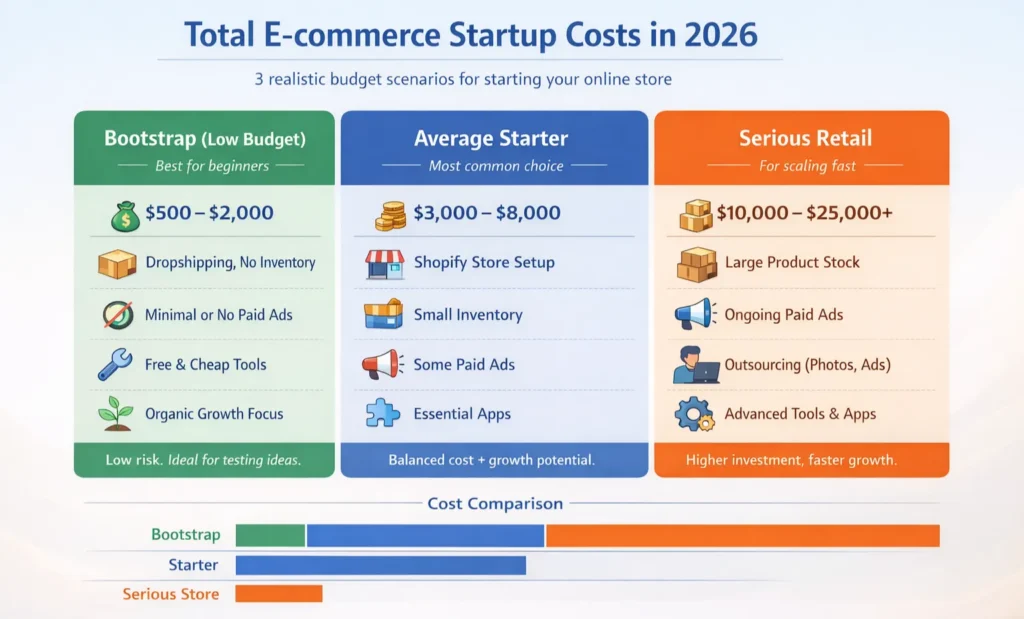
You now know all the individual costs. Here is how much it really costs to start an online store in 2026:
Bootstrap Scenario (Lowest Cost)
You start very small with dropshipping and almost no paid ads. You use free or cheap tools and grow slowly with organic traffic. Check the Shopify dropshipping plans for more.
Total cost: $500 – $2,000
This option is perfect if you have a tight budget and want to test your idea with very little risk. Many people launch their first store this way and upgrade later when they make sales.
Average Starter Store Scenario
You use Shopify, buy a small amount of inventory, run some paid ads, and add a few useful apps.
Total cost: $3,000 – $8,000
This is the most common choice for new store owners. You get a professional-looking store, some products in stock, and enough marketing to get your first customers. It gives you a good balance between cost and growth potential.
Consult our Shopify accountant and have sales with no worries.
Serious Retail Store Scenario
You stock a larger selection of products, run regular paid ads, hire help for photos or ads, and use many apps.
Total cost: $10,000 – $25,000 or more
This scenario suits you if you already have experience or want to launch a bigger brand from day one. You spend more upfront, but you can grow faster and make higher profits per sale.
This table shows how your total startup cost changes depending on the size and type of store you want to run.
| Expense Category | Bootstrap Scenario | Average Starter Store | Serious Retail Store | % of Total Budget |
| Website & Platform | $400 – $800 | $600 – $1,200 | $1,000 – $2,500 | 10 – 15% |
| Inventory / Products | $200 – $800 | $2,000 – $4,000 | $5,000 – $12,000 | 35 – 45% |
| Marketing & Ads | $0 – $500 | $1,000 – $2,500 | $3,000 – $8,000 | 25 – 30% |
| Apps & Tools | $50 – $150 | $150 – $400 | $400 – $800 | 5 – 10% |
| Legal & Insurance | $300 – $600 | $500 – $1,000 | $800 – $1,500 | 8 – 10% |
| Total Estimated Cost | $500 – $2,000 | $3,000 – $8,000 | $10,000 – $25,000 | 100% |
Case Study: How Mike in Mississauga Builds a Profitable Store2
Mike sells modern home decor and lighting from his small warehouse in Mississauga. He started his online store in January 2026. His total startup cost is $6,800.
Problem:
In the first three months, his sales stay slow. He spends $800 to $1,000 every month on marketing and apps. However, he does not track his real profit clearly. He does not know his true margins. He also does not know the best way to handle taxes.
What we do:
Mike hires SAL Accounting to help him. We set up proper bookkeeping and connected his Shopify account. We help him track all his expenses correctly. We show him how to cut unnecessary apps. We also help him improve his pricing and register for GST/HST so he can claim back taxes on his inventory and ads.
The Result:
After six months, Mike’s monthly revenue grows to $18,000. His net profit increases from $1,200 to $4,800 per month. He recovers his entire startup investment in just 5 months. He now runs a stable and profitable business.
Conclusion: How to Start Your E-commerce Business in 2026 on a Budget
You can open an online store in 2026 without spending too much. You now know the real costs, website, apps, inventory, shipping, marketing, and taxes. The secret is simple: plan for both one-time expenses and monthly bills from the start. Smart store owners begin small. They test their products first. They only spend more money when sales start coming in. Make your budget carefully. Keep clear records from day one. Watch your taxes as your sales grow. Good planning now can save you a lot of money later.
If you need help with bookkeeping or taxes, our team at SAL Accounting is ready to support you. Book your consultation today and enjoy more profits.