Our goal is to help you make the right choice between building your own Shopify store or growing with Amazon FBA. But here’s what most sellers miss: Starting January 15, 2026, Amazon will raise average FBA fulfillment fees by $0.08 per unit. This small change will quietly eat into many sellers’ profits.
In this SAL Accounting guide, we explain exactly how these new fees, along with the main differences in costs, control, and growth potential, will affect your business. You will see clearly which option fits you best.
Quick Takeaways
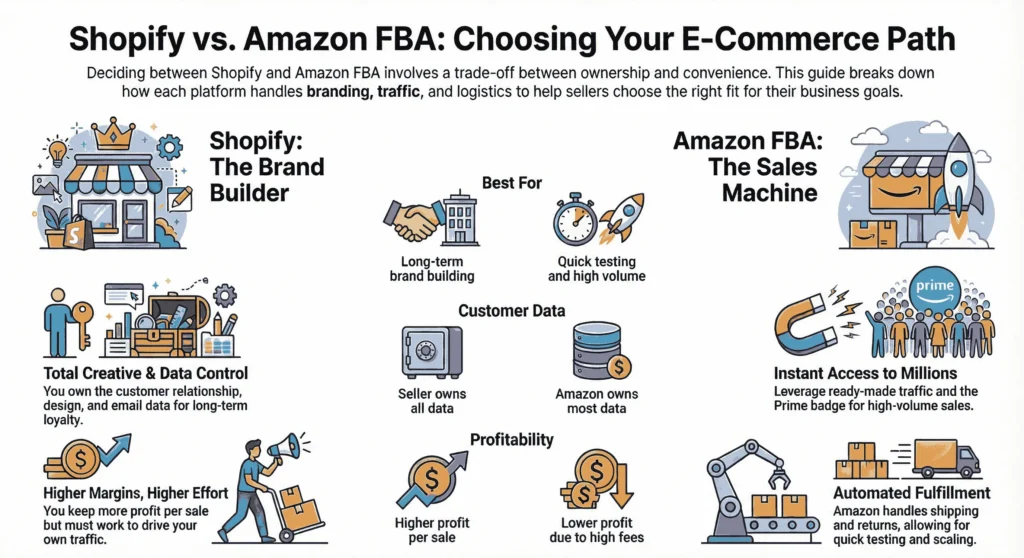
- Shopify gives you full control and higher profit per sale, while Amazon FBA offers faster sales and Prime shipping.
- Amazon FBA is easier for beginners who want quick sales, but Shopify is better for long-term brand building.
- In 2026, Shopify usually costs less per sale than Amazon FBA due to lower fees.
- Most successful sellers use both platforms together for maximum growth and profit.
- Choose Shopify for branding and profit. Choose Amazon FBA for speed and volume.
Shopify vs Amazon FBA: What Is the Main Difference?
Before you decide which one fits your business, let’s look at each option clearly. Shopify gives you your own store. Amazon FBA lets you sell inside Amazon’s big marketplace and use their shipping service. If you can’t make up your mind now, read the post to the end or consult our e-commerce accounting and bookkeeping expert. Let’s read about both:
What Is Shopify? How a Shopify Store Works in 2026
Shopify lets you build and run your own online store. You own everything: the design, the products, and the customer list. Here is how Shopify works in 2026:
- You pick a theme and change the look with your logo and colors.
- You add your products, write descriptions, and set your own prices.
- Customers come straight to your website.
- Shopify handles payments.
- You manage shipping yourself or use a partner.
- You collect customer emails and build your own list.
In 2026, the prices are simple. Basic plan, which is the best plan for beginners on Shopify, costs $39 per month (or $29 if you pay for the year). Grow plan costs $105 per month. Advanced costs $399. You also pay 2.5% to 2.9% plus 30 cents on each sale.
Example: If you sell handmade jewelry, you take nice photos, tell your brand story, and send special offers to your customers later.
Pro Tip: Start with the Basic plan if you are new. You can upgrade when sales grow.
What Is Amazon FBA and How Does It Work?
Amazon FBA means Fulfillment by Amazon. You sell on Amazon’s marketplace, and Amazon takes care of storage, packing, shipping, and returns. Here is exactly how Amazon FBA works:
- You send your products to Amazon’s warehouses.
- Amazon stores your items and makes them Prime-eligible.
- Customers buy on Amazon.com and get fast, free shipping with Prime.
- Amazon picks, packs, ships the order, and handles customer service.
- You pay $39.99 every month as a Professional seller.
- Amazon takes 8% to 15% referral fee plus shipping fees.
Amazon FBA helps you reach millions of buyers fast. You do not need your own website or ads. But you compete with lots of other sellers on the same page. You also have less control over your brand and customer information. Check Amazon FBA plans and fees too.
Example: if you sell kitchen tools, you send stock to Amazon and let Prime shipping bring the sales. Growth can be quick, but you cannot easily contact buyers again.
Pro Tip: Test with a small amount first. Check the real fees and demand before you send a lot of stock.
How Do Fees Compare Between Shopify and Amazon FBA? (2026 Costs)
Now let’s talk about money. Costs are one of the biggest differences between Shopify and Amazon FBA. Here is a clear breakdown for 2026:
| Expense | Shopify | Amazon FBA | Notes |
| Monthly fee | $39 (Basic) to $399 (Advanced) | $39.99 (Professional seller fee) | Shopify has yearly discount |
| Fee per sale | 2.5% – 2.9% + $0.30 | 8% – 15% referral fee + FBA fulfillment fee | Amazon fees are usually higher |
| Shipping & fulfillment | You pay (or use 3PL) | Amazon handles it (extra fee) | Big difference |
| Storage fee | None (unless you use 3PL) | Monthly storage + long-term fees | Amazon charges more if items sit long |
| Payment processing | Included in Shopify fees | Handled by Amazon | — |
| Total cost on a $50 item | Around $3 – $5 | Around $12 – $20 | Amazon often takes 30-40% total |
Shopify costs
Shopify is known for keeping fees low and predictable. You pay less per sale and have no hidden storage or shipping charges from the platform itself. Shopify’s refund policies are always clear. This usually helps you keep more money in your pocket. Here’s what the numbers mean in Shopify pricing plans and how they affect your profit:
- The monthly fee is low and predictable ($39 to $399).
- You only pay 2.5% to 2.9% plus 30 cents on each sale.
- No storage or fulfillment fees from Shopify.
- You keep more profit per sale (usually $25–$27 on a $50 item).
- Downside: You must pay extra for advertising to bring customers to your store.
Amazon FBA costs
Amazon FBA has higher fees because it includes storage, packing, and shipping. Amazon seller taxes are essential to consider. The platform also raised some charges in 2026. Here’s what the numbers mean in Amazon FBA pricing and how they affect your profit:
- The monthly fee is $39.99.
- You pay high referral fees (8%–15%) plus fulfillment fees.
- Starting January 15, 2026, fulfillment fees go up by $0.08 per unit on average.
- The total cost per $50 item is often $12–$20, so you keep less profit.
- Big advantage: Amazon brings customers for free and handles all shipping.
Example: You sell a product for $50 that costs you $20. This gives $30 gross profit.
- With Shopify, you keep about $25 to $27.
- With Amazon FBA, you keep only about $10 to $18 after the new 2026 fees.
Quick Comparison: Shopify wins on profit per sale. Amazon FBA wins on easier sales volume. The best choice depends on whether you want more money per item or more total sales.
Pro Tip: Sit down and calculate your own numbers. Take your selling price, subtract all fees for both platforms, and see which one leaves you with more money. Use a good financial software for Amazon FBA to calculate.
Does Amazon FBA Handle Shipping Better than Shopify?
Shipping is a big part of running an online store. Let’s see how Shopify and Amazon FBA compare when it comes to getting orders to your customers:
How fulfillment works on Shopify
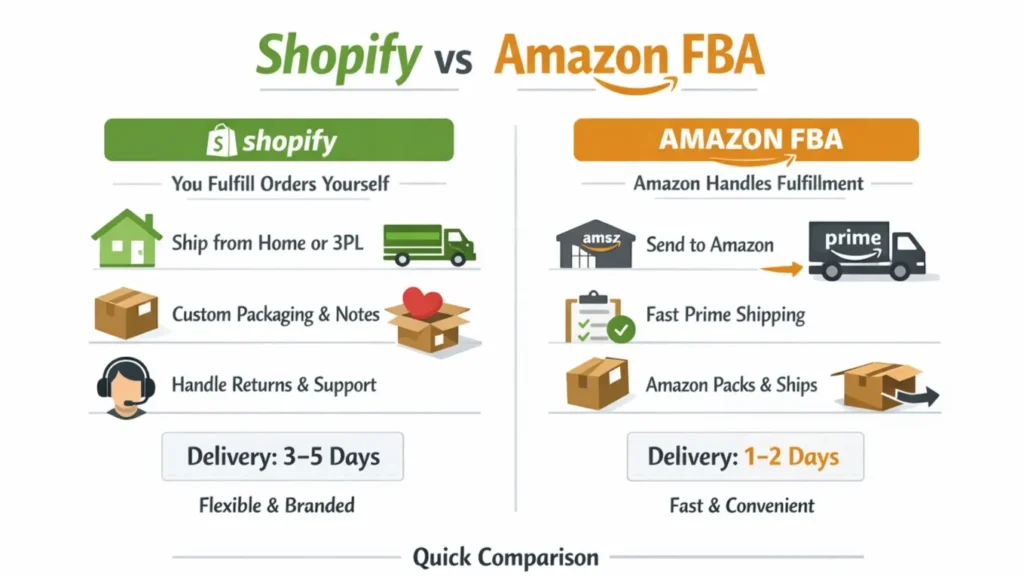
With Shopify, you are in full control of shipping. You decide how to pack and send orders. Selling internationally on Shopify is possible. Here is what it looks like:
- You can ship orders yourself from home or office.
- You can use a third-party logistics company (called 3PL).
- You can work with print-on-demand services like Printful or Gelato.
- You choose the shipping carrier (USPS, UPS, FedEx, DHL, etc.).
- You set your own shipping rates and delivery times.
- You handle returns and customer questions about shipping.
How fulfillment works with Amazon FBA
With Amazon FBA, Amazon does almost all the shipping work for you. International selling on Amazon FBA seems easier. Here is what fulfillment looks like:
- You send your products to Amazon warehouses.
- Amazon stores your items and makes them Prime-eligible.
- When a customer orders, Amazon picks, packs, and ships the item.
- Customers get fast, free shipping with Prime.
- Amazon handles returns and customer service for shipping issues.
- You can also use Multi-Channel Fulfillment (MCF) to ship orders from your Shopify store.
Example: You sell phone cases priced at $25.
- On Shopify: You pack the order at home and send it with USPS. Delivery takes 3–5 days. You control the box and add a thank-you note.
- On Amazon FBA: You send stock to Amazon. When someone buys, it ships the next day with Prime. Delivery is usually 1–2 days, but you cannot add your own note or choose the box.
Quick Comparison: Amazon FBA wins on speed and convenience. Shopify wins on flexibility and branding. If fast shipping is most important to your customers, Amazon FBA is stronger. If you want to create a special unboxing experience, Shopify gives you more control.
Pro Tip: Many smart sellers use both. They keep best-sellers in Amazon FBA for fast Prime shipping and use Shopify + 3PL for special or high-margin products.
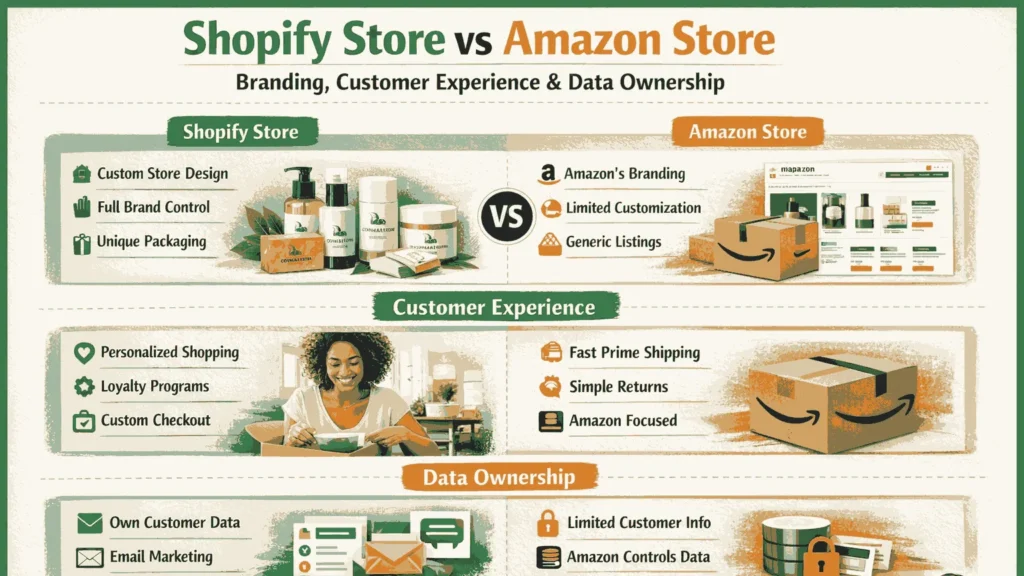
Branding, Customer Experience & Data Ownership: Shopify Store vs Amazon Store
Your brand and customer experience matter a lot. They decide if people buy from you once or come back again and again. Let’s compare Shopify and Amazon FBA in the key areas that matter most.
Branding
Shopify lets you build your own brand exactly how you want. You design the store with your colors, logo, fonts, and layout. There are a lot of Shopify tools and integrations to help you. You write your own product stories and control the full look. Customers remember your brand, not just Amazon. You can create special packaging and thank-you notes.
Amazon FBA limits your branding. You sell on Amazon’s website, so the Amazon brand is stronger. You can add A+ Content, but your page still looks like an Amazon page. You have less control over packaging, and customers often see your product next to competitors.
Customer Experience
Shopify gives you full control over the shopping journey. Customers feel like they are shopping at your own personal store. You can make the checkout smooth, add loyalty programs, and create a nice unboxing experience.
Amazon FBA offers fast and easy shopping with Prime shipping and simple returns. Customers enjoy quick delivery, but the experience feels more like shopping on Amazon than from your own brand.
Data Ownership
Shopify lets you own all customer data. You get their emails, addresses, and purchase history. You can contact them anytime with special offers or new products.
Amazon FBA keeps most customer data. You cannot easily get buyer emails or build your own list. Amazon controls the customer information. Bookkeeping on Amazon FBA is not a problem.
Example: You sell natural skincare products.
- On Shopify, a customer buys once. You send them a nice email with 10% off their next order. They become loyal fans of your brand.
- On Amazon FBA, a customer buys, but you cannot contact them again. They only know the product as something sold by Amazon.
Quick Comparison: Shopify wins on branding and data ownership. You build your own strong brand and keep your customers. Amazon FBA wins on a fast and easy shopping experience, but you lose control over your brand and customer relationships.
Pro Tip: If you want to grow a real brand that lasts for years, start with Shopify. You can always add Amazon FBA later to get more sales. Let our Amazon tax accountant help you in this way.
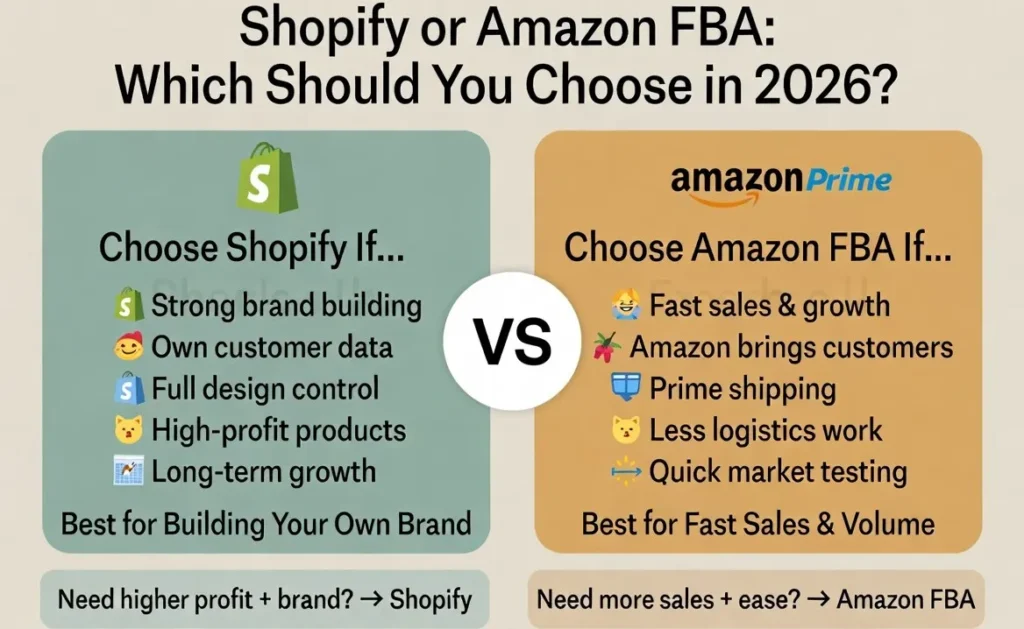
Shopify or Amazon FBA: Which Should You Choose in 2026?
You now know the main differences between Shopify and Amazon FBA. But the big question is: which one is right for you? The answer depends on your goals, your products, and how you want to grow. Here is a simple guide to help you decide:
Choose Shopify if…
Shopify is the better choice when you want to build your own brand and keep full control. It works well if you care about long-term growth. Shopify plans for dropshipping or other features make it an excellent platform. Choose it if:
- You want to build a strong brand that lasts.
- You want to own your customer emails and data.
- You like full control over your store design and packaging.
- You sell unique or high-profit products.
- You are okay with finding your own customers.
- You plan to grow your business for many years.
Choose Amazon FBA if…
Amazon FBA is the better choice when you want fast sales and less work on logistics. This is good for e-commerce cross-border sales or other purposes. It is great if you need quick growth. Choose Amazon FBA if:
- You want fast sales and quick growth.
- You want Amazon to bring customers to you.
- You are okay with higher fees.
- You sell products that work well with Prime shipping.
- You want Amazon to handle storage, packing, and shipping.
- You are new and want to test the market fast.
Quick Decision Guide
- Want higher profit and your own brand? → Choose Shopify.
- Want more sales and easy shipping? → Choose Amazon FBA.
- Want both? → Use Shopify as your main store and Amazon FBA for extra sales.
Case Study: Toronto Jewelry Maker Builds Strong Brand on Shopify1
Sarah runs her handmade jewelry business from a small studio in Kensington Market, Toronto. She creates unique silver necklaces and wants to build a strong personal brand.
Problem: She spends too much time on shipping and customer service. She also wants to own her customer emails so she can send special offers and build loyalty. But selling only on marketplaces makes this difficult.
What We Do: We recommend she start with Shopify on the Basic plan. She designs her own store with custom packaging and thank-you cards. She focuses on collecting customer emails and drives traffic through Instagram and local pop-up events in Kensington Market.
The Result: Sarah grows her email list to over 4,000 subscribers. She now makes 70% of her sales directly from her Shopify store with higher profit margins. She has full control over her brand and packaging while she keeps growing steadily.
Pro Tip: Start small. Test one platform for 30 to 60 days. Look at your real numbers before you spend a lot of time or money.
There is no single winner. Many successful sellers use both. They use Shopify as their main brand store and Amazon FBA to get more sales and Prime customers.
Think about your products, your budget, and your goals. Pick the one that matches what you want most.
What Are the Pros and Cons of Shopify vs Amazon FBA?
Many sellers get confused about the real advantages and disadvantages of each platform. Here is a simple side-by-side comparison to make it clear:
| Aspect | Shopify Advantages | Amazon FBA Advantages | Shopify Disadvantages | Amazon FBA Disadvantages |
| Branding & Control | Full control over design, packaging, and look | Quick setup and Prime badge | You must drive all your own traffic | Limited branding, Amazon brand dominates |
| Traffic & Sales | You build your own loyal customers | Millions of ready buyers, fast sales | Takes time and money to get traffic | Heavy competition on the same page |
| Profit Margins | Higher profit per sale | High sales volume | Lower volume at the beginning | Lower profit per sale due to high fees |
| Customer Data | You own all emails and data | Easy returns and fast delivery | No built-in audience | Amazon owns most customer data |
| Fulfillment | Full flexibility and custom experience | Fast Prime shipping, Amazon handles everything | You manage shipping or pay 3PL | Less control over packaging and speed |
| Best For | Building a long-term brand | Quick testing and high volume | Takes more work to start | Harder to stand out from competitors |
Can You Use both Shopify and Amazon FBA Together?
Many successful sellers do not choose just one platform. They use Shopify and Amazon FBA together. Shopify and Amazon integration is the best for many sellers. This is called the hybrid model, and it is becoming very popular in 2026.
Why the hybrid model works so well
You use Shopify as your main brand store to build your own look and collect customer emails. At the same time, you use Amazon FBA to reach millions of Prime customers and get more sales. You can send some products to Amazon warehouses for fast Prime shipping. You can also use Amazon’s Multi-Channel Fulfillment to ship orders from your Shopify store with Prime speed. This way, you get the best of both worlds.
How the hybrid model works in real life
You run your Shopify store as the home of your brand. Customers who find you through Google, Instagram, or email buy directly from your site. At the same time, you list your popular products on Amazon using FBA. This brings extra sales from people who already shop on Amazon.
Benefits of using both
You own your brand and customer data on Shopify. You get more total sales through Amazon. You can offer Prime shipping even on orders from your own website. You also reduce risk by not depending on only one platform.
Pro Tip: Start with Shopify first to build your brand. Then add Amazon FBA with a small amount of inventory. Test for 1 to 2 months and see the results before sending more stock.
Still not sure? Our Amazon and Shopify accounting services can help you compare real costs, track profits, and make the smartest choice.
Case Study: Mississauga Phone Accessory Seller Scales Fast with Amazon FBA2
Mike runs his phone accessory shop from a home office in the Port Credit area of Mississauga. He sells wireless chargers and screen protectors.
Problem: He struggles to handle storage, packing, and shipping while he tries to grow his sales. Managing orders from home takes too much time and limits how many products he can sell.
What We Do: We recommend Amazon FBA. Mike sends his inventory to Amazon’s fulfillment center near the airport in Mississauga. He lists his products on Amazon and focuses only on finding new items to sell.
The Result: His products become Prime-eligible, and he receives steady orders from across Canada. His sales volume increases a lot, even with the higher fees. Mike now spends much less time on logistics and more time growing his business.
Final Thought
Choose between Shopify and Amazon FBA in 2026 based on your goals. Shopify gives you full control, stronger branding, and higher profit per sale. Amazon FBA gives you faster sales, Prime shipping, and less work. Many successful sellers use both platforms together. Look at your products, budget, and long-term plans. Then start small and test.
Still unsure which one fits you best? Our SAL Accounting team excels in Shopify and Amazon FBA. Book a consultation today and get clear guidance.