You’ve built a solid Amazon business in Canada and now you’re thinking about expanding beyond your home market. Maybe you’re eyeing the massive US customer base. Maybe you want to reach shoppers in both countries at once. Either way, the opportunity is real. According to Marketplace Pulse, 69% of Amazon sellers still operate in just one marketplace, leaving significant revenue on the table.
This Amazon global selling guide from SAL Accounting covers what you need to know: how Amazon’s global selling program works, what it actually costs, how to handle fulfillment, and what your cross-border tax obligations look like when you start selling internationally.
Quick Takeaways
- One North American Unified Account covers the US, Canada, and Mexico with no separate registration needed.
- Start with market validation, then set up fulfillment, pricing, and localized listings before your first sale.
- FBA is the easiest fulfillment path, but always calculate your full landed cost before pricing.
- Sort your cross-border tax and compliance early, mistakes here are the most expensive.
- Canadian sales over CAD $30,000 trigger GST/HST registration, and FBA inventory in the US creates tax nexus.
Why Is Selling Internationally on Amazon Worth It?
Selling internationally on Amazon is one of the most effective international e-commerce strategies available today. For Canadian sellers, Amazon market expansion starts with Amazon.com naturally. It gets close to 3 billion monthly visits, it’s the same language, and your existing account already gives you access without any additional registration.
Going the other way is also worth considering. US sellers expanding to Amazon.ca are stepping into a market with 231 million monthly visits and noticeably less competition than the US in most categories, which means an easier path to visibility and sales.
The timing matters too. As of August 29, 2025, the US eliminated the $800 de minimis exemption, meaning all cross-border shipments now face duties. Sellers who work with US Canada tax accountants to adapt their pricing and cost structure now will have a real edge over those who wait.
What Is Amazon Global Selling and How Does It Work?
Before jumping into the steps, here’s what you need to know about Amazon’s marketplace structure and account setup.
What Markets Can You Sell In?
Amazon operates in 21+ marketplaces across North America, Europe, the Middle East, and Asia-Pacific. For Canadian sellers, the North American setup is what matters most. Europe and Asia-Pacific are a bigger undertaking and a separate conversation.
- Also read: “Amazon FBA Bookkeeping: A Detailed Guide for Sellers”
How Does the Account Setup Work?
A North American Unified Account covers the US, Canada, and Mexico from one Seller Central account; no extra registrations, no extra fees. To get started, you’ll need:
- Business name and email
- Credit card and bank account info
- Phone number and tax details
If you already sell on Amazon.ca, you can activate Amazon.com through the same account and vice versa. Existing listings transfer through the Catalog tab, so you’re not rebuilding from scratch, though you’ll still want to localize them (more on that in Step 5). If you have more complex problems that you don’t know how to fix, our e-commerce store tax accountants can help you find the right solutions.
How Does Amazon Global Selling Work? A Step-by-Step Guide
Here are the exact steps to get your cross-border Amazon business up and running, without the guesswork.
Step 1: Validate Your Market First
Don’t assume your product will sell just because it does well at home. Use Amazon’s Product Opportunity Explorer in Seller Central before setting anything up. It shows real search volume, demand trends, and competition levels by marketplace, so you know if you’re walking into a real opportunity or a saturated one.
You can consult our Amazon tax accountants for more professional advice and take all financial matters into consideration.
Step 2: Activate Your Account
Global seller registration on Amazon for Canada-US expansion is simple:
- Log into Seller Central
- Go to the “Sell Globally” dashboard
- Select Amazon.com or Amazon.ca and follow the activation steps
You do not need a new account. Just link within your existing North American account.
- Also Read: “Amazon and Shopify Integration Guide“
Step 3: Choose Your Fulfillment Method
This decision affects your costs, margins, and customer experience, so get it right early.
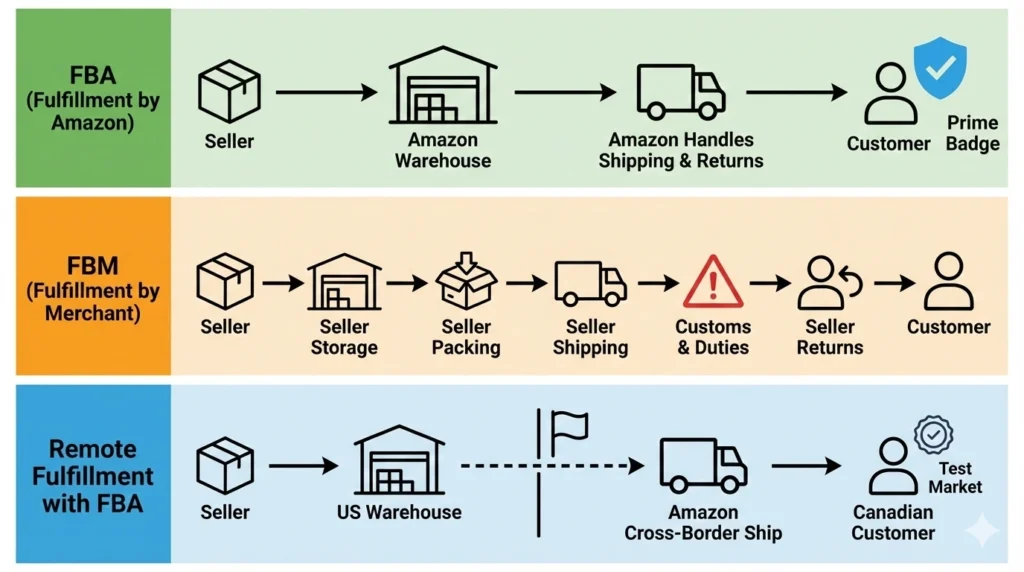
FBA (Fulfillment by Amazon): Amazon FBA international shipping makes cross-border fulfillment simple. You send your inventory to Amazon and they handle everything: picking, packing, shipping, customer service, and returns in the local language. You also get the Prime badge, which directly boosts conversions and search ranking. The tradeoff is higher fees and less direct control.
FBM (Fulfillment by Merchant): You handle everything yourself. Lower Amazon fees and more control, but cross-border shipping and returns can get complicated fast.
Remote Fulfillment with FBA: It sits in the middle. You can sell on Amazon.ca without ever sending inventory to Canada. Amazon ships from your US warehouses. No Prime badge, but it’s the easiest way to test the Canadian market before going all in.
| Situation | Best Approach |
| Scaling up, want Prime eligibility | FBA |
| Testing a new market | FBM or Remote Fulfillment with FBA |
| Tight margins, want lower fees | FBM |
| Want Amazon to handle customer service | FBA |
If you’re just starting out with cross-border selling, FBA is the safest bet for most Canadian sellers.
Step 4: Price for Actual Profit
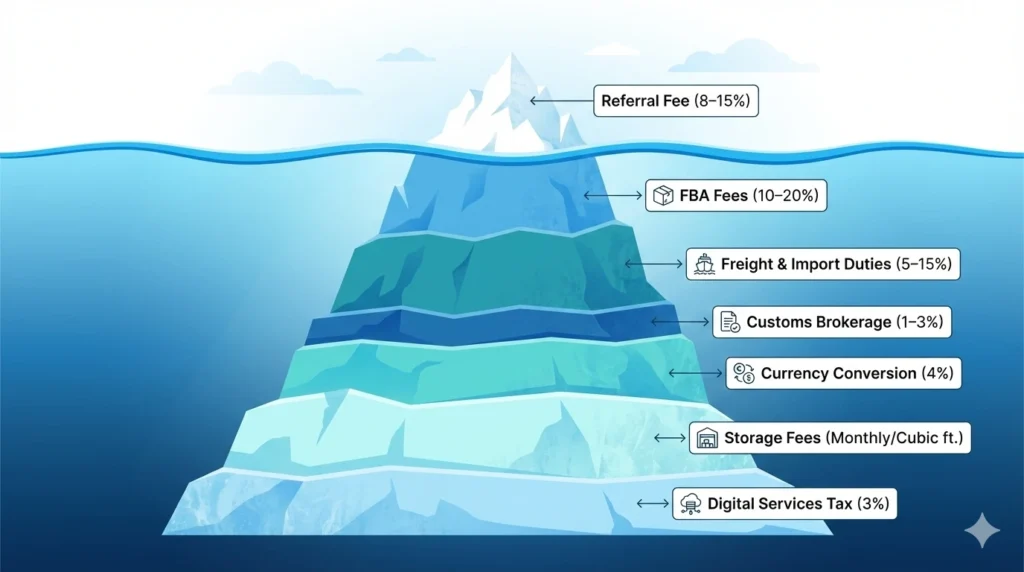
Most sellers only look at the referral fee. That’s a costly mistake. Your real cost is your landed cost:
Product cost + freight to fulfillment center + import duties + customs brokerage + currency conversion + Amazon fees
Here’s what you’ll actually be paying on Amazon Canada:
| Fee | Details |
| Professional selling plan | CA$29.99/month |
| Individual selling plan | CA$1.49 per item sold |
| Referral fee | 8-15% of sale price (varies by category) |
| FBA fulfillment (standard-size) | From CA$5.92/unit |
| FBA storage fee | Charged monthly per cubic metre of space used |
| Currency conversion via ACCS | ~4% per transaction |
| Digital Services Tax (DST) | +3% on FBA fees in Canada, new from October 2025 |
On referral fees: The rates aren’t identical between Amazon.com and Amazon.ca, so always check the fee schedule for the marketplace you’re selling in before you set your price.
On currency: Payment processing for international sales is another hidden cost. Amazon’s built-in converter (ACCS) costs around 4% per transaction. A multi-currency account like Wise lets you hold CAD and USD and convert at much better rates. At real volume, the difference adds up fast.
On payment timing: Amazon pays out every 14 days. For cross-border sellers, when you convert your earnings matters. A bad exchange rate window can quietly eat into your margins.
Step 5: Localize Your Listings
Don’t just copy-paste your existing listing into a new marketplace. It won’t work. Each market needs its own version.
Canadian sellers going to Amazon.com: Keywords and search behavior differ between markets. What ranks on .ca won’t necessarily rank on .com, so rethink your keywords entirely for the US audience.
US sellers coming to Amazon.ca: You should watch out for these three things.
- Bilingual requirements: Certain categories require French on packaging and listings, especially for Quebec.
- Measurements: Canadian shoppers are more familiar with metric, so adapt where relevant.
- Pricing: Don’t just convert USD to CAD. Make sure your price actually makes sense in the Canadian market.
Pro Tip: Reviews don’t carry over between marketplaces, so you start from zero in each one. And once your listings are live, Amazon’s Build International Listings (BIL) tool helps you sync pricing across markets automatically.
Step 6: Get Customs and Shipping Right
Customs duties for Amazon sellers are one of the most overlooked parts of cross-border fulfillment. With FBA, Amazon handles fulfillment once your inventory hits their network. But getting it there? That’s on you. For cross-border shipments, don’t overlook these three things:
- HS codes: Every product crossing a border needs an accurate Harmonized System code. Get it wrong and you’re looking at delays and fines.
- Declared values: Always declare accurately. Undervaluing shipments is a customs violation and not worth the risk.
- The $800 US de minimis threshold is gone: As of August 2025, all cross-border shipments now face duties. If your pricing relied on this, you need to revisit your numbers now.
Note: For moving inventory between Canada and the US, give Amazon Global Logistics (AGL) a serious look. It includes customs clearance support and is usually far simpler than coordinating with a third-party freight broker.
What Are the Tax Obligations When Selling Internationally on Amazon?
Navigating VAT/GST for Amazon sales (whether GST/HST in Canada or VAT in Europe) is where the most expensive surprises come from.
A. Canadian sellers on Amazon.com
The good news is Amazon collects and remits sales tax in 45 US states through Marketplace Facilitator laws, so that part is handled. But three things still catch sellers off guard.
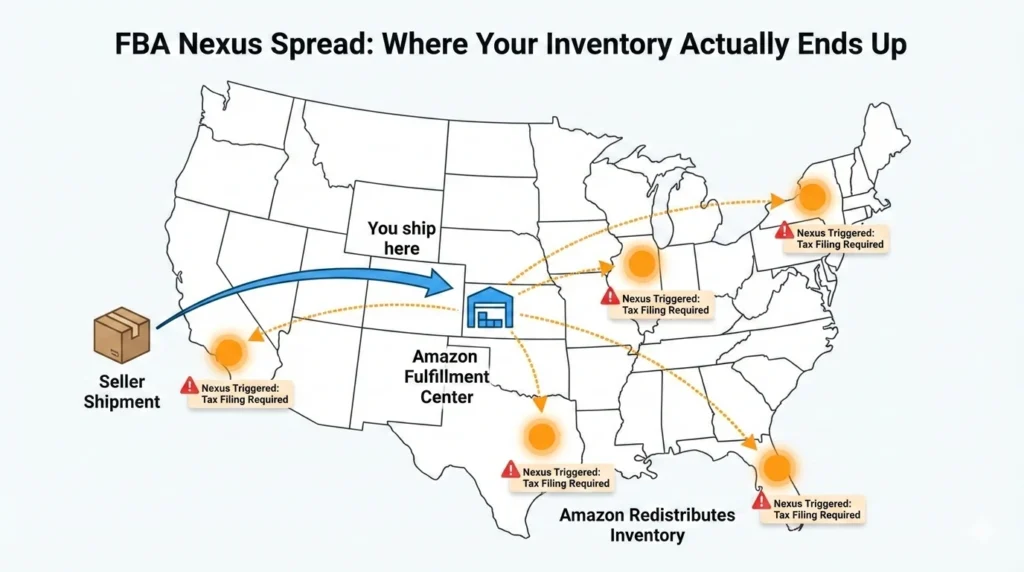
Risk #1: FBA Nexus Risk
Amazon automatically distributes your inventory across multiple fulfillment centers. Your products can end up in states you never chose, triggering tax and filing obligations you weren’t expecting.
Risk #2: US Federal Income Tax
The Canada-US tax treaty offers protection, but it depends on your business structure and it’s not automatic. Get proper advice from our U.S. incorporation experts before you’re doing serious volume.
Risk #3: Permanent Establishment
Having FBA inventory in multiple US states could trigger a US permanent establishment under the Canada-US tax treaty, meaning potential US corporate tax obligations on top of state-level ones. Review this with a cross-border accountant before you scale.
B. US sellers on Amazon.ca
GST/HST registration is required once your Canadian sales hit CAD $30,000 over any four rolling quarters. Here’s what tax looks like by province:
| Tax | Where | Rate |
| GST | All provinces and territories | 5% |
| HST | Ontario, NS, NB, NL, PEI | Up to 15% |
| PST | BC, Saskatchewan, Manitoba | 6-7% (separate registration) |
| QST | Quebec | 9.975% |
Two things that catch US sellers off guard every time:
- You need a Canadian Business Number (BN) before your first import. This is your identifier with Canada Border Services. Don’t wait until a shipment gets held at the border.
- Storing FBA inventory in a Canadian fulfillment center means you’re “carrying on business” in Canada. GST/HST registration is required from day one, regardless of how much you’ve sold. When it happens, you can consult with our HST experts immediately.
Cross-border tax between Canada and the US is genuinely complicated. The rules are not obvious, they change, and getting them wrong means penalties and back-taxes. (If you later expand to Europe, you’ll also need to deal with VAT registration per country; another reason to get help early.)
Common Amazon International Selling Mistakes + Solutions
These are the mistakes that cost sellers the most, and they’re all avoidable.
- Pricing based on referral fees alone: Your landed cost is much higher. Always run the full numbers before you set a price.
- Missing GST/HST registration: If you sell without collecting the tax you owe, you end up paying it out of pocket retroactively.
- Not accounting for FBA inventory placement: Amazon chooses where your inventory goes, which can create nexus in states you never planned for.
- Using Google Translate for listings: Poor localization hurts your search ranking and conversions. For French requirements in Canada especially, this is not optional.
- Assuming your North American account covers Europe: It doesn’t. Separate regional accounts are needed.
- Letting inventory run low: Amazon charges a low-inventory-level fee when stock drops below 28 days of supply.
- Still relying on the $800 de minimis threshold: It was removed in August 2025. If your cost structure depended on it, update your numbers now.
Conclusion
Selling internationally on Amazon is one of the most practical ways to grow your e-commerce revenue as a Canadian seller. The platform, the customer base, and the tools are already there.
What separates profitable sellers from the rest is preparation: knowing your real costs, localizing properly, and getting your cross-border tax compliance sorted before it becomes a problem.
The tax and compliance details genuinely matter, and that’s where mistakes get expensive. If you want to make sure your expansion is set up correctly from day one, reach out to SAL Accounting for a FREE tax strategy call. We specialize in cross-border tax and accounting for Canadian and US e-commerce businesses.
Frequently Asked Questions
Yes. With a North American Unified Account, Canadian sellers can activate Amazon.com directly from their existing Seller Central account. No separate registration needed.
Go to the “Sell Globally” dashboard in Seller Central. For Canada-US expansion, your existing account covers both marketplaces, just activate the one you want. Make sure your tax and customs obligations are sorted before your first sale.
Activate Amazon.com through your North American Unified Account, pick your fulfillment method, localize your listings for the US market, and get your cross-border tax setup right before you launch.
Yes. One North American Unified Account covers the US, Canada, and Mexico. For Europe or Asia-Pacific, you would need a separate regional account.
Expect a professional plan fee (CA$29.99/month), referral fees (8-15% by category), FBA fulfillment from CA$5.92/unit, and currency conversion at around 4% via ACCS. Since October 2025, a Digital Services Tax also adds 3% to FBA fees in Canada.
Typically 8-15% as a referral fee depending on your category, plus FBA fulfillment fees if you use them. On Amazon.ca, factor in the additional 3% Digital Services Tax on FBA fees.
Amazon collects and remits GST/HST in most cases, but you still need to register once your Canadian sales exceed CAD $30,000.
Amazon handles sales tax in 45 states. But storing FBA inventory in US fulfillment centers creates nexus, and your federal income tax obligations depend on your business structure. Get proper advice before you scale.
You are, as the seller, when shipping inventory into a fulfillment center. For FBA orders, Amazon handles the logistics, but you need to account for duties in your landed cost calculations upfront.
With FBA, Amazon handles returns and customer service in the local language. With FBM, returns are your responsibility, so factor that into your fulfillment decision early.
Yes, once your Canadian sales hit CAD $30,000 over any four rolling quarters. If you store FBA inventory in a Canadian fulfillment center, registration is required from day one regardless of how much you have sold.