

Our goal is to help you handle Canadian payroll registration for your international business without the usual stress and confusion. We want to make the whole process clear and straightforward for global companies like yours. But here’s what surprises most international businesses. You can actually get hit with CRA penalties and interest charges even before you pay your first employee in Canada.
SAL Accounting will walk you through the exact steps, important 2026 updates like higher CPP limits, and simple ways to stay compliant right from day one.
Quick Takeaways
- International businesses must register for Canadian payroll as soon as they hire someone who works in Canada.
- You need a Business Number (BN) and a CRA payroll account (RP0001) before making the first payment.
- Every paycheck requires deducting federal and provincial income tax, CPP, and EI.
- Send all deductions to the CRA monthly by the 15th of the following month.
- Missing registration or late payments can trigger penalties and interest — even before the first pay cheque.
- Keep all payroll records for at least 6 years.
- You can handle payroll yourself or outsource it to an Employer of Record (EOR) to reduce risk.
Why International Businesses Need Canadian Payroll Registration
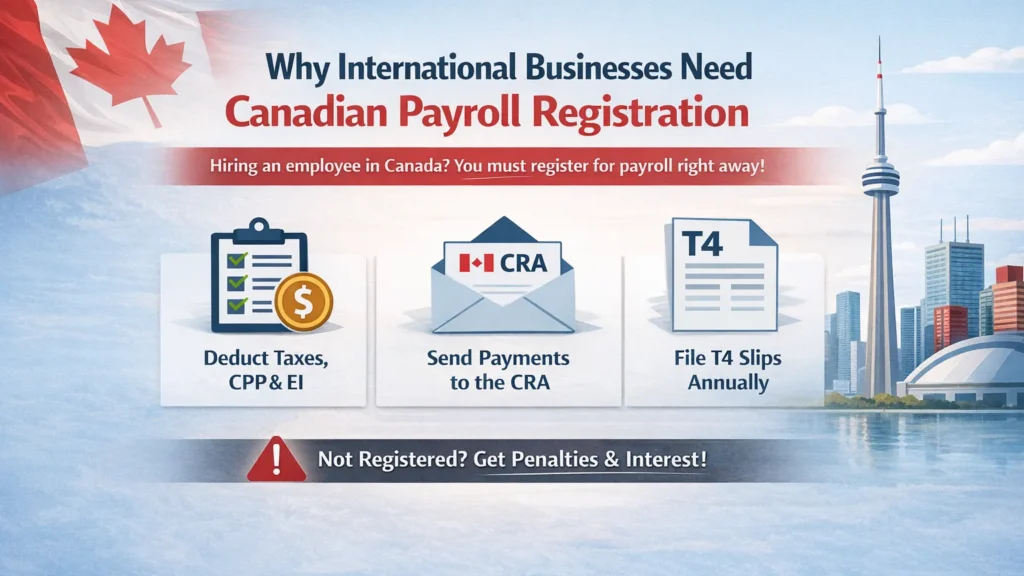
You might think, “I’ll worry about payroll registration later, after I pay my first employee.” But here’s the truth: that’s a mistake. The moment you hire someone who works in Canada, even for a short time, you become an employer in the eyes of the CRA. This rule applies to foreign companies, too. That’s why consulting our cross-border tax experts makes all the difference. So what you actually need to do is:
- Take out income tax, CPP, and EI from your employee’s pay
- Send that money to the CRA on time
- File T4 slips every year
If you don’t register on time, the CRA can charge you penalties and interest right away, sometimes even before you cut the first pay cheque. This is why you need to register when opening a foreign company branch in Canada.
Example: a U.S. company sent one developer to Toronto for three months. They forgot to register for payroll. A few months later, they got a big unexpected bill from the CRA.
How Does the Canadian Payroll System Work for Foreign Companies?
You have two main options for payroll setup as a foreign company in Canada: register it yourself or have an employer do the process for you. It can also be related to business structures in Canada. Below, we will explain both in detail:
Option 1: Register Yourself Directly with the CRA
You handle everything on your own. This is what it involves:
- You apply for a Business Number from the CRA
- You open a payroll account
- You manage all deductions, payments, and paperwork yourself
This option gives you full control. But it takes more time, and you carry all the responsibility.
Option 2: Use an Employer of Record (EOR) Service
Many international businesses prefer this option because it is easier. Here’s how it works:
- You partner with a Canadian EOR company
- They register for payroll on your behalf
- They handle deductions, send money to the CRA, and file all reports
- You simply hire the employee and pay the EOR a service fee
This option is faster and lowers your risk. It is especially popular when you are just starting in Canada.
Here’s a clear side-by-side comparison:
| Feature | Register Yourself with CRA | Use an Employer of Record (EOR) | Best For |
| Setup Time | 1 – 3 weeks | 1 – 5 business days | Fast market testing |
| Ongoing Cost | Lower | Higher monthly fee | Long-term operations |
| Control Level | Full control | Limited control | Companies wanting full ownership |
| Compliance Responsibility | You handle everything | EOR handles all compliance | Beginners or small teams |
| Risk of Penalties | Higher | Very low | Risk-averse international businesses |
How to Register for a CRA Payroll Account as an Aon-Resident?
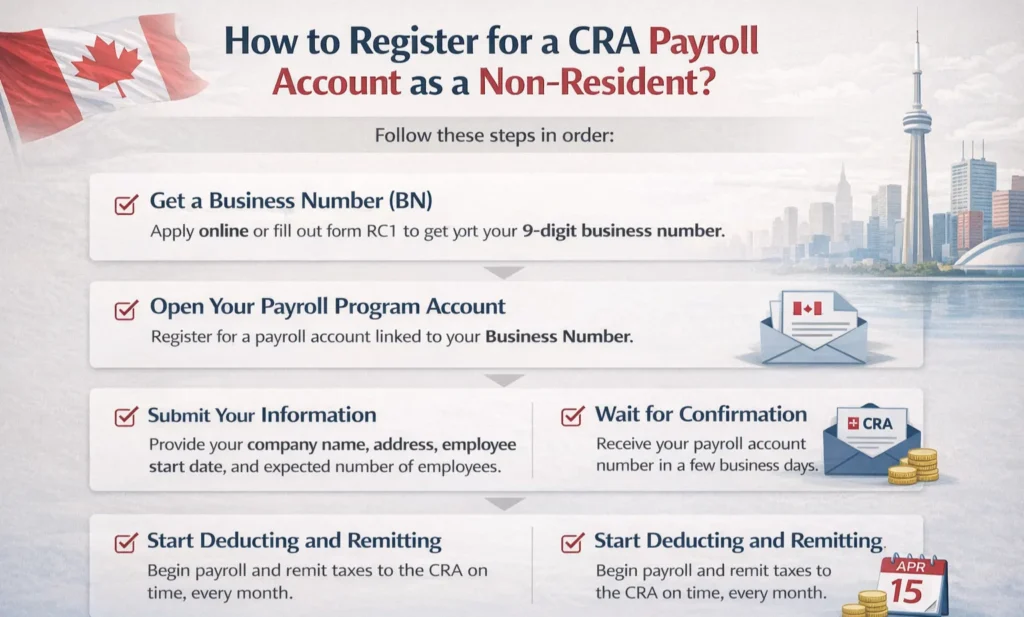
Now let’s get to the practical part. If you decide to register yourself directly with the CRA, here is exactly what you need to do. Follow these steps in order.
Get a Business Number (BN)
This is your company’s 9-digit ID with the CRA. If you don’t have one yet, you apply for it as a non-resident. You can apply online or fill out form RC1. This is the first thing you need before you open a payroll account. See how to apply for a TIN for your business.
Open Your Payroll Program Account
Once you have your Business Number, you register for the payroll account (How to open). This account lets you deduct and send taxes to the CRA. The account number usually ends with RP0001. You can register it at the same time as your Business Number or right after.
Submit Your Information
You tell the CRA some basic details about your company. You provide:
- Your company name
- Your address
- Expected number of employees
- When you plan to start paying them
You stay clear and accurate so you avoid delays.
Wait for Confirmation
The CRA usually sends your payroll account number within a few business days. You check your email and mail carefully. You keep this number safe because you will use it for every payment and report from now on. You can receive it through CRA My Business Account.
Start Deducting and Remitting
After you receive your account number, you begin payroll. You deduct taxes and contributions from your employee’s pay. You send the money to the CRA by the due date every month.Pro Tip: You do this before you pay your first employee. New employers usually remit monthly. If your employee works in Quebec, you also register separately with Revenu Québec.
Case Study: US Tech Company in Toronto1
Sarah owns a small software company in San Francisco, USA. She hires her first employee to work in Toronto.
Problem
Sarah believed she could pay her Canadian employee through her American payroll system. She did not register for a Canadian Business Number or a payroll account with the CRA.
What She Does
A few months later, the CRA sends her a letter asking for unpaid taxes, CPP, EI, and penalties. The total bill comes close to $15,000.
Sarah contacts SAL Accounting for help. We quickly register her Business Number and payroll account, fix the past filings, and set up correct monthly payments to the CRA.
The Result
She manages to reduce most of the penalty. Her employee in Toronto is now fully compliant. Sarah can now focus on growing her business in Canada without the fear of surprise bills from the CRA.
What Payroll Deductions Are Required for International Businesses in Canada?
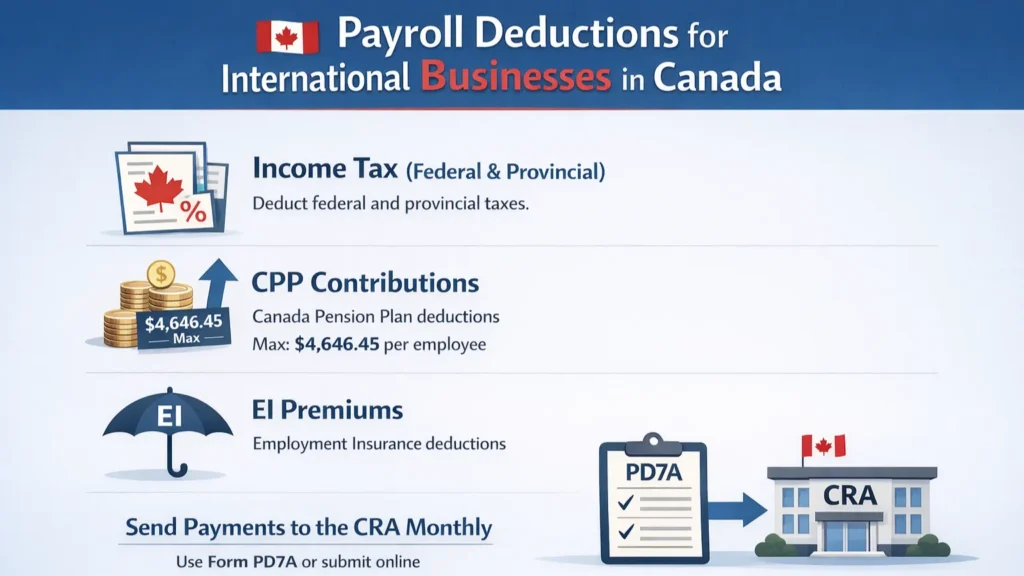
Once you have your payroll account, you start handling the money. Every time you pay your employee, you deduct these three things:
- Income tax (federal and provincial): You take out both federal and provincial tax based on where your employee works. Check the taxes for Canadians working remotely for US companies.
- CPP contributions: This is the Canada Pension Plan. In 2026, CPP will cost more. The maximum base CPP contribution is $4,230.45 each. If earnings go above $74,600 up to $85,000, you also add CPP2 contributions of up to $416 each. So the total maximum CPP contribution per employee can reach $4,646.45.
- EI premiums: This is Employment Insurance. You deduct this from the employee and also pay your own share as the employer.
After you deduct the money, you send it to the CRA every month using form PD7A. It is possible to submit it online, too.
Key Payroll Compliance Requirements for International Employers in Canada
Running payroll in Canada as an international company means you have to follow several important rules. The CRA wants you to get everything right from the very first paycheck. Here’s what you need to do:
1. Register for a Payroll Account
You have to apply for a Business Number and open a payroll account with the CRA before you pay anyone. If you wait too long, you can get hit with penalties even before your employee receives their first salary.
2. Deduct the Correct Amounts
When you pay your employee, you take out money for three main things:
- Federal and provincial income tax (Check the tax types in Canada)
- CPP contributions (you pay half, your employee pays half)
- EI premiums (you pay half, your employee pays half)
3. Remit Payments to the CRA on Time
You don’t just deduct the money; you have to send it to the CRA every month. You use the PD7A form for this. If you send it late, penalties and interest start adding up fast.
4. File Annual T4 Slips and Summary
At the end of every year, you prepare T4 slips for your employees and send the T4 Summary to the CRA by the end of February. Reporting T4 slips on your tax return shows how much your employee earned and how much tax and contributions you paid. Missing this deadline usually means extra fines.
5. Follow Provincial Rules
Canada has federal rules that apply everywhere, but every province has its own extra rules. You may need to register for workers’ compensation insurance or pay special employer taxes. The rules depend on the province where your employee actually works, not where your company is located.
6. Keep Records for 6 Years
You must save all your payroll records for at least 6 years. This includes pay statements, deduction calculations, payment proofs, and T4 forms. If the CRA asks for documents and you don’t have them, things can get very complicated and expensive.
Here’s a simple checklist to keep you on track:
| Requirement | Frequency | Deadline / Timeline |
| Business Number + Payroll Account | One time | Before first employee payment |
| Deduct Income Tax, CPP & EI | Every pay period | With every salary payment |
| Remit to CRA | Monthly | 15th of the following month |
| File T4 Slips & Summary | Annual | End of February |
| Keep Records | Ongoing | Minimum 6 years |
Difference Between Federal and Provincial Payroll Obligations in Canada?
Canada has two levels of payroll rules: federal and provincial. You need to handle both levels correctly to stay compliant. Also see how to avoid double taxation between Canada and the US. Let’s talk about them more as follows:
Federal Rules (CRA)
All provinces and territories follow these rules. It is the CRA that administers federal income taxes, CPP payments, and EI premiums. You then withhold this amount from your employee’s pay and remit it to the CRA. This process will be consistent regardless of what province your employee hails from.
Provincial Rules
These rules change depending on the province where your employee actually works. For example, provincial income tax rates are different in Ontario, British Columbia, and Alberta. You may also need to register for workers’ compensation insurance. This could be WSIB in Ontario or WorkSafeBC in British Columbia. Some provinces also charge an Employer Health Tax.
For professional support with payroll setup and ongoing compliance, check out our bookkeeping services in Toronto.
This table makes the differences easy to understand:
| Obligation | Federal (CRA) | Provincial Rules |
| Income Tax | Same across Canada | Different rates per province |
| Pension & Insurance | CPP + EI | QPP + QPIP in Quebec |
| Workers’ Compensation | Not required | Mandatory (WSIB, WorkSafeBC, etc.) |
| Employer Health Tax | Not applicable | Required in Ontario, BC, and others |
Common Payroll Mistakes International Businesses Make in Canada
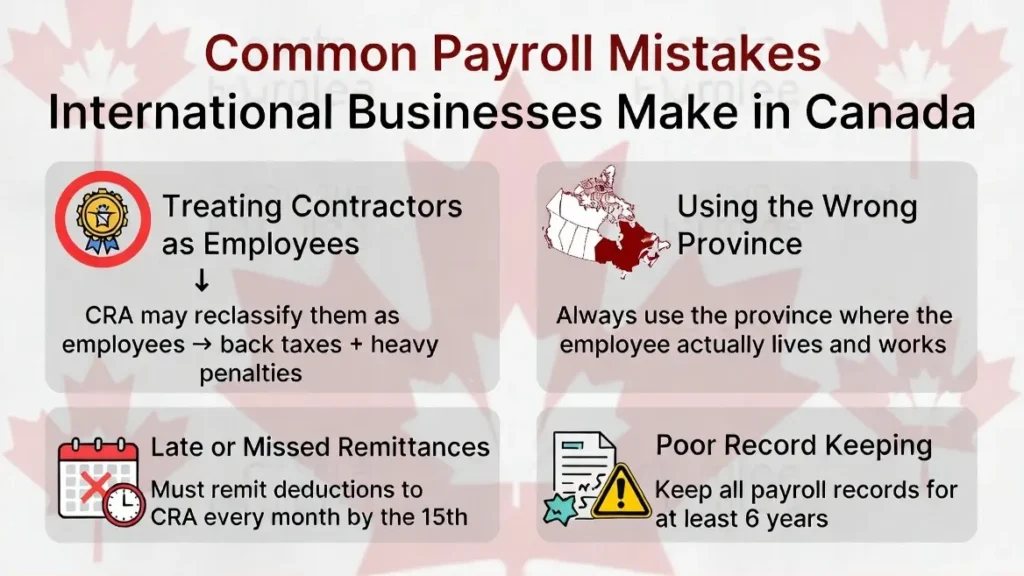
Many foreign companies run into problems when they set up payroll in Canada. Here are the most common mistakes you should avoid:
Treating contractors as employees
Some companies think they can just pay someone as a contractor and skip payroll registration completely. But if the person works regular hours, uses your tools, and follows your instructions, the CRA often considers them an employee. When this happens, you can face back taxes, penalties, and interest that add up fast. You may also need to pay attention to US taxes for Americans living in Canada.
Getting the province wrong
You must calculate taxes based on the province where your employee actually lives and works. To avoid this mistake, always check:
- The employee’s home address and work location
- Which province’s tax tables to use
- Whether remote work changes the rules
Many international businesses use the wrong tax tables by mistake. This leads to underpaying or overpaying taxes, and the CRA will charge you to fix it later.
Paying late or forgetting to remit
It is not enough to just deduct the money from your employee’s pay. You also have to send it to the CRA on time every month. Even one late payment can bring penalties and interest right away. Many companies forget this step and end up with an unexpected bill.
Not keeping good records
You are required to keep all payroll records for at least 6 years. This includes pay stubs, deduction calculations, and remittance proofs. Companies that do not keep proper records often face serious problems during a CRA review or audit. Always consult our cross-border personal tax accountant to avoid any mistakes.
Case Study: US Manufacturing Company in Mississauga2
Mike owns a manufacturing company in Austin, Texas. He opens a small distribution center in Mississauga and hires four local employees.
Problem
Mike wants to make sure he does everything the right way from the start so he does not face any penalties or problems with the CRA.
What He Does
He applies for a Canadian Business Number, opens a payroll account with the CRA, registers with WSIB in Ontario, and begins sending monthly payments using the correct Ontario tax tables.
The Result
He pays zero penalties. He files his first T4 slips on time without any issues. Mike now says that Canadian payroll is much easier than he expected, and his business in Mississauga is growing smoothly.
Conclusion: Key Takeaways for Canadian Payroll Registration in 2026
Canadian payroll registration takes some effort for international businesses. But it is worth it. You avoid expensive CRA penalties. You build trust with your Canadian employees. You also create a strong base for long-term growth in Canada. The best way forward is simple. Start early. Follow every step correctly. And ask for help when you need it.
Do you still have questions about Canadian payroll registration? Contact our team at SAL Accounting. We will gladly guide you through the entire process and make it easy for your business.