
Our goal stays simple. We want to give business owners, from freelancers and sole proprietors to medium-sized corporations and startup teams, a clear month-by-month list of every key CRA deadline. That covers personal taxes, corporate returns, quarterly instalments, GST/HST remittances, payroll obligations, and more.
Thousands still get hit with penalties even when the rules seem straightforward. Late-filing penalties start at 5% of your balance owing, plus 1% for each extra full month (up to 12 months), and daily interest often hits 7–10% a year. We at SAL Accounting will walk through every 2026 date, explain the real costs of missing one, and share straightforward tools so you never pay those extra fees again.
Quick Takeaways
- Key 2026 dates: April 30 (T1 pay), June 15 (self-employed T1 file), Mar/Jun/Sep/Dec 15 (installments), Feb 28 (T4/T4A slips).
- Pay taxes by April 30. Late payment adds 5% penalty plus 1% per month and 7% interest.
- Set up a pre-authorized debit in CRA My Business Account. Add reminders in Google Calendar.
- Small businesses remit payroll monthly or quarterly. Large ones use accelerated schedules. T4 due Feb 28.
- Missing deadlines costs thousands. Use QuickBooks, Zapier, and monthly reviews to stay compliant.
Why Do These Financial Dates Matter for Your Business?
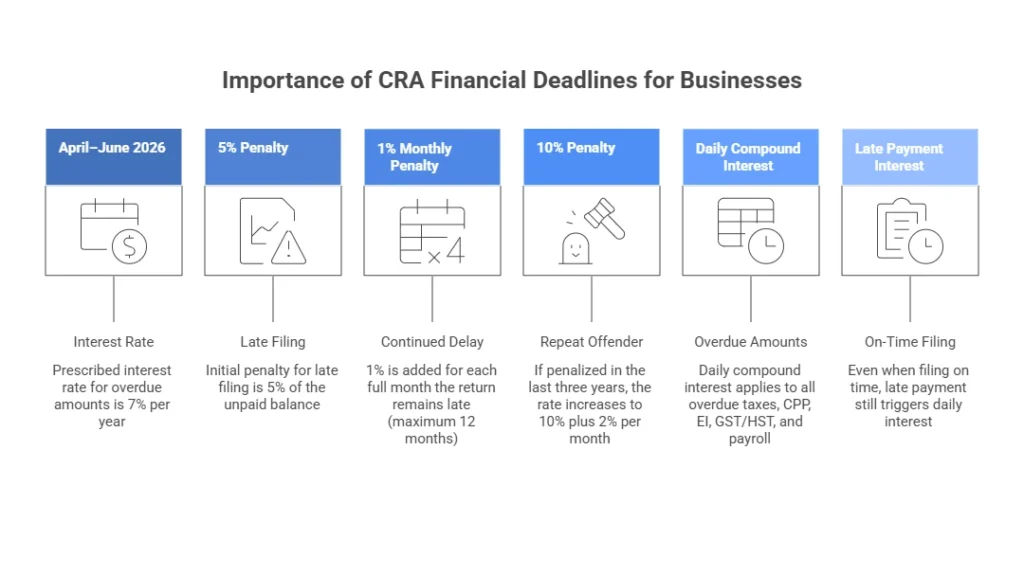
Financial dates protect your cash flow and profits. CRA deadlines cover every filing, payment, and remittance your business must complete. Meet them, and you avoid extra charges. Miss them and penalties plus daily interest start immediately. You need expert bookkeeping services to stay compliant. Here’s how these dates affect your business:
- Late-filing penalties begin at 5% of the unpaid balance.
- 1% is added for each full month the return remains late (maximum 12 months).
- If you were penalized in any of the last three years, the rate increases to 10% plus 2% per month.
- Daily compound interest applies to all overdue amounts (taxes, CPP, EI, GST/HST, payroll).
- The current prescribed interest rate for April–June 2026 is 7% per year.
Even when you file on time, late payment still triggers daily interest on the balance. One missed deadline can cost hundreds or thousands of dollars. Meeting all deadlines keeps your CRA account clear, speeds up refunds and credits, and reduces audit risk.
Case Study: Toronto Freelancer Avoids $2,600 Penalty in 20261
A Toronto-based freelance marketer in the Annex neighborhood owes $19,500 in taxes for 2025. In prior years, late filing and payment past April 30 trigger interest and penalties that add $2,600.
Problem
The missed April 30 payment deadline, daily compound interest at 7%, plus 5% late-filing penalty, and 1% per month erode profits and create cash flow stress.
What We Do
We guide her to set up a pre-authorized debit in the Canadian CRA My Business Account for automatic April 30 payment. She files by June 15 using NETFILE with calendar reminders. SAL Accounting helps track obligations and confirm compliance.
The Result
Zero extra costs in 2026. Cash flow stabilizes, no penalties or interest. She saves time and reduces stress, focusing on client work instead of tax worries. “Deadlines used to stress me out—now it’s automatic,” she says.
When Are the Personal & Self-Employed Tax Deadlines for Businesses?
These are the key CRA deadlines for business owners who file personal income tax returns (T1). This group includes sole proprietors, freelancers, independent contractors, consultants, side-hustle owners, and many entrepreneurs. Here are the exact 2026 dates for your 2025 tax year:
- February 23, 2026: NETFILE opens for electronic filing of your 2025 income tax and benefit return. Business owners should report T4, T4A, and other slips early.
- March 2, 2026: Final day to make RRSP (or PRPP/SPP) contributions deductible on your 2025 return. Many business owners use this to lower their taxable income.
- April 30, 2026: Deadline for most business owners to file the 2025 T1 return and pay any balance owing. Pay by this date to avoid interest and penalties (filing can happen later if no balance is due).
- June 15, 2026: Extended filing deadline specifically for business owners with self-employment income (or if your spouse/common-law partner has self-employment income). File by this date to avoid late-filing penalties, but pay any taxes owed by April 30, 2026, to prevent interest.
Reminder for business owners: Payment is due April 30, 2026, with no exceptions. Late payment triggers daily compound interest at the current prescribed rate (7% per year as of Q2 2026).
- Pro Tip: Use CRA My Account, NETFILE-certified software, or your accountant. Set reminders today; business owners who miss payment face immediate extra costs.
- Example: A freelance web developer owes $8,200 in taxes. He pays by April 30 but files on June 10. no penalties or interest. If he pays late, interest starts May 1 and compounds daily.
| Date | Action | Applies To | Key Note | Tip |
| Feb 23, 2026 | NETFILE opens | All T1 filers | Gather T4/T4A slips early | Use certified software |
| Mar 2, 2026 | Last RRSP/PRPP/SPP contribution for 2025 | Deduction claimants | Lowers 2025 taxable income | Contribute early |
| Apr 30, 2026 | File T1 & pay balance owing | Most owners | Pay by this date – no exceptions | Pay even if filing later |
| Jun 15, 2026 | Extended T1 filing deadline | Self-employed or spouse self-employed | Avoid late-filing penalty; pay by Apr 30 | Set reminders – payment strict |
When Are the Corporate Tax Deadlines for Business Owners in Canada?
These corporate tax deadlines in Canada apply to incorporated businesses filing the T2 corporation income tax return. Dates depend on your corporation’s fiscal year-end (most common is December 31).
T2 Filing Deadline
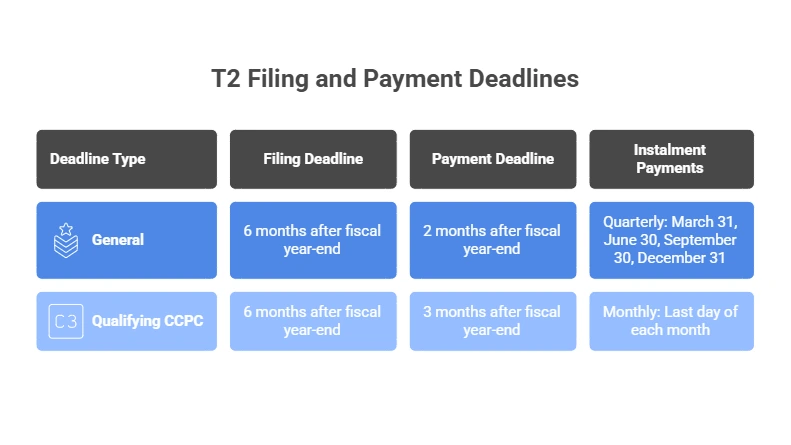
File your CRA T2 tax return within 6 months after your corporation’s fiscal year-end.
- For December 31, 2025, year-end → file by June 30, 2026.
- For March 31, 2026, year-end → file by September 30, 2026. Missing this triggers late-filing penalties starting at 5% of the unpaid balance plus 1% per month.
Balance Owing Payment Deadline
Pay any taxes owed within 2 months after the fiscal year-end (or 3 months for qualifying Canadian-controlled private corporations claiming the small business deduction).
- December 31, 2025, year-end → pay by February 28, 2026 (general) or March 31, 2026 (qualifying CCPC). Late payment starts daily compound interest at the current prescribed rate (7% per year as of Q2 2026).
Instalment Payments Deadline
If your corporation pays tax in instalments:
- Quarterly instalments (common for smaller amounts) → due March 31, June 30, September 30, December 31, 2026 (adjusted for calendar year).
- Monthly instalments → due on the last day of each month during the tax year. Check exact amounts and eligibility in CRA My Business Account or use the CRA instalment calculator.
- Example: A qualifying CCPC with a December 31, 2025, year-end owes $18,000. File T2 by June 30, 2026; pay balance by March 31, 2026. Late payment triggers immediate 7% daily interest.
- Pro Tip: File electronically through CRA My Business Account (mandatory for most corporations). Track your fiscal year-end carefully to avoid penalties.
When Are the 2026 Payroll Tax Deadlines for Businesses?
If you have employees or pay certain contractors, you handle payroll taxes. These include income tax, CPP, and EI deductions. You send this money to the CRA on time. You also file yearly slips. Doing this right avoids penalties and interest.
Source Deductions Remittances
You take deductions from paycheques and send them to the CRA. Have a tax deduction checklist for small businesses. Your schedule depends on your average monthly amount from last year.
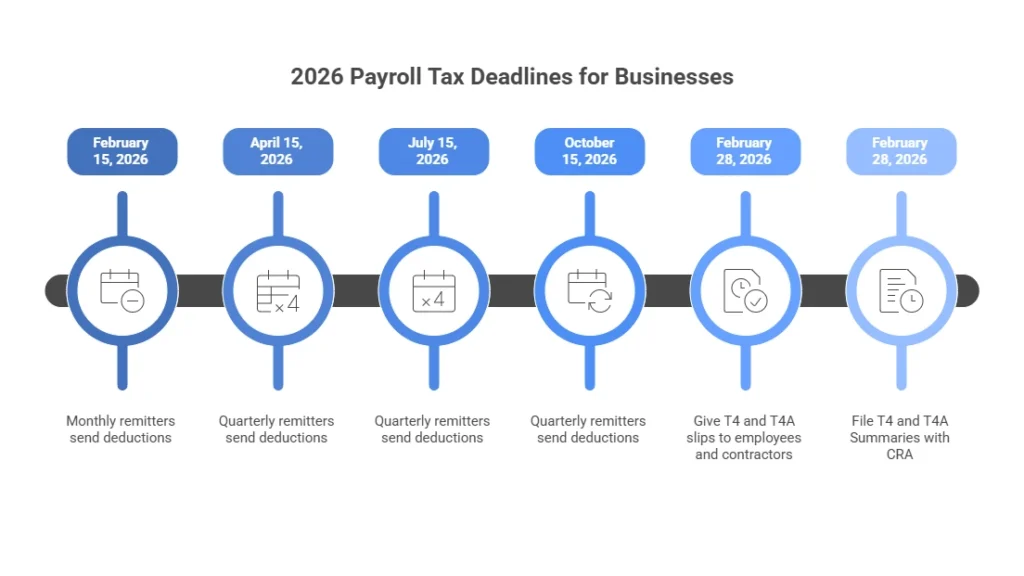
- Monthly remitters (most small and medium businesses): Send by the 15th of the next month.
Example: January payroll → send by February 15, 2026. This repeats every month in 2026.
- Quarterly remitters (small payrolls, average $1,000 or less per month): Send by the 15th after the quarter ends.
- January to March → due April 15, 2026
- April to June → due July 15, 2026
- July to September → due October 15, 2026
- October to December → due January 15, 2027
- Accelerated remitters (large payrolls, average over $25,000 per month): Send more often, often twice a month. Check your exact dates in CRA My Business Account.
If you send late, interest starts right away at 7% per year (current rate for Q2 2026). You may also get penalties.
T4 and T4A Slips and Summaries
At the end of the year, give slips to employees and some contractors.
- February 28, 2026: Give T4 slips to employees (shows pay and deductions). Give T4A slips for certain contractor payments.
- February 28, 2026: File T4 Summary and T4A Summary with the CRA. Most businesses must file electronically.
Example: A small shop pays employees in January. The owner sends deductions by February 15, 2026. At year-end, the shop gives T4 slips to everyone by February 28, 2026. Late deductions mean interest starts the next day. Late T4 slips can cost $100 per slip (with limits).
Pro Tip: Use the CRA Payroll Deductions Online Calculator to figure out amounts. Payments happen automatically. This makes life easier and helps you avoid mistakes.
Business Financial Deadlines 2026: Quarterly Instalments Due Dates
Instalment payments let you spread your income tax over the year instead of paying everything at once. This helps manage cash flow, especially for self-employed people, sole proprietors, freelancers, or businesses without withheld tax.
The CRA requires installments if you owed more than $3,000 in net tax last year (or $1,800 in Quebec) and expect to owe tax again this year. They send a notice with your estimated amounts. Most business owners pay quarterly on these 2026 dates:
- March 15, 2026 – First instalment payment of the year
- June 15, 2026 – Second instalment payment
- September 15, 2026 – Third instalment payment
- December 15, 2026 – Fourth and final instalment payment
If a date falls on a weekend or holiday, pay by the next business day. Check your CRA Notice of Assessment or My Business Account for your exact requirement. Check out our expert accounts payable services and never miss a deadline.
Pro Tip: Set up a pre-authorized debit in My Business Account so payments happen automatically. Use the CRA Instalment Calculator if your income changes.
Other Key Compliance Dates & Financial Milestones for Business Owners
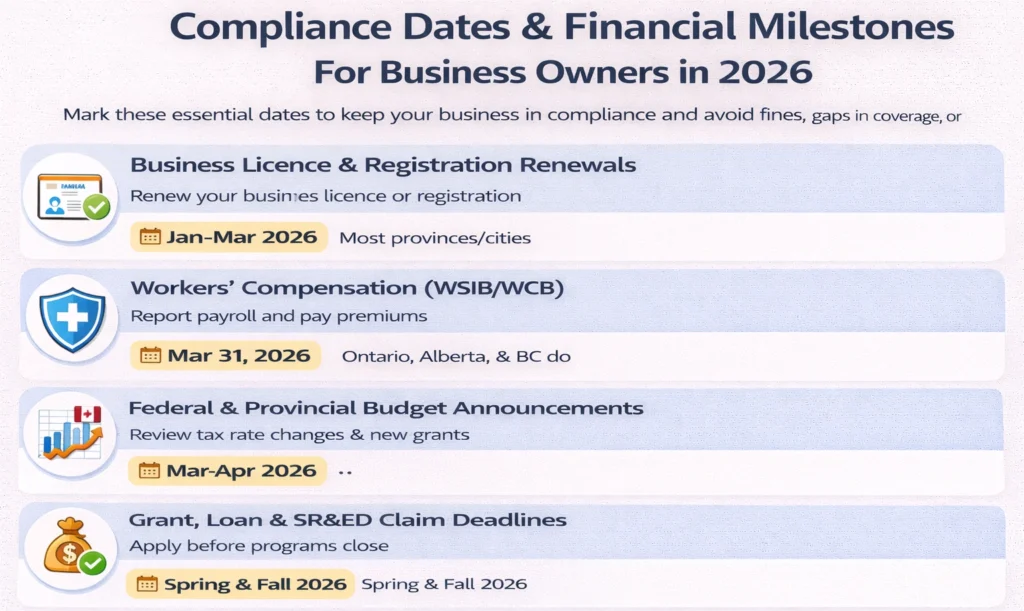
Business owners deal with more than taxes and payroll. Here are other important dates in 2026. These affect your licences, insurance, reports, and chances for grants. Missing them can bring fines, gaps in coverage, or lost money.
Business Licence & Registration Renewals
You renew your business licence or registration with your province or city. Many renewals happen between January and March 2026. For example, Ontario business names often renew on their anniversary date. British Columbia municipal licences usually renew in the spring. Check your province or city website in January.
WSIB / Workers’ Compensation Reporting Deadlines
If you have employees, you report payroll and pay premiums to your province’s workers’ compensation board.
- Ontario (WSIB): Send your 2025 payroll report and final payment by March 31, 2026.
- Alberta (WCB): Submit clearance certificate and final report around March 31, 2026 (check exact date).
- British Columbia (WorkSafeBC): Pay assessment premiums in March or April 2026 (varies by industry). Go to your provincial board website. See your deadline. Pay late, and you may face higher premiums or penalties.
Federal & Provincial Budget Announcements
The federal government usually releases its budget in March or April 2026. See how to claim the federal foreign tax credit in Canada with the T2209 Form. Provinces release theirs soon after. Watch for changes to:
- Small business tax rates or deductions
- New grants or loans
- SR&ED program rules
- Carbon pricing or fuel charge updates. Sign up for CRA or Finance Canada updates. You get alerts when budgets come out.
Grant, Loan & SR&ED Claim Deadlines
Government programs open and close at certain times.
- Canada Small Business Financing Program: Apply through your bank anytime (funds run out).
- SR&ED tax credits: Claim within 18 months of your tax year-end (links to your T2 or T1 filing date).
- Other grants (IRAP, regional funds): Many close in spring or fall 2026. Visit innovation.ca or your regional agency site often. Don’t miss windows.
Insurance Policy Renewals
Check and renew your business insurance before it ends. Common types are general liability, property, cyber, and commercial auto. Many policies renew on your start date (often January–March for new businesses). Get quotes 30–60 days early. Compare prices and coverage.
Foreign Income & Property Reporting (Form T1135)
If your business or you hold foreign property worth more than $100,000 CAD at any point in 2025, file Form T1135. Check what Form T1135 is and how to file it.
- Due: April 30, 2026 (or June 15, 2026 if self-employed). File late and penalties start at $100 per month (up to $2,500). Higher penalties apply for serious cases. File electronically through CRA My Account.
Pro Tip: Add all these dates to one calendar (Google Calendar or Outlook works great). Set reminders 2–4 weeks before each one. Include a link to the official website in every reminder. This way, you click straight to the form or info page.
Tools to Track 2026 Business Financial Deadlines in Canada
Never miss a CRA deadline again. These are the best bookkeeping tools for business owners, freelancers, and entrepreneurs to stay organized with reminders, automation, and alerts for important dates.
- CRA My Business Account (Free) Official portal. View personalized deadlines, get email alerts for filings/payments, and pay securely. Enable notifications + MFA.
- Google Calendar (Free): Add all CRA dates. Set reminders 1–2 weeks early. Share with the team/accountant. Use recurring events for annual tasks.
- Pre-authorized debit (CRA My Business Account) (Free) Set once. CRA automatically pulls installments, GST/HST, and payroll on due dates. Eliminates late fees.
- QuickBooks Online (Paid): Tax reminders, GST/HST tracking, payroll deadlines, CRA sync. Ideal for growing businesses.
- Zapier (Free basic): Automate alerts. Connect Google Calendar → send email/SMS/text for upcoming business financial deadlines 2026.
Annual Checklist: Key Requirements & Deadlines for Business Owners
Use this quick-reference table to track every major requirement. Copy it to your spreadsheet and mark off as you go.
| Requirement | Who | Deadline | Penalty | Tip |
| Personal T1 File & Pay | Sole proprietors/freelancers | Apr 30 | Interest + 5% + 1%/mo | Pay by Apr 30 |
| Self-Employed T1 File | Self-employed | Jun 15 | Late-filing penalty | Pay Apr 30 |
| RRSP (2025 deduction) | Deduction claimants | Mar 2 | No 2025 deduction | Contribute early |
| T2 Corporate Return | Corporations | 6 mo after year-end | 5% + 1%/mo on balance | File electronically |
| Corporate Balance Owing | Corporations | 2–3 mo after year-end | Daily interest (7%+) | Pay early |
| GST/HST Remittance (Qtrly) | GST/HST registrants | 1 mo after quarter | Interest + penalties | Auto-debit |
| Payroll Deductions (Monthly) | Employers | 15th next month | Interest + penalties | Use CRA calculator |
| T4/T4A Slips & Summaries | Employers | Feb 28 | $100/slip (limits) | Issue early |
| Quarterly Instalments | Owing >$3,000 last year | Mar/Jun/Sep/Dec 15 | Interest on underpayment | Auto-debit |
| T1135 Foreign Property | >$100,000 foreign assets | Apr 30 or Jun 15 | $100/mo up to $2,500+ | File electronically |
| WSIB Payroll Report (ON) | Ontario employers | Mar 31 | Higher premiums/penalties | Submit online |
| Business Licence Renewal | Most businesses | Varies (often Jan–Mar) | Fines/suspension | Check province/city early |
Case Study: Mississauga Retail Owner Saves $3,800 with Tools in 20262
A Mississauga small retail shop (home goods) near Square One misses payroll remittances and T4 filing in 2025, facing $3,800 in interest and penalties.
Problem
Late monthly source deductions, missed February 28 T4 deadline, compounding interest at 7%, and $100-per-slip fines hurt margins and create CRA scrutiny.
What We Do
We recommend adding all CRA dates to Google Calendar with 2-week reminders, setting up pre-authorized debit in My Business Account for automatic remittances, and using QuickBooks for payroll/GST/HST tracking. SAL Accounting reviews the setup for full compliance.
The Result
All remittances and T4s are on time in 2026. No penalties or interest. The business saves $3,800, enjoys smoother cash flow, and gains more time for sales growth. “These simple tools pay for themselves fast,” the owner notes. With getting services from expert accounting and bookkeeping firm, you can always solve your financial problems.
Final Thought
Stay on top of important financial dates for business owners in 2026 to protect your cash flow and profits. One missed date costs thousands in penalties and interest. Build simple habits, like setting up pre-authorized debit, adding reminders in Google Calendar, and using CRA My Business Account alerts. Review everything monthly and automate what you can.
At SAL Accounting, we help business owners stay penalty-free and focus on growth. Bookmark this guide and reach out if you need help.
FAQ: Financial Dates & Tax Deadlines for Business Owners
April 30 (T1 pay), June 15 (self-employed T1 file), Mar/Jun/Sep/Dec 15 (instalments), Feb 28 (T4/T4A), monthly/quarterly GST/HST, payroll 15th next month, T1135 Apr 30/Jun 15, WSIB Mar 31 (ON).
Use CRA My Business Account alerts, Google Calendar reminders (1–2 weeks early), pre-authorized debit for auto-payments, monthly review, QuickBooks/Zapier notifications.
No major date changes. Lowest federal bracket drops to 14% Jan 1. Electronic filing/digital notices stay mandatory. Interest rate 7% (Q2 2026).
Small (≤$1,000/mo avg): quarterly (15th after quarter). Most small/medium: monthly (15th next month). Large (> $25,000/mo): accelerated (often twice monthly). T4/T4A due Feb 28 for all.
Business licence renewals (Jan–Mar), WSIB payroll report (Mar 31 ON), T1135 foreign property (Apr 30/Jun 15), insurance renewals (anniversary), federal/provincial budgets (Mar–Apr).
Set a pre-authorized debit in a CRA account. Add dates to Google Calendar with reminders. Use Zapier for email/SMS alerts. QuickBooks/Xero gives built-in notifications. Review monthly.