Choosing the wrong Shopify plan can quietly eat into your margins from day one. Plus, most dropshipping stores operate on net profit margins of just 15% to 25%, based on TrueProfit’s study of more than 1,200 stores. So there’s really no room to throw money away on avoidable fees.
The difference between plans isn’t just the monthly price. This Shopify plan comparisons for dropshipping guide from SAL Accounting walks you through the best Shopify plan for dropshipping and the best Shopify pricing tier for dropshippers so you can pick the right one from day one.
Quick Takeaways
- Start on Basic. It covers everything you need to launch and test.
- The Starter plan ($5 per month) doesn’t support dropshipping apps, so skip it entirely.
- Use Shopify Payments on any plan. It eliminates the extra transaction fee.
- Move to Grow at 8K to 20K per month. Better reports and staff access start making sense.
- Advanced pays for itself at 50K per month and above. Fee savings outweigh the subscription.
What Shopify Features for Dropshipping Actually Matter?
Dropshipping margins are thin. A feature that barely matters for a regular store can make or break yours. So when comparing Shopify plans, the features that matter most for a regular ecommerce store aren’t always the ones that matter most for you.
Here’s what actually changes the game for dropshippers:
- Transaction fees are the biggest cost difference between plans. Even 0.5% adds up fast at volume
- App compatibility is non-negotiable. You need apps like DSers, Spocket, or AutoDS to run your store. Not every plan supports them
- Staff accounts matter more than most beginners expect. The moment you hire a VA or customer service help, you need to give them store access
- Reporting becomes critical as you grow. Basic stats are fine early on, but real growth requires real data on which products are profitable, which channels convert, and where customers drop off
- Flexibility also matters. You can switch plans anytime, so don’t overthink the first choice. Just know when to move
If you want help making sure your Shopify setup is fully optimized from day one, our ecommerce accounting team can review your store before growth.
Keep these in mind as we go through each plan. They’re what separates a good fit from the best Shopify pricing tier for dropshippers at your stage.
Shopify Pricing for Dropshipping Stores: The 2026 Comparison Table
Here’s the full picture before we go into detai (prices verified from Shopify’s official pricing page):
| Plan | Monthly | Annual | CC Rate (Shopify Payments) | 3rd-Party Fee | Staff Accounts |
| Starter | $5 | — | N/A | 5% always | 0 |
| Basic | $39 | ~$29 | 2.9% + $0.30 | 2% | 0 |
| Grow | $105 | ~$79 | 2.7% + $0.30 | 1% | 5 |
| Advanced | $399 | ~$299 | 2.5% + $0.30 | 0.6% | 15 |
| Plus | $2,300+ | — | Competitive rates — negotiated | 0.2% | Unlimited |
A few things worth knowing before diving in:
- Paying annually saves 25% on Basic, Grow, and Advanced. If you’re committing for the year, it’s almost always worth it.
- Shopify Payments eliminates the 3rd-party fee entirely, but it’s only available in certain countries (US, Canada, UK, Australia, and a handful of others). If it’s not available where you are, factor that extra fee into your pricing from day one. Check if your country is supported.
- The Grow plan was previously called the “Shopify” plan. You’ll still see it referred to that way in older articles, so don’t let that confuse you.
- New stores get a 3-day free trial, then $1/month for 3 months (availability varies by region).
Many store owners also use our Shopify bookkeeping and tax services to keep everything clean and accurate from month one.
What About the Starter Plan?
The Starter plan is designed for selling through social media links and messaging apps, not for running a real online store. It doesn’t support dropshipping apps like DSers, Spocket, or AutoDS, and it charges a 5% transaction fee on every sale, even if you use Shopify Payments. For dropshipping, it simply doesn’t work. Start on Basic.
Shopify Plan Comparisons for Dropshipping: Which One Fits You?
If you’re doing a Shopify plan comparisons for dropshipping, here’s exactly which plan fits your current stage.
1. Basic (Start Here)
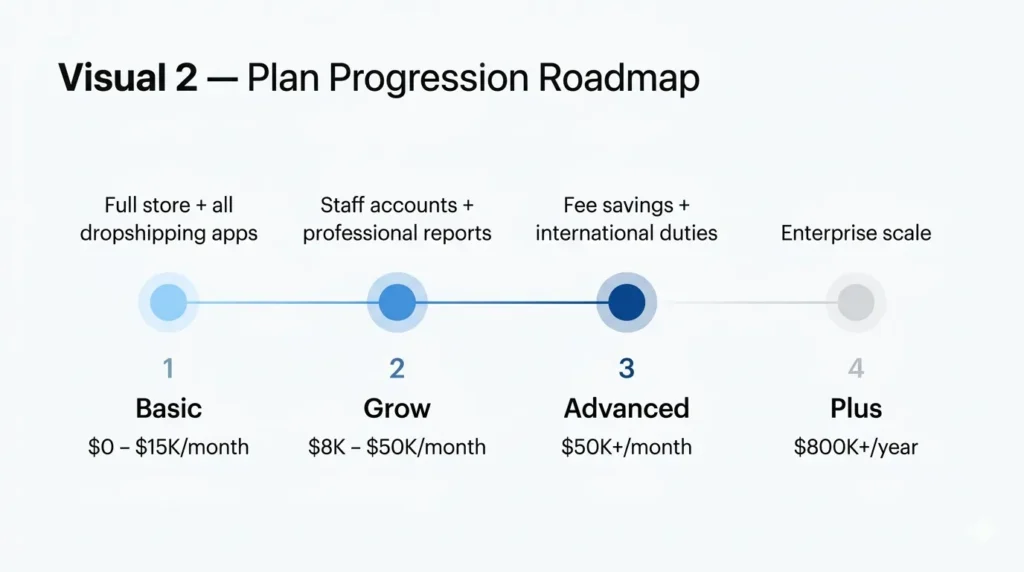
Best for: New dropshippers launching their first store or testing a niche Revenue range: $0–$15K/month
What you get:
- Full online store with unlimited products
- Access to all dropshipping apps (DSers, Spocket, AutoDS, etc.)
- Abandoned cart recovery and discount codes
- Up to 10 inventory locations
- Basic analytics
What you don’t get:
- Staff accounts (removed in Shopify’s 2025 update)
- Professional reports
- Lower transaction fees
Basic doesn’t include staff accounts, but you can still add unlimited collaborator accounts for developers or freelancers.
On fees: A $100 sale through Shopify Payments = $3.20 in fees (2.9% + $0.30). The same sale through a third-party gateway like PayPal or Stripe? Up to $5.20 once Shopify’s extra 2% is added on top.
Always use Shopify Payments on Basic. It’s the simplest way to protect your margin on this plan.
2. Grow (When You’re Past Testing)
Best for: Stores with consistent sales, small teams, or growing data needs Revenue range: $8K–$50K/month
What you get on top of Basic:
- 5 staff accounts
- Professional reports
- Lower CC rate: 2.7% + $0.30
- Reduced 3rd-party fee: 1%
- Better shipping discounts
Unlike basic analytics, professional reports show sales by channel, top-performing products, customer behavior, and where people drop off, the data you need to optimize, not just track.
The upgrade math: The Grow plan costs $66/month more than Basic, and the CC rate drops by 0.2%.
Break-even on fees alone: ~$33,000/month in sales
That said, staff accounts and better reporting often justify the upgrade well before you hit that number. If you’re managing the store solo and flying blind on your data, that’s your real signal to move up.
Pro Tip: Basic shows what sold. Grow shows which products return the most, which ads convert, and where customers drop off.
If you’re already feeling overwhelmed by the numbers, our small business accounting experts can help you.
3. Advanced (Built for High-Volume Dropshipping)
Best for: High-volume stores where fee savings outweigh the subscription cost Revenue range: $50K+/month
What you get on top of Grow:
- 15 staff accounts
- Custom report builder
- Lowest CC rate: 2.4% + $0.30
- Lowest 3rd-party fee: 0.6%
- Third-party calculated shipping rates at checkout
- Duties and import tax calculations for international orders (learn how it works)
The upgrade math: At $200K/month, dropping from 2.7% to 2.4% saves ~$600/month in CC fees alone. Advanced costs $294/month more than Grow. At that volume, the plan pays for itself.
If your store is shipping into the US, our US-Canada cross-border tax team works with Canadian e-commerce businesses handling exactly this.
4. Shopify Plus (Probably Not Yet)
Best for: Enterprise-level operations at $800K–$1M+ in annual revenue
For most dropshippers, Plus is overkill. It starts at $2,300/month, and the math only works in your favour once the lower transaction fees (0.2%) and negotiable CC rates offset that cost, which happens around $800K–$1M in annual revenue.
Where it makes sense for dropshippers:
- Running multiple stores across different markets
- Need full checkout customization and advanced automation
- Require enterprise integrations (ERP, CRM, order management systems)
Until then, Advanced covers everything you need.
- Read More: “Shopify Tax Exemption Explained: What It Is and How to Set It Up for Your Store in 2026“
What Does Shopify Pricing Actually Cost a Dropshipper?
The subscription is only part of the number. Understanding the full Shopify pricing for dropshipping stores means factoring in transaction fees, apps, and a few costs most people overlook. Here’s the full picture.
Transaction Fees
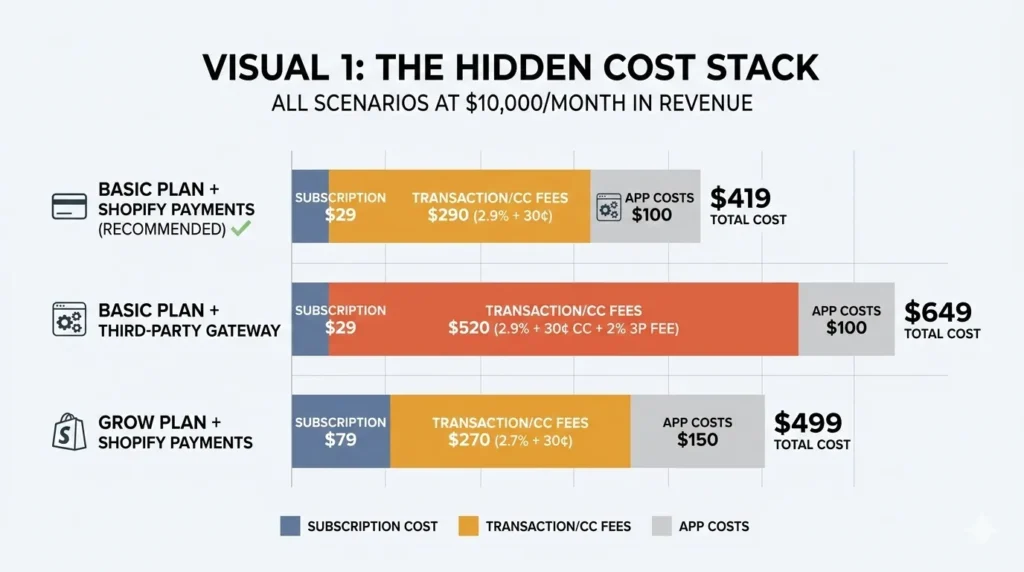
The rule is simple: use Shopify Payments wherever possible. It removes the extra platform fee entirely.
Here’s what $10,000/month in sales looks like on Basic:
| Payment Method | CC Fees | Extra Platform Fee | Monthly Total |
| Shopify Payments | ~$320 | $0 | ~$320 |
| Third-party gateway | ~$320 | +$200 (2%) | ~$520 |
That $200/month difference adds up to $2,400/year, more than the cost of upgrading to Grow.
Dropshipping Apps
All plans from Basic upward support the full Shopify App Store. Here are the most commonly used dropshipping apps and what they cost:
| App | Best For | Free Plan? | Paid Plans From |
| DSers | AliExpress sourcing, bulk orders | Yes (up to 3,000 products) | $19.90/month |
| Spocket | US/EU suppliers, faster shipping | Limited | $24/month |
| AutoDS | Full automation, AI-powered | No | $14.99/month |
| Zendrop | Custom branding, global fulfillment | Limited | $49/month |
| CJDropshipping | Large catalog, no monthly fee | Yes | Pay per order |
A typical dropshipping store spends $40–$100/month on apps depending on what’s needed. Our Shopify accounting experts regularly help store owners keep costs under control.
Other Costs to Factor In
- Domain: ~$16–$20/year (~$1.50/month).
- Theme: free themes work well when starting out. Paid themes are a one-time $150–$380 and not necessary early on.
- Email marketing app: $20–$30/month once you have steady traffic and want to build a customer list.
Realistic Monthly Total by Plan
| Plan | Subscription | Typical Apps | Domain | Est. Total/Month |
| Basic | $39 | $40–$80 | ~$1.50 | ~$80–$120 |
| Grow | $105 | $40–$80 | ~$1.50 | ~$145–$185 |
| Advanced | $399 | $40–$80 | ~$1.50 | ~$440–$480 |
Excludes transaction fees and ad spend, which vary by volume and strategy.
The Break-Even Formula
Before upgrading, run this quick check:
Monthly fee difference ÷ rate difference = break-even monthly revenue
Basic → Grow: $66 ÷ 0.2% = $33,000/month Grow → Advanced: $294 ÷ 0.3% = $98,000/month
If you’re close to those numbers, or staff accounts and reporting are already a bottleneck, it’s time to upgrade.
How to Know When It’s Time to Upgrade Your Shopify Plan?
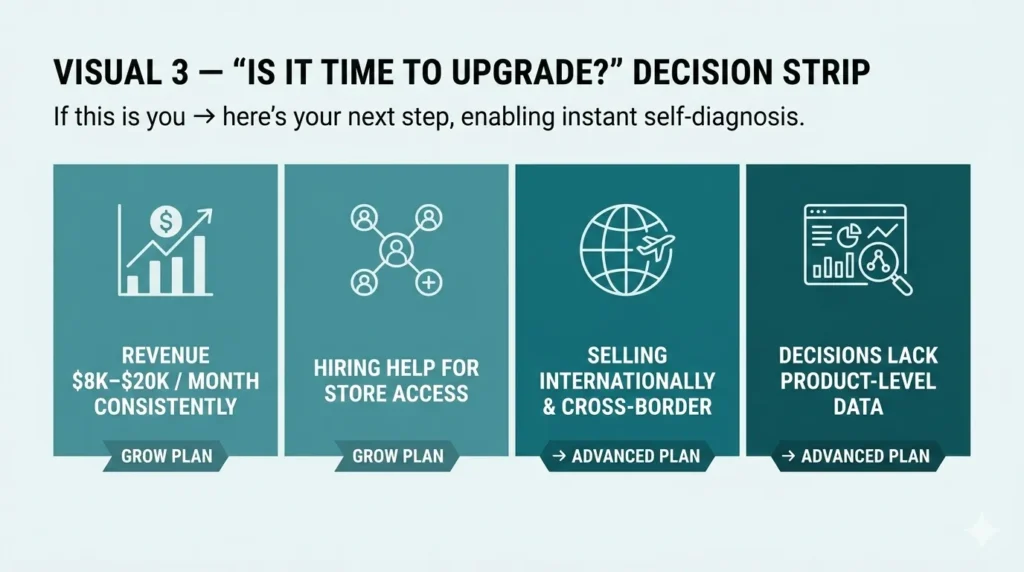
Most dropshippers upgrade too late and lose money on fees before they run the numbers. Here are the clear signals:
You’re Hitting the Revenue Threshold
Most dropshippers upgrade at these two key points:
- Basic to Grow: Consistent $8K–$20K/month and you need real data to make decisions
- Grow to Advanced: $50K+/month where fee savings cover the plan difference
You Need to Bring In Help
Basic has no staff accounts. The moment you hire a VA or anyone who needs backend access, move to Grow.
You’re Selling Internationally
Accurate duties and import tax calculations at checkout require the Advanced plan. Customers hit with surprise customs fees on delivery cancel orders, leave bad reviews, and don’t come back.
Your Reports Aren’t Enough Anymore
If you’re making decisions based on total sales alone with no visibility into product profitability or channel performance, you’ve outgrown Basic.
How Switching Works?
Shopify Admin > Settings > Plan > Select new plan
Two minutes. Store stays live, products stay in place, order history stays intact. Shopify prorates the billing difference automatically. You can also downgrade the same way. See Shopify’s full guide on changing plans.
Conclusion
The best Shopify plan for dropshipping depends on where you are right now. If you’re just starting out, Basic is the right call. It is the best Shopify pricing tier for dropshippers who are still testing and validating. Making consistent sales? Move to Grow. The Shopify growth tools, reporting, and staff access start earning their keep.
High volume? Advanced is where Shopify Basic vs. Advanced stops being a close call. The fee savings make the decision for you. Enterprise scale? Plus is worth evaluating once you’re at 800K annually and above.
The goal is simple. Don’t over-invest early, but don’t ignore the point where higher fees start eating into margins you’ve worked for. Run the break-even formula, know your signals, and move when the numbers say so. If you’re not sure what your real margins look like after all fees and costs are factored in, that’s worth figuring out before you scale. At SAL Accounting, we help e-commerce businesses understand their actual numbers so every decision is backed by data, not guesswork.
FAQs about Best Shopify Plan for Dropshippers
The Basic plan ($39/month or $29/month annually) is the best Shopify pricing tier for dropshippers just starting out. It gives you a full store, unlimited products, and access to all major dropshipping apps. Just make sure to use Shopify Payments to avoid the extra 2% transaction fee.
The main differences are staff accounts, reporting, and transaction fees. Basic has no staff accounts and limited analytics. Grow adds 5 staff accounts, professional reports, and a lower CC rate of 2.7% vs 2.9%. For growing dropshipping stores, Grow is where the Shopify Basic vs. Advanced conversation starts getting real.
With Shopify Payments, the CC rate goes from 2.9% + $0.30 on Basic down to 2.4% + $0.30 on Advanced. Without Shopify Payments, Shopify adds an extra fee on top: 2% on Basic, 1% on Grow, and 0.6% on Advanced. Keeping Shopify transaction fees compared across plans in mind is key to protecting your margins.
No. The Starter plan doesn’t support dropshipping apps like DSers or Spocket, and it charges a 5% transaction fee on every sale. It’s not built for running a real dropshipping store. Start on Basic.
Yes, especially when you’re starting out. It covers all the essential Shopify features for dropshipping, including unlimited products, full app access, and abandoned cart recovery, at the lowest price point. Once you’re past $8K–$15K/month, run the upgrade math and see if Grow makes more sense.
Shopify pricing for dropshipping stores typically runs $80–$120/month on Basic when you factor in the subscription, apps, and domain. That excludes transaction fees and ad spend. The full breakdown is in the cost section above.
It can be, but it’s tight. Your first month on Basic with apps costs around $80–$120. That leaves roughly $380 for ads and testing, which is enough to get started but not much room for error. Keep your app stack lean and test with a small ad budget before scaling.
No. Shopify itself starts at $39/month, and you’ll also need apps to source and fulfill products. That said, many dropshipping apps like DSers and CJDropshipping have free plans, so you can keep costs low early on. There’s no way to run a proper dropshipping store completely for free.
Yes, but margins are thinner than they used to be. Most stores operate at 15% to 20% net profit, so choosing the right Shopify plan and keeping fees low matters more than ever. Dropshippers who treat it as a real business, tracking costs, optimizing ads, and scaling smart, still do very well. Shopify remains the best ecommerce platform for dropshippers in terms of app ecosystem and ease of use.
Shopify occasionally offers a deal where new stores pay $1/month for the first 3 months after the 3-day free trial. Availability varies by region, so check Shopify’s pricing page to see if it’s active where you are.
Yes. Shopify Admin > Settings > Plan. Two minutes. Your store stays live, everything stays in place, and billing is prorated automatically. You can switch up or down at any time.
App compatibility, transaction fees, and reporting are the big three. Staff accounts matter once you build a team. Calculated shipping rates and duties calculations on Advanced matter if you’re selling internationally or have products with variable weights.
Not until you’re at $800K–$1M+ in annual revenue. Before that, the Advanced plan handles everything you need at a fraction of the cost.
For most dropshippers, yes. Shopify’s app ecosystem, reliability, and ease of use are hard to beat. WooCommerce gives you more control but needs more technical setup. BigCommerce has no transaction fees but caps annual sales per plan. When doing a Shopify plan comparison for dropshipping against other platforms, Shopify wins on overall ecosystem and simplicity.