
If you’ve formed a US limited liability company (LLC), or you’re about to, one of the first real decisions you’ll face is where to bank. And it matters more than most people think.
The right business bank account protects your legal liability, keeps your books clean, and saves you money on fees. The wrong one quietly eats into your margins every month while making tax season painful. According to a Nav survey, businesses without a dedicated account are 70% more likely to be denied a business loan.
This guide from SAL Accounting covers the best business bank accounts for LLC business banking in 2026, what to look for before you choose, and how to open one step by step. If you’re a Canadian operating a US LLC remotely, there’s a dedicated section for you too.
Quick Takeaways
- Every LLC needs a dedicated business bank account to protect its limited liability status
- Best overall (including Canadian-owned LLCs): Mercury, free, remote-friendly, $5M FDIC coverage
- Best for ecommerce (Shopify, Amazon, Etsy): Novo, direct integrations, no fees
- Canadians can open top US accounts fully remotely, no US address or SSN required
- You’ll need your EIN, Articles of Organization, and government-issued ID to get started
If you’re a Canadian with a US LLC, our cross-border tax accountants have you covered.
Why Does Your LLC Need a Separate Business Bank Account?
This is the part most people skip, and it’s actually the most important.
1. It protects the legal shield you formed your LLC for
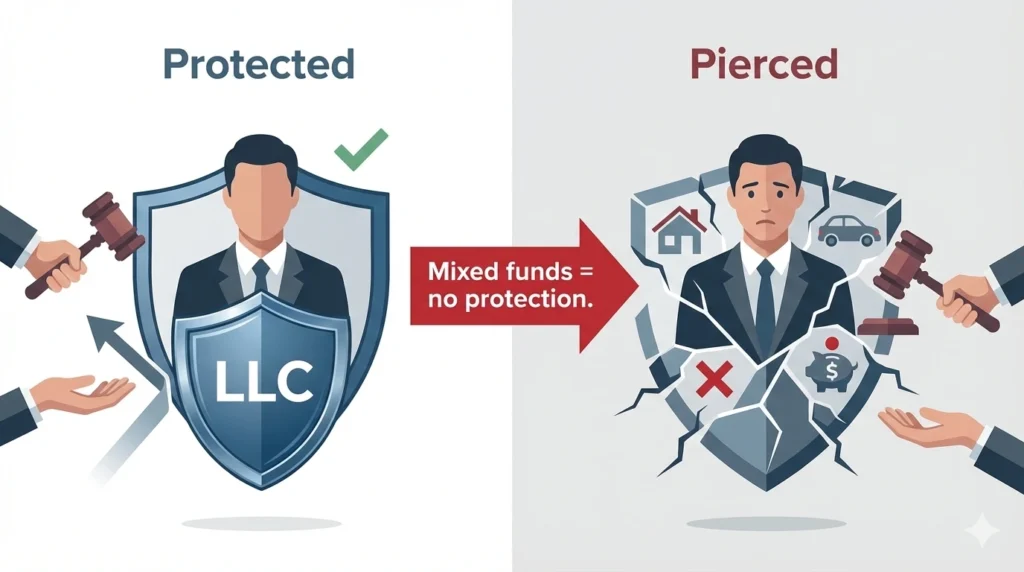
You formed your LLC for one main reason: to protect your personal assets (home, savings, car) if your business gets sued or goes into debt. But that protection only holds if you treat your LLC as a truly separate entity. One of the first things a court looks at is your bank account.
If you mix personal and business funds, a court can decide your LLC was never really separate from you. This is called piercing the corporate veil, and when it happens, your personal assets are fair game.
Keep a separate account and use it only for business. It’s the simplest way to protect yourself. If you haven’t formed yours yet, our US LLC formation service can walk you through the process.
2. Lenders won’t take you seriously without one
Banks and vendors want to see a proper business account before they extend credit, offer wholesale pricing, or approve financing.
3. It builds your business credit history
Every payment from a business account builds a credit profile for your LLC, separate from your personal credit score. That matters when you’re ready to apply for a business credit card, a line of credit, or a loan.
However, if you are not sure if LLC is your go-to choice and want to consider other business structures as a Canadian, it is better to consult with our US business incorporation experts for better guidance.
4. It makes tax time a lot less painful
A dedicated account gives you one clean record of every dollar that came in and went out of your LLC. Easier deductions, less back-and-forth with your accountant, and a much lower chance of filing errors.
The IRS expects clear, separate records. Mixing funds raises your audit risk. Our professional bookkeeping team can make sure your records stay clean year-round.
For Canadian LLC owners, this also helps with CRA reporting forms like T1134. For the exact reporting steps, read our Form T1134 Guide for Canadians Owning U.S. LLCs.
What Are the Best Business Bank Accounts for LLCs in 2026?
No single account is best for every business. Here’s how the top options compare.
| Bank | Monthly Fee | APY | FDIC Coverage | Remote/Non-US Friendly | Best For |
| Mercury | $0 | N/A | Up to $5M | Yes | Startups, online businesses, Canadian-owned LLCs |
| Bluevine | $0 to $95 | Up to 3% | Up to $3M | Limited | LLCs wanting to earn interest |
| Relay | $0 to $30 | 0% checking/ up to 2.68% on savings | Up to $3M | Yes | Organization, multiple sub-accounts |
| Novo | $0 | N/A | Up to $250K | Limited | Ecommerce LLCs |
| Chase Business Complete | $15 (waivable) | N/A | Up to $250K | No | Branch access, traditional banking |
Also read our guide How to Open a US Bank Account as a Canadian to see exactly which fees, wire costs, and fine print to watch out for.
Mercury (Best Overall)
Mercury charges no monthly fees, has no minimum balance, and offers free transfers and wires. Your deposits are covered up to $5M through its partner banks. It works with QuickBooks, Xero, Stripe, and Shopify, and you can send payments in 40+ currencies for a 1% fee.
If you’re Canadian, Mercury is the easiest option. You don’t need a US address or social security number. Just a US-registered LLC, your EIN, and a passport. The application is fully online and takes under 10 minutes.
Best for: Startups, online businesses, agencies, consultants, and Canadian-owned US LLCs.
Bluevine (Best for Earning Interest)
Most business accounts earn you nothing on your balance. Bluevine is different. Here’s what each plan pays:
- Standard plan (free): 1.3% APY on balances up to $250,000, if you meet a monthly activity goal (spend $500/month on your Bluevine debit card or receive $2,500 in customer deposits)
- Plus plan ($30/month): 1.75% APY on balances up to $250,000
- Premier plan ($95/month): 3.0% APY on balances up to $3,000,000
To give you a real example, an LLC with $200,000 sitting in a standard Bluevine account earns around $2,600 per year. A traditional bank account would earn close to nothing on that same balance.
It also has no transaction fees, free transfers, and built-in bill pay and invoicing.
Best for: LLCs with steady cash who want that money working harder.
Relay (Best for Staying Organized)
Relay’s checking accounts earn 0% interest. You can open separate savings accounts that automatically sweep idle cash and earn up to 2.68% APY (Scale plan at $90/mo), 1.55% APY (Grow plan at $30/mo), or 0.91% APY (free Starter plan).
With a free Relay account you can:
- Open up to 20 separate checking accounts under one login
- Issue up to 50 debit cards with custom spending limits
- Set up automatic transfers between accounts
- Integrate with QuickBooks, Xero, and Gusto
It’s a great fit if you simply want separate accounts for things like taxes, payroll, and day-to-day expenses. No monthly fees, no minimum balance, no overdraft fees on the standard plan.
One thing to know: Relay is not a bank. Your money is held through Thread Bank and is insured up to $3M.
Best for: Multi-member LLCs, Profit First users, and anyone who wants better financial organization.
Novo (Best for Ecommerce LLCs)
If you sell on Shopify, Amazon, or Etsy, or get paid through Stripe, PayPal, or Square, Novo can help you. You can see income by source, get your Stripe funds two days early, and get ATM fees refunded up to $7 per month.
To learn exactly which expenses you can track and deduct, read our guide: Expenses for E-commerce Business and How to Track Them.
No monthly fees, no minimum balance, and new Stripe users get up to $20,000 in free payment processing.
Best for: Ecommerce sellers, freelancers, and service businesses that rely on online payments. If you need help setting up your books properly, our e-commerce tax accountants are here to support you.
Chase Business Complete Checking (Best for Branch Access)
Chase has over 5,000 branches and 14,000 ATMs across the US. If you deal with cash or just want to walk into a bank when something comes up, Chase is the most practical choice. The $15 monthly fee is easy to waive by keeping a $2,000 daily balance or linking Chase payment solutions. New accounts can earn up to $500 as a welcome bonus; $300 with a $2,000 minimum deposit or $500 with a $10,000 minimum deposit, valid through May 14, 2026.
A few things worth knowing before you choose Chase:
- Wire fees are $25 to $40 per transfer
- No interest earned on your balance
- Only available to US-based applicants (not an option if you’re Canadian and applying remotely)
Best for: LLCs that handle cash, want branch access, or plan to use Chase’s business credit products.
How to Choose a Business Bank Account for Your LLC?
Now that you’ve seen the options, here’s what actually matters when you’re comparing them for your specific needs.
| Factor | What to check |
| Monthly fees | Is there one? How do you waive it? |
| Minimum balance | $0 or locked capital? |
| Transaction limits | Caps before extra fees kick in? |
| APY | Is your idle cash earning anything? |
| Integrations | QuickBooks, Xero, Shopify, Stripe? |
| Wire fees | $0 or up to $40 per transfer? |
| FDIC coverage | $250K standard, or $3M+ via sweep? |
| Non-US friendly | Important if you’re Canadian |
The features of business accounts vary more than most people expect.
How to Open a Business Bank Account for Your LLC (5 Steps)
The process is easy once you have your documents ready.
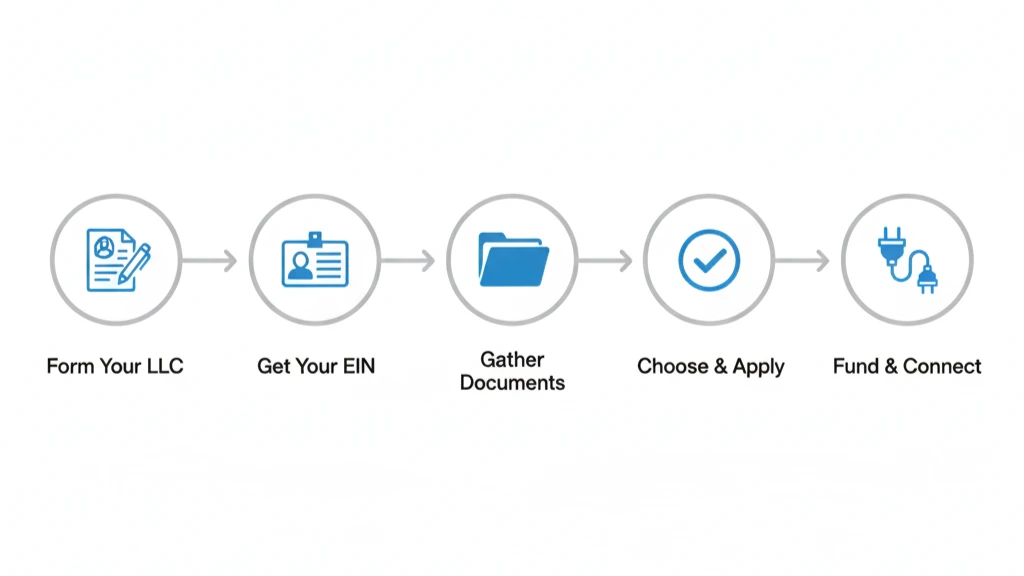
Step 1: Form your LLC first
You need your Articles of Organization before any bank will accept your application. This is the document you file with your state to officially create your LLC.
If you feel like you dont have enough information, check our guide: What Is an LLC? Meaning, Structure, Pros and Cons for Businesses.
Step 2: Get your EIN
Your EIN (Employer Identification Number) is basically a tax ID for your business, like a Social Security Number but for your LLC. You can apply for free at IRS.gov and it takes about 10 minutes.
Canadians can get a US EIN too, no US address or residency needed.
Step 3: Gather your documents
Have these ready before you start your application:
- Articles of Organization (or Certificate of Formation, depending on your state)
- EIN confirmation letter from the IRS
- LLC Operating Agreement (especially for multi-member LLCs)
- Government-issued ID for all owners with 25% or more ownership
- Business license, if your industry requires one
Step 4: Choose your bank and apply
Most online banks approve you in under 10 minutes. Traditional banks may ask you to come in person. If you’re Canadian and applying from abroad, Mercury and Relay are your two best options. When comparing online business banking options, start with fees and integrations.
Step 5: Fund the account and connect your tools
Move your initial funds in, connect your accounting software, and set up your payment processors. It’s also a good idea to open a second account just for tax savings right from the start.
Pro Tip: Every time money comes in, move 20 to 30% of your net income into that tax account automatically. It’s a simple habit that saves a lot of stress at year-end.
Are You a Canadian Running a US LLC? Read This First
Most major US banks, including Bank of America, Wells Fargo, and Chase, require applicants to be US-based. Mercury and Relay are the two best options for Canadians, both allowing you to open an account fully online without a US address or SSN.
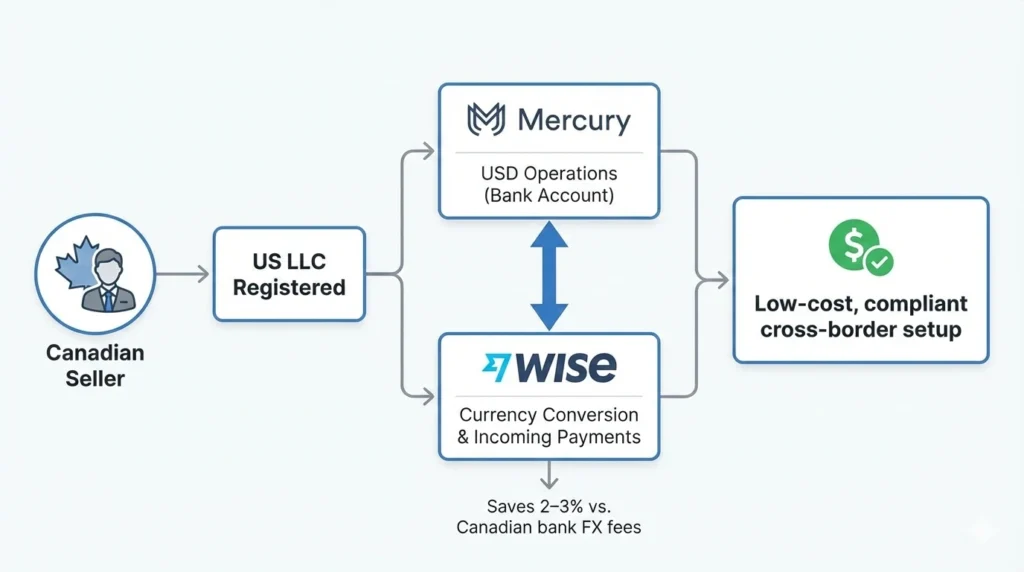
One tool worth adding to your setup is Wise Business. It’s not a bank, but it gives you real US banking details to receive USD payments and lets you convert between USD and CAD at a fair exchange rate with low fees. Many Canadians pair it with Mercury:
- Wise handles currency conversion and incoming payments
- Mercury takes care of everything else on the USD side
Together they save you the 2 to 3% fee that Canadian banks typically charge on every conversion.
Note: the banking setup is the easy part. How your US LLC connects to your Canadian tax obligations is where things get more confusing. If you’re unsure, our US Canada accounting team can help you stay compliant on both sides.
Common LLC Banking Mistakes (And How to Avoid Them)
Setting up your LLC bank account is simple, but a few common mistakes can cost you more than you’d expect. Here’s what to watch out for:
- Using your personal account “just temporarily”: There is no grace period. Even mixing funds for a short time puts your personal assets at risk.
- Chasing the lowest fee without reading the fine print: Hidden transaction caps, wire fees, and expiring APYs can make a “free” account cost more than expected. Understanding banking fees for LLCs upfront can save you hundreds per year.
- Not getting your EIN before you apply: Most banks won’t even start your application without it.
- Ignoring FDIC coverage limits: If you keep more than $250,000 in your account, make sure your bank covers beyond that through a sweep network.
- Skipping the Operating Agreement: Some banks require it, especially for LLCs with more than one member. Have it ready before you apply.
- For Canadians, ignoring FX fees: Converting CAD to USD through a Canadian bank usually costs 2 to 3% per transfer. Using Wise instead cuts that cost significantly.
Conclusion
Opening a professional LLC bank account is one of the first real steps in running your LLC properly. It protects your personal assets, keeps your taxes clean, and helps you make smarter financial decisions as you grow.
For most LLCs, Mercury is the top bank account for small businesses and LLCs in 2026. No fees, strong FDIC coverage, good integrations, and open to non-US founders. Add Bluevine if you want to earn interest on your balance, Relay if you want a better financial organization, or Novo if ecommerce is your focus.
If you’re a Canadian with a US LLC, pairing Mercury with Wise gives you a simple, low-cost setup that works on both sides of the border. Also, you can contact our experts at SAL Accounting for a free consultation now!
FAQs: Best business bank accounts for LLC corporations
For most LLCs, Mercury is the best starting point in 2026. No monthly fees, no minimum balance, up to $5M in FDIC coverage, and open to non-US founders. If earning interest on your balance is the priority, Bluevine is the stronger choice.
Canada doesn’t have LLCs. The closest equivalent is a corporation (Inc.) or a limited partnership. Many Canadians form a US LLC specifically to do business in the US market.
Yes. Canadians can form a US LLC without living in the US. You’ll need to register in a US state, get an EIN, and open a US business bank account. Mercury and Relay are the most popular banking options for Canadian-owned LLCs.
Yes. Most major US banks require you to be US-based, but Mercury and Relay both allow Canadians to open an account fully online. You’ll need your US LLC documents, EIN, and a passport.
Mercury and Relay are the two most practical options. Both support non-US residents and allow full remote onboarding. Most traditional banks like Chase, Bank of America, and Wells Fargo require a US address.
No. Sole proprietors and partnerships can open business bank accounts too. But if you have an LLC, a separate account is essential to protect your limited liability status.
Technically yes, but it’s risky. Mixing personal and business funds can lead courts to pierce the corporate veil, which removes your personal liability protection. It also makes tax filing a lot more complicated.
Focus on monthly fees, minimum balance requirements, transaction limits, software integrations, wire transfer fees, and FDIC coverage. If you deal with international payments, multi-currency support and FX rates matter too.
Yes. Mercury, Relay, Bluevine, and Novo all offer fast online approval. For Canadians, Mercury and Relay are the best options since they support non-US residents.
It depends on the bank. Online banks like Mercury, Relay, and Novo charge no monthly fees. Traditional banks like Chase charge $15 to $25 per month, though fees can often be waived by keeping a minimum balance.
Business accounts are registered under your LLC’s name and EIN, not your personal name. They handle higher transaction volumes, come with tools like invoicing and expense tracking, and keep your LLC legally separate from you as an individual.