
Our goal is to make it easy for you to register a subsidiary company in Canada as a foreigner. We want to help you expand your business confidently into Canada’s stable and welcoming market. Foreign companies invested a huge $96.8 billion in Canada in 2025, the highest amount since 2007. Yet many smart business owners still get stuck on the legal steps and tax rules.
We at SAL Accounting walk you through the full Canadian subsidiary registration for foreigners process, step by step. You will discover exactly what to do, avoid costly mistakes, and make the most of this exciting opportunity in 2026.
Quick Takeaways
- Foreigners can own 100% of a Canadian subsidiary with no Canadian partner needed.
- A subsidiary gives strong liability protection — your main business stays safe.
- Ontario and British Columbia are the easiest provinces for non-residents to incorporate.
- The whole registration process usually takes 1 to 4 weeks.
- You need a real physical address in Canada — a PO Box is not allowed.
- Always file the Articles of Incorporation and get your Business Number from the CRA.
Why Should a Foreign Company Set Up a Subsidiary in Canada?
There are many good reasons to do it. Canada has a stable economy. It also gives easy access to the big North American market. Plus, the rules for foreign businesses are not too strict. Our cross-border tax accountant can explain everything to you in a consultation session. Let’s look at the main benefits.
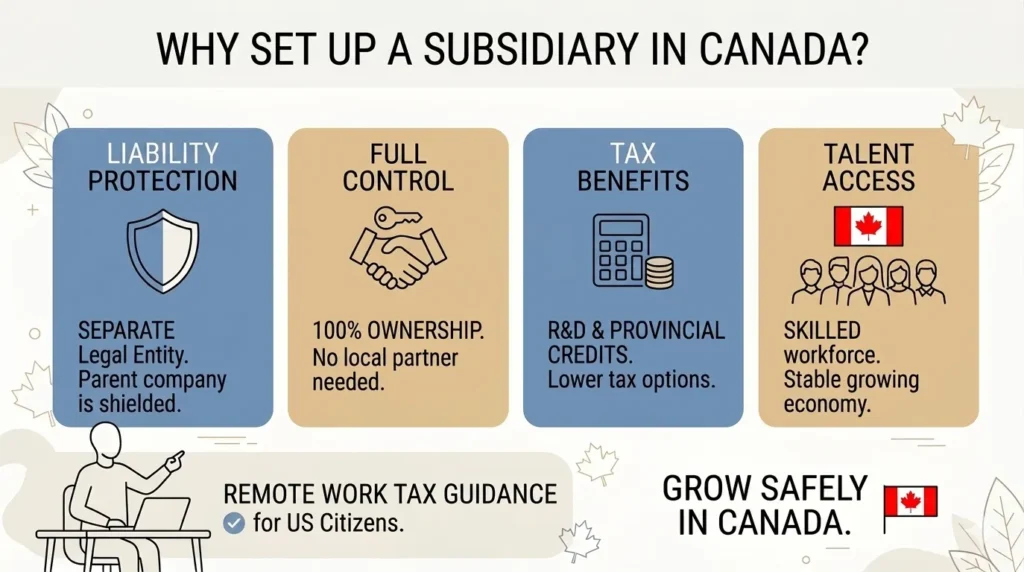
- Strong liability protection: Your subsidiary is its own separate company. If problems happen in Canada, they usually stay there. They do not touch your parent company back home (CRA guide for establishing a Canadian business).
- Full ownership: You can own 100% of the business even as a foreigner. You do not need any Canadian partner. This means you keep full control.
- Nice tax benefits: You can get research and development tax credits. Some provinces offer lower tax rates. Trade agreements also make exporting much easier.
- Talent and market access: Canada has skilled workers. This makes it easier to hire and keep good employees. You also build a strong presence in a stable economy.
In short, opening a subsidiary helps you grow safely. You get to enjoy everything Canada offers, and just need to check the taxes for US citizens working remotely in Canada.
Should You Open a Canadian Subsidiary or a Branch?
When you want to do business in Canada, you have two main options: a subsidiary or a branch. They sound similar, but they are actually very different. Opening a foreign company branch in Canada has its own rules. Here is a simple comparison:
Liability Protection
- Subsidiary: You get strong protection. The subsidiary is a completely separate company. If trouble happens in Canada, the problem usually stays with the Canadian company. Your main business back home stays safe.
- Branch: You get much less protection. A branch is not a separate company. It is just an extension of your foreign company. Any debts or legal trouble in Canada can come straight back to your parent company.
Ownership
- Subsidiary: With a subsidiary, you can own 100% of the company even as a foreigner. You do not need any Canadian partner. You stay in full control and make all the decisions.
- Branch: With a branch, you do not create a new company. It simply becomes part of your existing foreign business. You still own everything, but you miss the separate legal protection.
Taxes
- Subsidiary: A subsidiary pays its own taxes in Canada. This makes everything clearer. You can enjoy local tax benefits like research credits and lower rates in some provinces. Always check the corporate tax deadlines in Canada to avoid trouble.
- Branch: A branch in Canada does not pay separate taxes. All profits go straight into your foreign company’s tax return. This can create extra complications and sometimes cost you more in taxes.
Setup and Rules
- Subsidiary: A subsidiary needs a bit more time and paperwork. You follow Canadian rules, but you gain more benefits and flexibility for the long term.
- Branch: A branch in Canada is usually quicker and simpler to start. But you get fewer protections and have to follow extra rules from your home country.
Quick Comparison:
- If you want to build something that lasts many years in Canada, go with a subsidiary.
- If you only want to test the market quickly, a branch can be a fast option. See if you must pay branch profit taxes in the US or not.
- Always talk to a lawyer or accountant first. The right choice can save you a lot of money and stress later.
Most foreign business owners choose a subsidiary. It simply gives better protection and more control for long-term success. Here is a simple table that compares subsidiary and branch:
| Feature | Subsidiary | Branch | Best For |
| Liability Protection | Strong – separate legal company | Weak – problems affect parent company | Long-term safety |
| Ownership | 100% foreign ownership allowed | 100% ownership but no separation | Full control |
| Taxes | Pays its own Canadian corporate tax (23-27%) | Profits taxed in home country | Using local tax benefits |
| Setup Time & Paperwork | Takes longer (1-4 weeks) | Faster and simpler | Quick market test vs long-term growth |
| Director Rules | Flexible in Ontario & BC | Follows parent company rules | Non-residents who want ease |
Case Study: US Tech Founder Successfully Launches Subsidiary in Toronto1
Alex runs a small software company from Seattle, USA. He wants to expand his business into Canada.
Problem
Alex is worried about liability and taxes. He is not sure whether to choose a subsidiary or a branch. He needs strong protection for his US company while still being able to grow safely in Canada.
What He Does
He decides to set up a subsidiary in Toronto, Ontario. He chooses Ontario because it does not require Canadian directors. He hires a local incorporation service to handle the paperwork and completes the process smoothly.
The Result
The entire setup takes only three weeks. Six months later, his Toronto team signs its first three local clients, and the subsidiary becomes profitable. Alex now feels confident that any issues in Canada will not affect his main US business.
How to Set Up a Subsidiary in Canada as a Non-Resident? (Step-by-Step Guide)
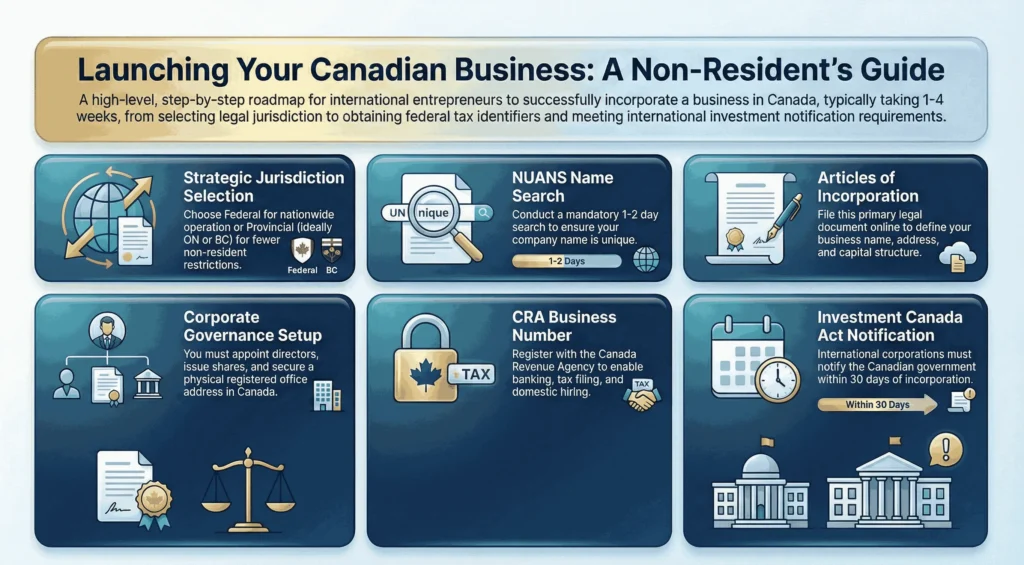
Now you have probably made your decision and picked the subsidiary in Canada for yourself. So, it’s time to gain information about how to open one. Follow the steps below for your purpose. The whole process usually takes between 1 and 4 weeks:
Step 1: Choose Federal or Provincial Incorporation
First of all, it is important to know where you are going to incorporate. Have a look at this list:
- Federal incorporation gives you the right to operate anywhere in Canada.
- Provincial incorporation is simpler and cheaper if you plan to work mainly in one province.
Pro Tip: Ontario or British Columbia seems to be a better choice for you as a non-resident. That’s because of fewer restrictions that a foreigner may face there. You can also compare incorporating in Canada vs. the U.S. to make your final decision.
Step 2: Search for a Company Name
The next step is your favorite, picking a unique name for your business. Remember that the name must be new; no one else has picked it before. So, you need to do research to ensure it is done correctly. This step is called a NUANS search. It takes about 1 to 2 days.
Step 3: Prepare and File the Articles of Incorporation
This is your primary document. This consists of basic information regarding your business, including its name, address, and capital structure. You submit your document online. Your business entity becomes legally registered upon approval.
Step 4: Set Up Your Company
After you get approval, you need to do a few important things:
- Appoint directors
- Create company bylaws
- Issue shares
- Choose a registered office address in Canada (you need a physical address)
Step 5: Get Your Business Number from the CRA
First, you have to register with the Canada Revenue Agency. You will be assigned a Business Number. The number will allow you to open a bank account and file your taxes, and employ people.
Step 6: Send the Investment Canada Act Notification
Secondly, since you are an international corporation, there will be a requirement for you to notify the Canadian government about yourself. You typically do this within 30 days of when you were incorporated.
Step 7: Finish Other Important Tasks
Now you can:
- Open a Canadian bank account.
- Register for GST/HST return in Canada if needed.
- Get any special permits or licenses for your industry.
Pro Tip: Hire a local lawyer or a US business incorporation service for the first time. They help you avoid small mistakes that can cost you time and money later.
What Documents Do You Need for Canadian Subsidiary Registration?
It’s not necessary to submit a huge number of documents; however, all documents should be prepared thoroughly. The following list contains everything you will need:
- Confirmation of the existence and legitimacy of your parent company (for instance, your incorporation certificate or a document proving that your company is registered in your home country)
- Full names and personal data of all directors and shareholders
- Passport copies or government identification documents of all directors and shareholders
- Real physical address of your registered office in Canada (a P.O. box address can’t be used)
- Information on the share structure and the method of its distribution
- Articles of Incorporation filled out properly.
Pro Tip: Check the regulations regarding directors if you’re planning to become the only director and you live abroad. There are some jurisdictions that require having a Canadian resident director among all directors of the company.
Here is a clear table of required documents:
| Document | Purpose | Provided By | Key Note |
| Parent company certificate | Prove company exists | Home country | Must be official |
| Passport/ID of directors | Identify owners | Directors | Clear copies |
| Canadian physical address | Official registered office | Virtual office service | PO Box not allowed |
| Share structure | Show ownership | You decide | Number and type of shares |
| Articles of Incorporation | Main registration document | You or lawyer | Filed online |
Tax Considerations for Your Canadian Subsidiary
You should be familiar with the tax implications before opening a subsidiary in Canada. Below are some basic facts to help you get started:
The corporate tax rate in Canada is combined at both the federal and provincial levels. Usually, it ranges from 23% to 27% depending on the chosen province. Your subsidiary operates independently in Canada, and therefore, taxation will be less complicated compared to a branch office. Here are the key points to consider:
- Dividends: When your Canadian subsidiary decides to send money to the parent company, Canada withholds taxes up to 25%. However, various countries have tax treaties that cut the amount to 5%, 10%, or 15%.
- Research & Development Tax Credits: If you do any R&D or innovative activities, you are eligible for tax deductions, which is among the main advantages when it comes to foreign companies operating in Canada. Have a tax deduction checklist for your business to get the best results.
- Thin Capitalization Regulations: Canada restricts the amount of capital transferred by a parent company to its subsidiary through lending. The excess interest may not be deducted from the company’s tax liabilities.
- GST/HST Registration: You need to register if your subsidiary makes sales above $30,000 yearly. This is a sales tax charged by the company to consumers.
Pro Tip: Open an account in Canada earlier to avoid mistakes while planning to minimize tax liabilities legally.
Common Challenges When You Open a Canadian Subsidiary as a Foreigner
Many foreigners face a few challenges when they register a subsidiary in Canada. Here are the most common ones and how you can solve them:
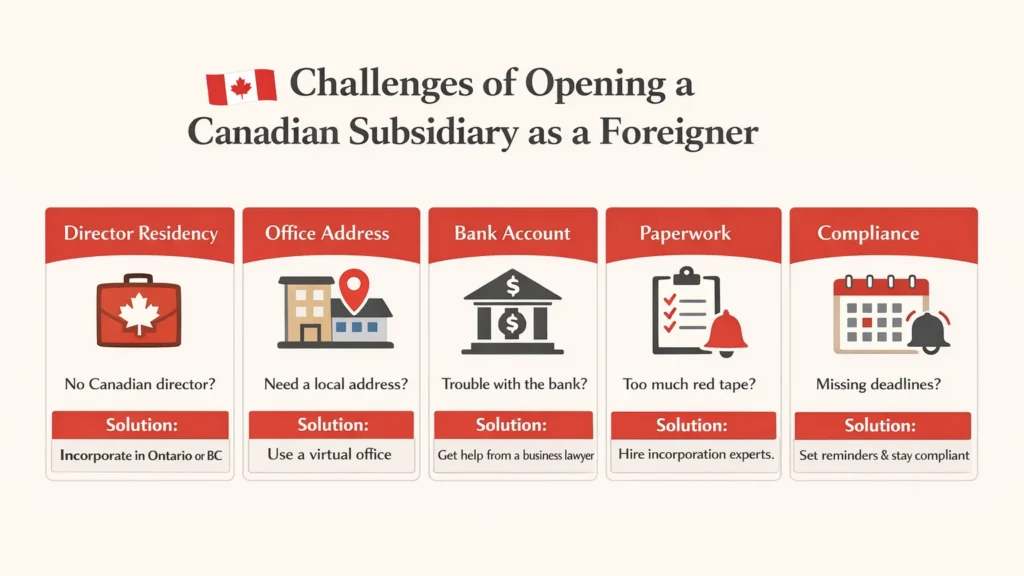
1. Director Residency Requirement
Some options require at least one Canadian resident director among others. This may be a problem if all your directors reside abroad.
Solution: Incorporate in Ontario or British Columbia, since there are no requirements for Canadian resident directors there.
2. Registered Office Address Requirement
It is required to have an actual physical address in Canada where all correspondence and official documents will be sent. It is not allowed to use only a P.O. Box in this case.
Solution: Use virtual offices that will provide you with a real street address to operate.
3. Opening a Bank Account
Canadian banks usually delay opening an account for foreign-owned companies. Usually, many additional documents are required to be provided. See the list of the best Canadian banks for US citizens.
Solution: Be ready to provide additional documentation and ask a business lawyer to make an introduction to the bank in question.
4. Paperwork and Deadlines
The procedure of registering your company will be tedious and take some time if you make mistakes and misunderstand instructions.
Solution: Work with professionals, such as incorporation services, to get all issues sorted quickly.
5. Compliance Issues
After you incorporate, you should regularly provide reports to the authorities. Unfortunately, many new owners ignore this requirement.
Solution: Create reminders yourself or consult our cross-border personal tax accountant to remind you about the deadlines.
Case Study: US E-commerce Company Overcomes Setup Challenges in Oakville2
Sarah runs an e-commerce company selling wellness products from Austin, Texas. She wants to expand into Canada.
Problem
Sarah faces several difficulties. Banks are slow to open an account for her. She needs a proper physical address in Canada. She is also worried about director rules and ongoing compliance.
What She Does
She incorporates her subsidiary in Ontario and chooses Oakville for the registered office. She uses a virtual office for the physical address. She hires a local lawyer to help open the bank account and brings in a part-time bookkeeper from the start.
The Result
Within four months, her Oakville subsidiary lands its first major client and runs smoothly. Sarah says the professional help she hired saves her months of stress and likely thousands of dollars in mistakes.
- Read More: “How to Set Up a Corporation in Canada : 8-step guide”
Conclusion: Why a Canadian Subsidiary Is Worth It for Foreign Businesses
A subsidiary in Canada for a foreigner takes some work. But it is worth it. You get strong protection for your main business back home, keep full ownership and control, enjoy nice tax benefits, and you get access to skilled workers. Plan each step carefully. Get help when you need it. This helps you grow safely. You reach more customers without big risks.
Still have questions about a Canadian subsidiary? Feel free to reach out to our team at tax@salaccounting.ca. We are happy to help you make it simple.